

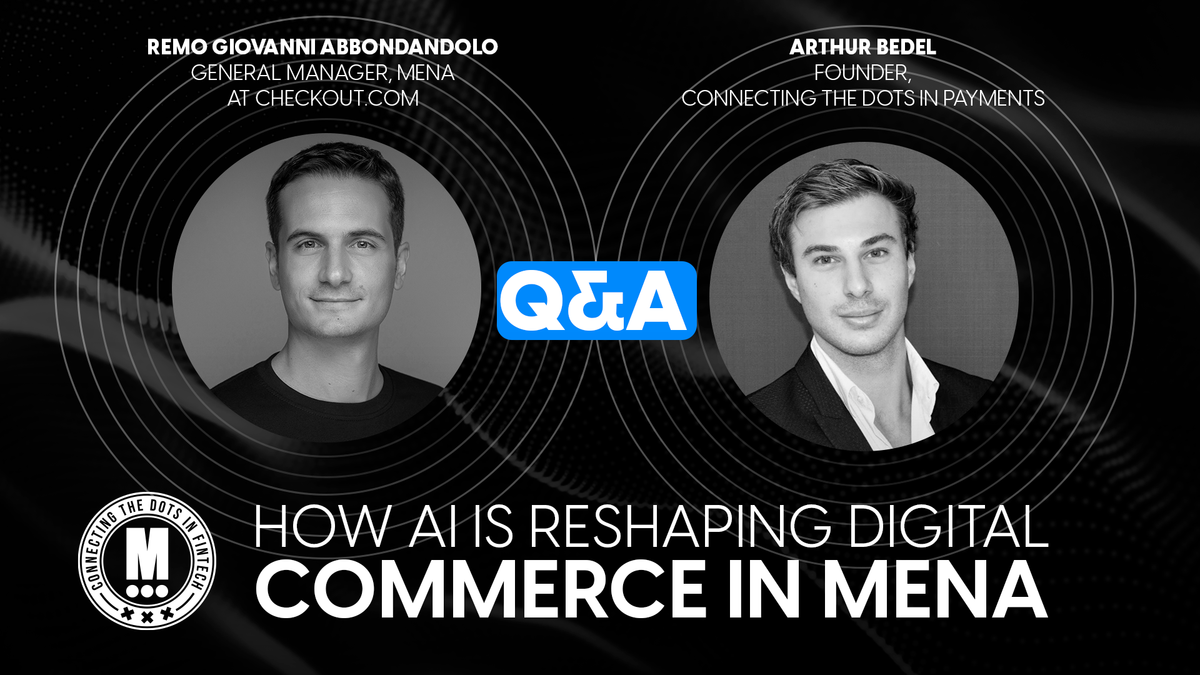
How AI is reshaping digital commerce in MENA - A conversation with Remo Giovanni Abbondandolo
Hey there,
Digital commerce in MENA has evolved beyond simply getting consumers online to now meeting expectations for secure, localized, enhanced, and almost invisible payment experiences.
I recently sat down with Remo Giovanni Abbondandolo, General Manager of MENA at Checkout.com, about the findings from their latest report “MENA Digital Commerce 2026: The New Era of AI in Payments”. We explore how merchants can make the most of the surge in online spending.
Arthur Bedel: Let’s start at the beginning. How would you describe the growth in digital commerce across MENA?
Remo Giovanni Abbondandolo: We’re in acceleration mode with more consumers than ever before building online shopping into daily life.
Our latest report found 45% of MENA consumers shop online weekly or more often, and 63% expect to shop online more frequently over the next 12 months. Checkout.com’s total processing volume in the region grew 62% year over year, which reflects that broader shift toward online spending.
Success in this new environment will belong to the merchants that make the checkout experience feel effortless, while remaining deeply focused on performance, security, and localisation behind the scenes.
Arthur: You mentioned, “effortless.” The report talks about invisible payments. What does that actually mean?
Remo: Invisible payments are about reducing unnecessary friction without impacting trust. Consumers want fewer screens, fewer prompts, and less authentication challenges. In fact, 97% of MENA consumers say it is important for payments to happen with minimal visible steps.
But invisible does not mean uncontrolled. Think of it like a great translator: the customer does not need to see every technical decision, but the system must understand the context and route the payment correctly.
A strong invisible payment experience has three layers: Convenience, which involves fewer interruptions at checkout; Confidence, which relies on visible trust signals and secure processing; and Performance, which is driven by intelligent routing, authentication, and fraud decisions in the background. That combination is where payments become a strategic advantage for merchants.
Arthur: That challenges the assumption that speed is always the priority. Is safety now the bigger conversion lever?
Remo: Speed matters, but trust decides whether the customer completes the purchase and returns to the merchant in the future.
62% of MENA consumers say a safe and secure payment process is important, and a false decline can push 62% of consumers away from a merchant’s site. The goal is not to choose between security and conversion, but find the right balance for each merchant.
Arthur: How does localization fit into that performance story?
Remo: Localization is fundamental. A customer is more likely to convert when they see a payment method, currency, and checkout flow they recognize.
Cards remain important, representing 44% of online payment market share in MENA, but global digital wallets now account for 32%, and buy now, pay later (BNPL) represents 11%. Domestic schemes are also critical: our TPV through mada in Saudi Arabia grew 94% year over year, while KNET in Kuwait surged 347%.
A modern payment strategy cannot be one-size-fits-all. It needs to adapt by market, device, vertical, and customer segment. That is why localized payment performance is a strategic priority for us.
Arthur: The elephant in the room is AI. Where is it having the biggest commercial impact?
Remo: AI is already influencing where consumers choose to shop. In MENA, 40% of consumers said AI-driven features influenced their choice of food delivery service. For travel, the figure is 33%, and for general retail it is 29%.
The strongest AI use cases are the ones that reduce effort: better recommendations, smarter search, faster support, and more relevant offers.
But merchants need guardrails. Consumers are concerned about privacy, fraud, deepfakes, and inaccurate AI-generated content.
So the real opportunity is not “AI everywhere.” It is trusted AI: useful, transparent, secure, and accountable.
Arthur: Looking ahead, what should merchants do now to prepare for agentic commerce?
Remo: They should prepare now with discipline. Agentic commerce is moving quickly: 65% of MENA consumers are familiar with agentic AI, and 50% say they are comfortable with AI shopping on their behalf.
The winning merchants will focus on four things:
- Clean product data so AI agents can understand and recommend accurately
- Clear controls such as approval steps, spending limits, and easy returns
- Secure payment credentials built for AI-enabled journeys
- Continuous enhancement across acceptance, fraud, routing, and checkout design
Arthur: What should merchants in MENA do now to get the most out of this next phase of digital commerce?
Remo: Merchants that succeed will be those who strike the right balance between simple experiences and strong protection. What we are seeing in MENA is a clear redefinition of what a good payment experience looks like. It is no longer about speed alone; it is about confidence at every step.
Consumers are telling us they want payments to disappear into the background, but only if they can trust what is happening behind the scenes. That is why security, intelligence, and reliability are now inseparable from growth in digital commerce.

Comments ()