

Klarna Goes Live on Visa Acceptance Platform
Hey Payments Fanatic!
Earlier this week, I wrote about Klarna becoming the first non-card option in Adyen's agentic checkout. Now Klarna has added another big acceptance platform to its list.
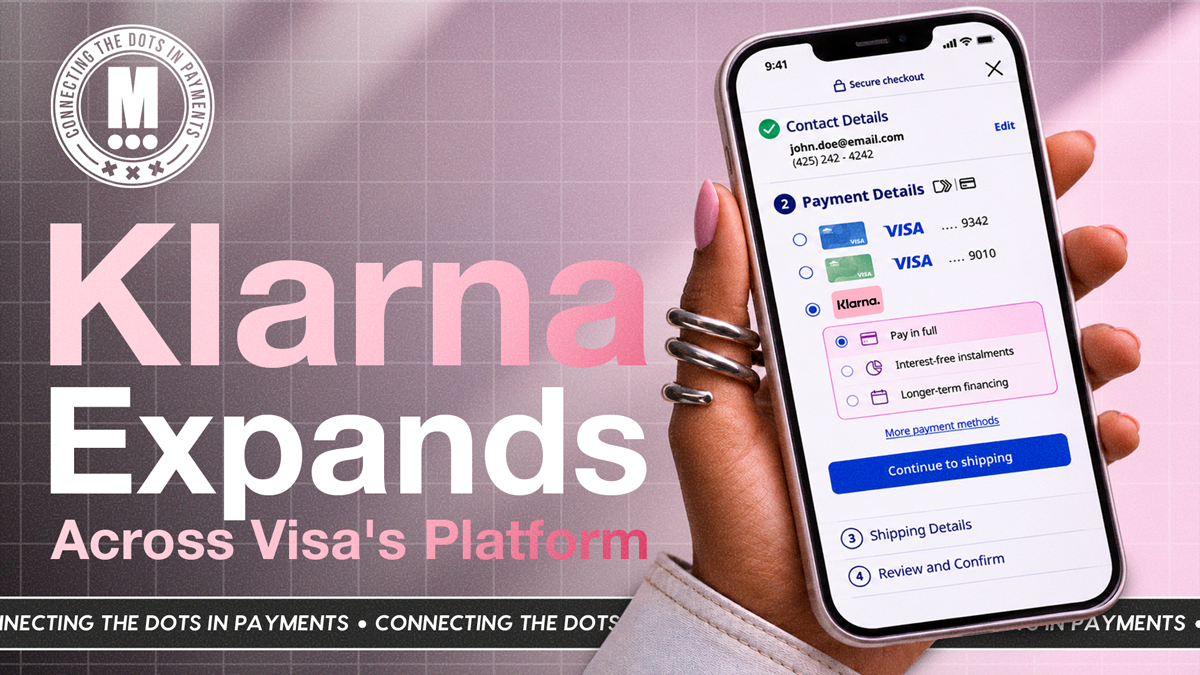
Klarna has gone live on Visa Acceptance Platform. Merchants already using it in the US, Canada, the UK and Europe can now offer Klarna at checkout through their existing setup, without a separate integration.
That covers paying in full, interest-free instalments and longer-term financing.
What stands out to me is how Klarna is growing its reach with merchants. Rather than signing up businesses one by one, it's getting itself inside the platforms where they already process their payments.
Klarna's President and Chief Commercial Officer, David Sykes, calls it "another step in making Klarna available wherever merchants process payments."
The relationship with Visa isn't new either. It builds on the Klarna Card, which Klarna launched with Visa in 2025.
For a merchant on Visa's platform, offering flexible payments now looks more like switching something on than starting an integration project. That's how a payment method ends up at a lot more checkouts.
Here's what else is happening in payments today👇
See you tomorrow!
Cheers,
PODCAST RECOMMENDATION
💡 Paddle: Spotify, Growth & Why Simplicity Always Wins with Sven Ahrens. In this episode, Andrew Davies speaks with Sven Ahrens, who spent eight years leading growth at Spotify as it scaled from 20M to over 200M subscribers, before leading growth at Muse and serving as CEO of Yousician. They discuss why simplicity often beats polish, how consumer behaviour shapes growth, and what it takes to build a successful consumer app today with a lean team of just three people. A practical conversation about growth, product strategy and what really matters when building consumer businesses. Watch the full episode here.
Taking Spotify From 20M → 200M Users
NEWS
🇸🇪 Klarna becomes available to merchants on Visa Acceptance Platform. Businesses on the platform in the US, Canada, the UK and Europe can now switch on Klarna's flexible payment options, from pay in full to interest-free instalments and longer-term financing, without a separate integration.
🇯🇴 Safwa Islamic Bank and Mastercard launch the Fakher World Elite credit card. The Sharia-compliant card for affluent customers in Jordan was unveiled in Amman. Through The Mastercard Collection, holders get priority restaurant access, entertainment events and smoother airport journeys.
🌏 HarnessBuy signs an MoU with Mastercard on agentic commerce in Asia-Pacific. HarnessBuy's platform, integrated with Mastercard Agent Pay, enriches merchant catalogues so AI agents can find, compare and buy products. A demo showed an agent completing an order, and regional pilots are being explored.
🇳🇱 Pieter van der Does to retire as Adyen Co-CEO after 20 years. The co-founder will step down on 31 December and remain an advisor, while Ingo Uytdehaage, Co-CEO since 2023, becomes sole CEO. Adyen says its standing financial objectives are unchanged.
🇪🇬 Egypt's central bank extends card tokenisation to Android phones. Customers can now pay contactless in shops and online, confirming with face or fingerprint. The first phase with Apple Pay, launched in December 2024, handled about 292 million transactions worth EGP228B to the end of September.
🇸🇬 Singapore and China explore linking their fast payment systems. MAS and the People's Bank of China will study a link for low-value transfers, one of 29 cooperation initiatives agreed at the 22nd bilateral Joint Council. DBS has also started services as Singapore's second renminbi clearing bank.
🇬🇧 Marex launches a global payments platform after FCA authorisation. The platform will offer cross-border payments in more than 150 fiat and digital currencies, combining FX pricing with routing to local rails. Marex is building the operational infrastructure before opening it to banks, corporates and institutions.
🇪🇬 Kiwe launches its social money app in Egypt. Customers can open an account and order the Kiwe Card, co-developed with Banque Misr, Visa and Meeza. Features include shared savings Pools, transfers and bill-splitting, and backers include EFG Hermes and Valu.
🇸🇬 OCBC and StraitsX pilot stablecoin payments for cross-border business flows. Selected businesses receive stablecoin payments directly into their OCBC accounts without handling the tokens. NTT DOCOMO ASIA is the first client, with a payment from Japan settling the same day.
🇮🇳 MobiKwik's Zaakpay goes live with Visa Payment Passkey. Zaakpay merchants can now let eligible Visa cardholders confirm online payments with device biometrics or a PIN instead of an SMS one-time password, after a one-time registration.
🇸🇬 M-DAQ works with Circle to bring USDC into cross-border payments. The Singapore FX and payments firm is developing a single integration that lets institutional clients convert local currencies to and from USDC. It will also support M-DAQ's own fund flows across ASEAN and beyond.
🇮🇳 Paytm brings QR payments to more than 15,000 ChargeZone EV charging points. Drivers can pay with Paytm QR at more than 1,200 ChargeZone locations on highways and in cities and commercial hubs. The integration runs through the ChargeIndia platform, and ChargeZone targets one million charging points by 2030.
🇸🇦 TenPay Global and barq sign an MoU on China payments. The planned integration would let users of the Saudi wallet send money to Weixin wallets in mainland China and pay Weixin Pay merchants by QR when travelling there. barq has more than 15 million users.
🇩🇪 Cleverbridge confirms hackers copied payment card data, including security codes. The payments and subscription platform for software sellers detected the unauthorised activity on 4 November. Card numbers, expiry dates and CVV codes were copied, and notifications to affected customers began on 20 November.
🇸🇦 Tamara secures $400M in asset-backed financing from MUFG and Standard Chartered. MUFG provides SAR749M, about $200M, which Tamara calls the first riyal securitisation funding from an international bank to a regional fintech. Standard Chartered expands its core USD facility by $200M.
🇬🇧 Acorda raises £1.8M pre-seed to tackle authorised push payment fraud. Concept Ventures led the round for the London startup founded by three former Monzo fraud leads, with Eileen Burbidge also investing. Its network lets banks share fraud risk scores before money moves.
🇨🇦 Cloud9 acquires Canadian money services business Monix Pay. Registered with FINTRAC for foreign exchange, money transfers and digital asset transactions, Monix Pay becomes the Kenyan digital bank's Canadian subsidiary. Cloud9 is building its own payment rails between Africa and North America.
🌍 Apis takes a majority stake in African freight payments firm Korridor. Korridor handles tolls, border fees, fuel and insurance payments for nearly 50,000 trucks across 13 sub-Saharan countries. Apis invested from its Growth Fund III and plans to add credit and insurance.
🇺🇸 Visa upgrades its CLI with an agent wallet for US cardholders. Invited US cardholders can link a card to verify an AI agent and connect it to task marketplaces, where it can earn the OUSD stablecoin. The wallet integrates with Machine Payments Protocol and Tempo.
🇸🇬 WooshPay demos agentic payments with Yunfeng Financial's AlphaToken. The demo turns a chat prompt into a card payment through intent recognition, card selection and SMS verification. A pilot for merchants and AI platforms is planned for the first quarter of 2027.
GOLDEN NUGGET
Your gateway never sees the card number when someone pays with Apple Pay.
Here’s what it actually receives, and how it unlocks it:
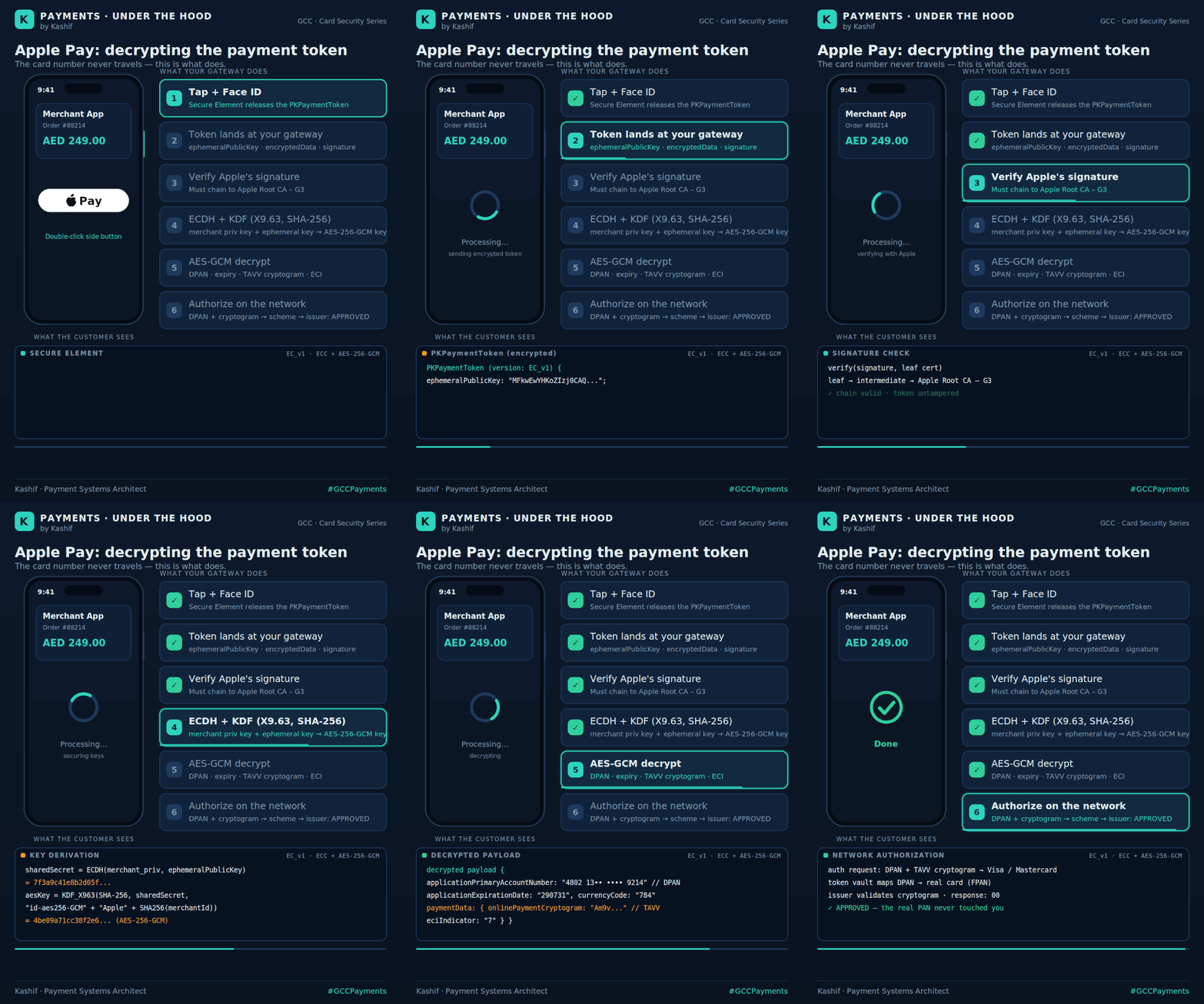
When a customer confirms a payment with Face ID, Apple Pay doesn’t simply send the card’s PAN.
Instead, the Secure Element releases a PKPaymentToken.
Think of it as an encrypted envelope that only the payment processor with the right certificate can open.
Inside that token:
→ An ephemeral public key
→ An encrypted payload
→ Apple’s signature
Then the process begins:
→ First, Apple’s signature is verified.
→ The merchant’s private key and the device’s ephemeral key are used to create a shared secret.
→ That secret is turned into an AES-256-GCM encryption key.
→ The payment token is decrypted.
And out comes:
The DPAN.
The expiry.
The ECI.
And a one-time cryptogram (TAVV) created for that payment.
The DPAN + cryptogram then travel through the card network.
Behind the scenes, the token vault knows which real card that DPAN represents.
And the issuer can approve or decline the transaction.
The clever part?
Even if someone managed to steal the payment token, the DPAN is tokenized and the cryptogram is single-use.
So what looks like a simple Face ID + tap is actually an encrypted payment flow happening almost invisibly in the background.
Source: Muhammad Kashif’s Payments · Under the Hood series
Trusted reach among senior decision-makers in FinTech, Payments & Banking.
👉 Explore Partnership here



Comments ()