

Noah’s Seed Round Hits $38M as Revenue Jumps 538%

Hey Payments Fanatic!
Noah just closed its seed round with $38 million in the bank.
The round was topped up with another $16 million from new and existing investors.
The London-based company is using stablecoins to make moving money across borders a lot simpler.
And Noah seems to have found its stride: 150 new customers this year, revenue up 538% compared with the same period last year, and 31% month-on-month growth.
Not a bad year so far at all.
Noah’s co-founder and CEO Shah Ramezani wants international payments to feel as easy as clicking a button, with stablecoins quietly doing the heavy lifting in the background.
With the new money in place, Noah can start pushing into more markets, connect to more local payment methods, and go harder on the US.
That gives the company plenty of room to keep expanding the footprint it has already built, and I’ll be curious to see how far it can take it from here.
Here’s what else is happening in payments today👇
See you tomorrow!
Cheers,
INSIGHTS
💡 Incognia: Can you outbuild a fraudster with AI? Incognia CEO André Ferraz looks at the growing AI arms race between fraudsters and the teams trying to stop them. As AI makes it easier to build and adapt fraud attacks, the challenge isn't simply building better tools - it’s keeping up with how quickly those tools can be tested and attacked. Ferraz explores why staying ahead of AI-powered fraud takes more than building faster.

NEWS
🇬🇧 Noah closes its seed round at $38M after an extra $16M raise. The stablecoin payments infrastructure provider reports YTD revenue up 538% versus 2025 and has signed over 150 new customers in 2026. The new funding will expand Noah's regulatory footprint and open a New York office as part of its US expansion.
🇧🇭 Mastercard expands its collaboration with stc pay Bahrain to grow SME digital payments. The partners will keep evolving the wallet's Mastercard Business prepaid proposition for small businesses. Mastercard will also help shape stc pay Bahrain's future product roadmap and explore regional expansion opportunities.
🇸🇬 zerohash is named a Tempo validator, bringing Tempo's stablecoin rails to its partners. zerohash becomes the first onchain infrastructure provider to hold a validator seat on Tempo, a blockchain built for stablecoin payments. The integration brings Tempo's network to partners such as Visa Direct, Marqeta and Worldpay.
🇺🇸 Pliant is looking at how commercial cards have changed - gradually, then suddenly. Pliant CEO Malte Rau highlights the shifts happening across the market, from the rise of newer players such as Ramp and Brex to Capital One’s acquisition of Brex. With Ramp now valued at $44B, Rau looks at what these changes mean for Pliant and the wider commercial card market.
🌎 Stuut raises $52.5M Series B to run order to cash with AI. Insight Partners led the round, bringing total funding to $93M ten months after its Series A. The platform automates collections, payments, disputes and deductions, helping customers cut DSO by 47% and free up to 40% more cash flow.
🇺🇸 Anchorage Digital buys Routable to add corporate payment rails. The acquisition brings Routable into Anchorage Digital and extends its offering into business payments. According to The Defiant, the deal will add corporate payment rails to Anchorage Digital's existing services.
🌍 Payrails launches a Merchant of Record product built to be outgrown. Companies can run MoR in some markets and their own direct acquiring in others from one platform. They can move a market in house without reintegrating, while Payrails handles tax, invoicing, fraud and disputes as legal seller.
🌍 SAP-backed Tereina launches a payment service inside SAP's business software. The new service puts payments directly within SAP's business software environment. Reuters reported on October 6 that the launch will let companies handle payments inside the software they already use.
🌍 Ether.fi moves its core payments infrastructure onto MoonPay's integrated stack. The crypto neobank will use MoonPay for headless ramps, cross chain trading, virtual accounts and crypto deposits. The setup covers how users fund the app, move money inside it and cash out, while users keep control of their keys.
🌏 Gate launches Gate Money, a financial services gateway connecting assets, funds and payments. The platform brings digital assets, equities, payments and asset management under a single account. Eligible users can upgrade to a bank account under their own name for everyday and cross border transfers.
🌐 Polygon Labs adds TRON support to Open Money Stack for stablecoin payments and international transfers. Remittance firms and payment providers can convert bank transfers, cards or cash into Tether's USDT.
🇺🇸 Nayax enters US fuel retail through a distribution partnership with Allied Electronics. The deal brings Nayax Fuel's VPOS Media 5 outdoor payment solution to fuel retailers across the United States. Cards now account for 81% of transactions at the pump, up from 64% a decade ago.
🇪🇬 Valu and Alshaya Group partner to expand flexible payment solutions in Egypt. Customers can use interest free payment plans across participating Alshaya brands, including H&M, Bath&Body Works, American Eagle and Victoria's Secret. The offering will be available both online and in store
🌏 Sends and UnionPay International announce global cooperation on card issuing and acquiring. The two companies will work together across both card issuing and acquiring. The agreement will open a global cooperation between Sends and UnionPay International.
🇯🇵 SBI, Mesh, and Money Forward plan a Japan crypto payments joint venture. The proposed venture would bring the three companies together to develop crypto payment services for the Japanese market, although the initiative has yet to be formally established.
GOLDEN NUGGET
9 in 10 SMEs are about to switch cross-border payment providers.
And FinTechs are set to take the lead from banks.
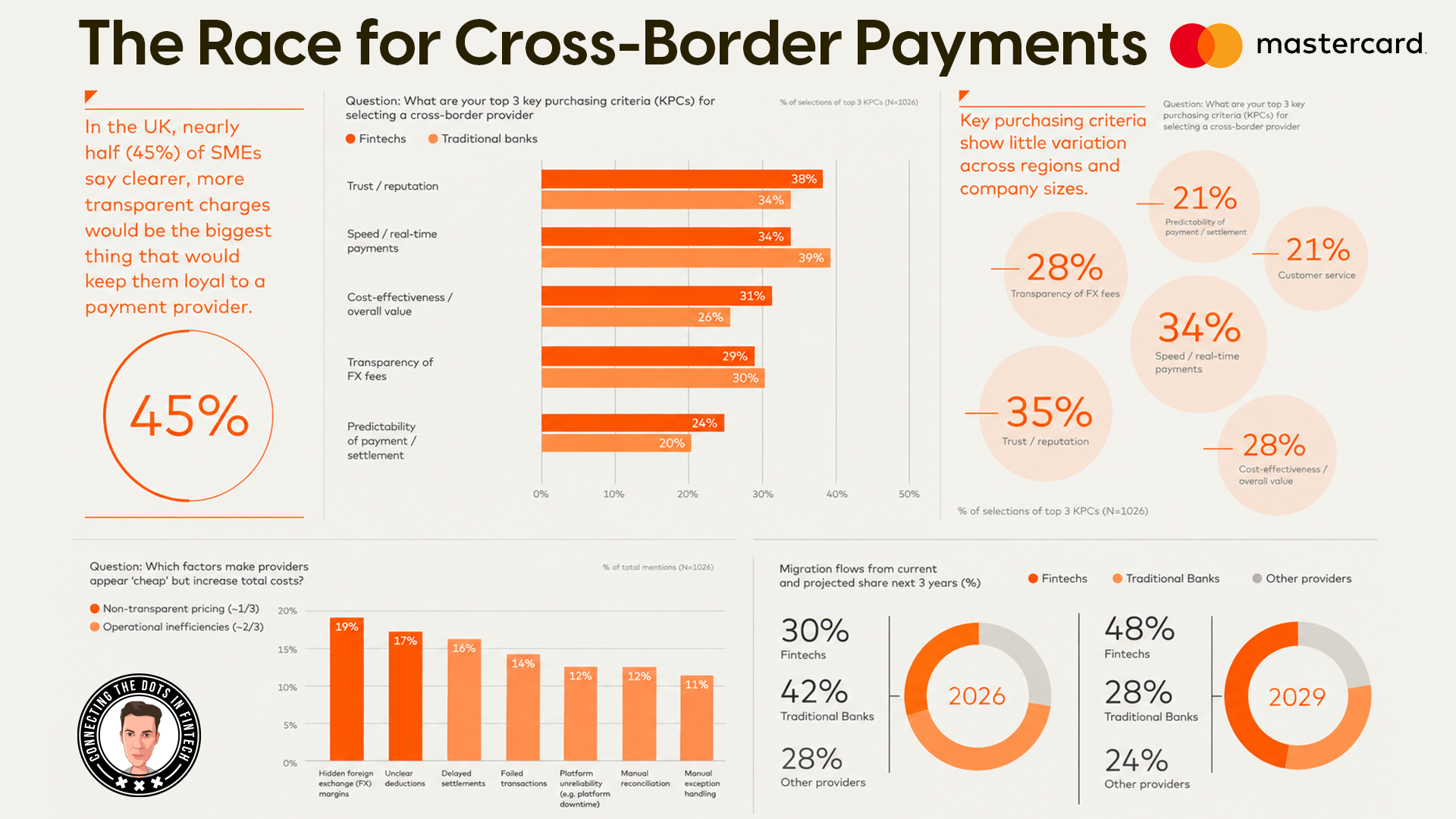
A new Mastercard report with Bain & Company, "Money in Motion", surveyed 1,100+ SME decision-makers across 11 markets.
The headline finding:
By 2028, FinTechs overtake banks as the main choice for SME cross-border payments:
• FinTechs: 30% → 48%
• Banks: 42% → 28%
Here's what's driving the shift:
Speed and trust now rank ahead of cost and transparency when SMEs pick a provider:
• Trust: 35%
• Speed: 34%
• Cost: 28%
• Transparency: 28%
Among SMEs that recently switched, 2 in 3 (67%) did it for faster transactions and more reliable settlements.
A few more stats that stand out:
• 92% already use multiple providers
• Payment tracking (43%) and fraud detection (42%) are the most wanted add-ons
• The B2B cross-border market: $31.7T (2024) → $47.8T by 2032
To bring the speed angle to life, Mastercard tied it all to Formula 1.
In a new film with McLaren, an end-to-end cross-continental payment went head-to-head with the team's fastest-ever pit stop: 1.8 seconds.
Earlier this year, a US 🇺🇸 to Philippines transfer took just under a second.
The takeaway for banks and FinTechs is simple:
Cross-border payments are no longer just a back-office service.
For SMEs, they've become a test of whether a provider understands their business.
Those that keep pace build deeper relationships.
Those that don't risk losing the whole account.
Do you think FinTechs will really overtake banks by 2028?
Source Mastercard. Get report here
Trusted reach among senior decision-makers in FinTech, Payments & Banking.
👉 Explore Partnership here



Comments ()