

PhotonPay Moves Beyond Payments with Hong Kong SFC Licenses
Hey Payments Fanatic!
Today started differently for me.
I traded Caribbean heat in Curaçao for London’s cooler air… and far hotter payment conversations. But here’s the story that stood out today.
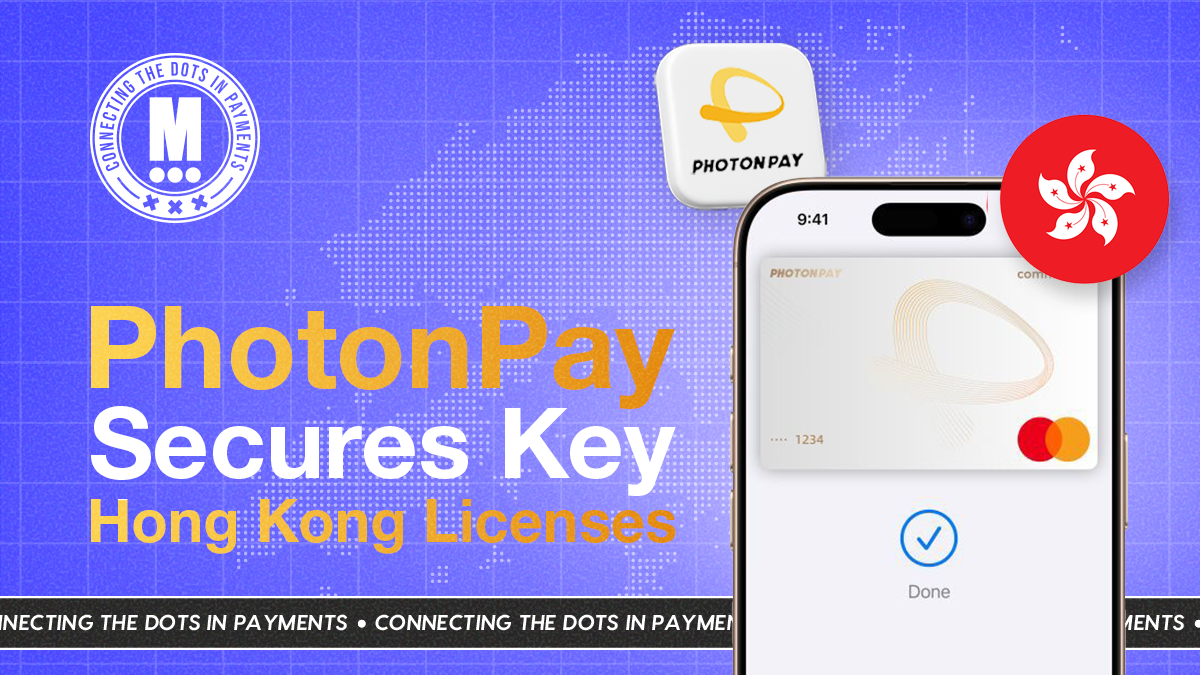
PhotonPay just secured a Trust or Company Service Provider license in Hong Kong.
It also obtained SFC approvals for Type 1, Type 4, and Type 9. Securities dealing. Advisory. Asset management.
In the U.S., it built payment rails. In Hong Kong, it is adding capital markets capabilities. Payments on one side. Asset management on the other. Cross-border players are moving up the value chain. Volume first. Margin next.
“With these licenses, we are building a one-stop financial infrastructure,” said Lewison Chen. “We are not just moving money; we are empowering international enterprises to maximize capital efficiency.”
The regulatory puzzle is coming together piece by piece. And Hong Kong remains a strategic node in that expansion.
And since I’m in London this week, one quick note for anyone local.
The FinTech Running Club is meeting on March 7, 7:30 am at Waterloo Station. It’s one of those low-key ways the ecosystem actually connects, hosted by Tobi John.
No panels. No badges. Just operators showing up.
If you’re around and feel like starting the day with a run and real conversations, details are below.
Keep scrolling for more updates below. I’ll unpack what’s next tomorrow.
Cheers,
INSIGHTS
➡️ Metal Magnitude: Premium touch to captivate high-value customers. Recent research from CompoSecure and Capuchin Behavioural Science demonstrates that metal cards are an exceptionally effective tool for acquiring high-value customers, retaining them, and driving the card to the top of the wallet. Download here
Metal Magnitude: Premium Touch to Captivate High-Value Customers
NEWS
🇭🇰 PhotonPay unlocks new growth with strategic Hong Kong financial licenses. PhotonPay has obtained a TCSP license and secured SFC approvals for Type 1 (Dealing in Securities), Type 4 (Advising on Securities), and Type 9 (Asset Management) licenses. These additions strengthen its ability to provide integrated financial solutions that help businesses manage treasury, risk, and capital alongside global payment operations.
🌎 Getnet launches global developer community, Get Code to drive payments innovation. Through networking events, hackathons, and content sharing, the platform aims to connect tech talent with real market needs, supporting innovation and giving developers access to resources, visibility, and global opportunities.
🇬🇧 Santander and Mastercard complete Europe’s first live end-to-end payment executed by an AI agent. The solution allows an AI system to securely and transparently complete a purchase through existing payment networks while maintaining strict standards for security, privacy, and consumer protection.
🇬🇧 Mastercard hires Whitehall veteran to bolster push for key UK contract. Mastercard is stepping up efforts to secure a leading role in upgrading Britain’s payments systems by appointing Sir Jon Thompson, a veteran public servant and business leader, to chair its UK subsidiary Vocalink.
🇧🇷 Brazil’s Pix payment system now processes more transactions than the two global payments giants. According to data from Brazil’s central bank, Pix handled over 224 million transactions in a single day in early 2025, a figure that dwarfs the combined card transaction volumes of the two global payments giants operating in Latin America’s largest economy.
🇧🇷 Pix turns one year old with modest numbers and an Apple freeze. In numbers, Pix's contactless payment system moved R$ 46.5 million in 1.06 million transactions in January 2026. In the same month, Pix as a whole registered R$ 3.2 trillion in just over 7 billion operations, according to data from the Central Bank.
🇮🇳 FinTech Pine Labs to launch stablecoin payments outside India across nine countries in the Middle East, Africa, and Southeast Asia by the end of April, marking its entry into the growing digital asset payments space. CEO Amrish Rau said the rollout will target markets with a stablecoin-friendly regulatory stance.
🇨🇳 WeChat Pay HK becomes the first e-wallet to participate in the 'Cross-Border Payment Connect,' partnering with HSBC to provide real-time transfers to bank accounts in mainland China. Users can now transfer funds to mainland bank accounts anytime and anywhere via their mobile phones.
🇸🇪 Incore Invest completes the acquisition of CoreOrchestration and establishes PaymentIQ as a standalone company. As of closing, Incore Invest assumes full ownership and will support the business as an active, long-term partner, with a clear focus on value creation through accelerated product development and international expansion.
🇺🇸 Wise strengthens board with appointment of Scott Hill as an independent non-executive director, adding a seasoned FinTech and technology board operator to its leadership. Hill’s background spans senior finance roles at IBM, chairing CS Disco, and board and audit responsibilities at Cardlytics, reinforcing Wise’s governance and financial oversight.
🇺🇸 Visa to be anchor investor in PayPay IPO. Visa is reportedly joining Qatar Holding and the Abu Dhabi Investment Authority to invest more than $200 million as anchor investors for the forthcoming US IPO of Softbank's PayPay. Read more
🇬🇧 Payhawk’s newly verified AI agents collect invoices and save 4 years of manual work for customers. The agent automatically downloads, codes, and submits invoices, removing repetitive manual work and helping customers save the equivalent of four years of processing time in 2026.
🇬🇷 Klarna: Exceeded 280,000 monthly users in Greece. Klarna is recording strong growth, as announced, as the application now exceeds 55 million active users on a monthly basis, while 9 million users use it daily. Keep reading
🇿🇦 GoTyme Bank is changing its relationship with Pick n Pay. While Pick n Pay will remain a cash-in and cash-out partner, the bank plans to expand through dedicated mall-based Customer Hubs and continue kiosk operations in TFG and Boxer stores as part of its evolving growth strategy.
🇸🇪 Sony Bank to explore real-time Yen stablecoin purchases from deposits. The initiative, which is being developed in partnership with stablecoin issuer JPYC, aims to streamline the move from yen deposits to on-chain digital currency holdings for retail clients to potentially engage with tokenized money.
🇬🇧 Paysend and Nodu bring stablecoin payouts to bank accounts & wallets. The integration allows institutions to convert stablecoins into 43 currencies and initiate payouts across 62 countries via Paysend’s global network. The companies said the offering is among the first off-ramp solutions at this scale.
🌎 FinTech Oxus Finance raises $2.4 million for global expansion. With the new funding, the company plans to extend its reach into North American, European, and Asian markets from its current offices in Brazil and the United States.
GOLDEN NUGGET
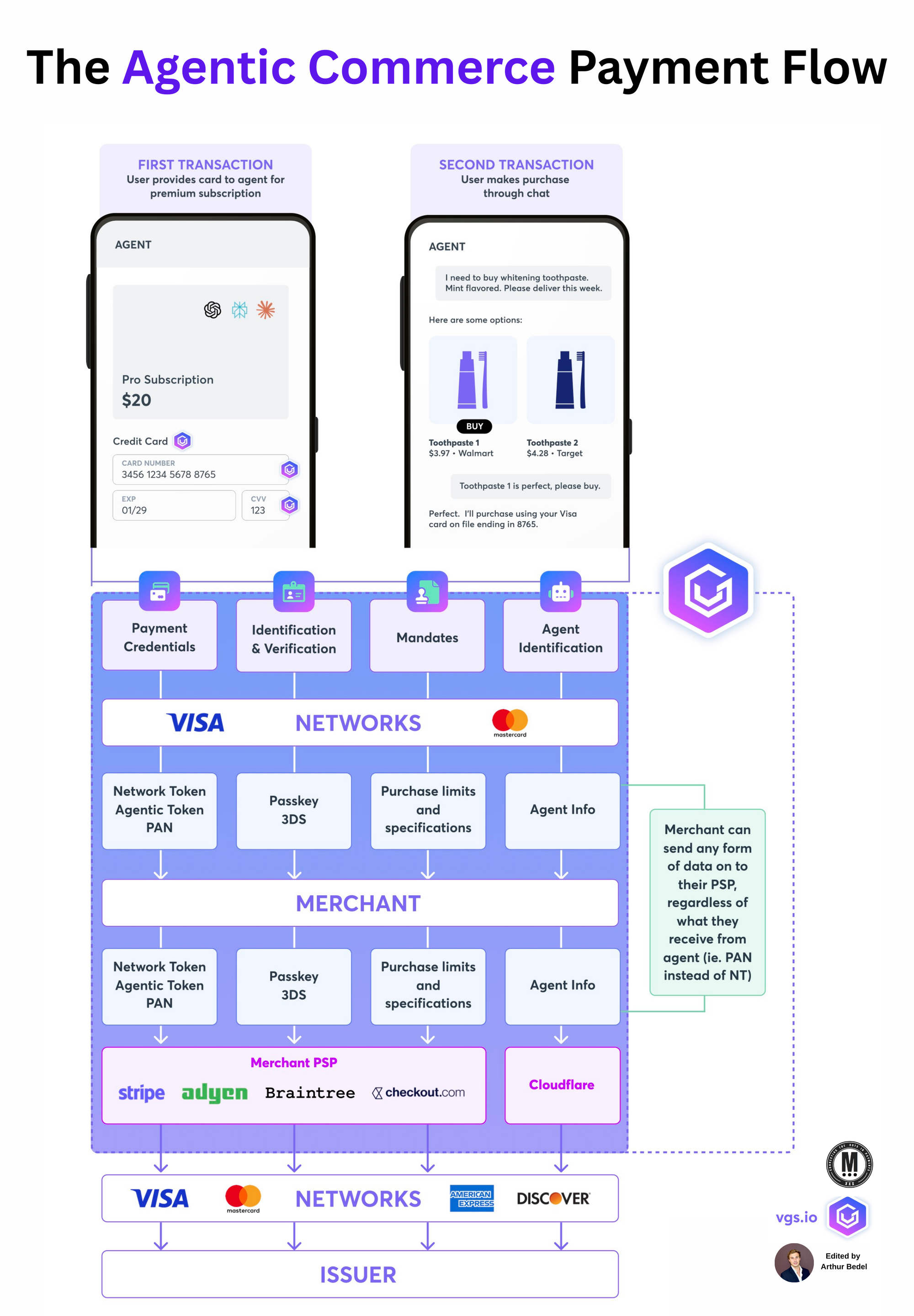
The 𝐀𝐠𝐞𝐧𝐭𝐢𝐜 𝐂𝐨𝐦𝐦𝐞𝐫𝐜𝐞 Payment Flow👇 Created by Arthur Bedel 💳 ♻️
Agentic commerce isn’t about assistants browsing products.
It’s about trusted agents completing purchases on a user’s behalf, fundamentally changing how payments are initiated, authorized, and executed.
In a traditional checkout, the user, device, and merchant interact once.
In agentic commerce, there are multiple handshakes — each requiring specific identity, credential, and policy signals to flow correctly:
• Consumer → Agent
• Agent → Merchant (Etsy, Walmart)
• Merchant → PSP (Checkout.com, Stripe)
• PSP → Networks (Visa, Mastercard) → Issuers (Fiserv, Chase)
The data exchanged across these steps goes far beyond what legacy payment stacks were designed to handle.
𝐊𝐞𝐲 𝐩𝐚𝐲𝐦𝐞𝐧𝐭 𝐢𝐧𝐟𝐫𝐚𝐬𝐭𝐮𝐫𝐞 𝐜𝐨𝐧𝐜𝐞𝐩𝐭𝐬:
1️⃣ Payment Credentials
These authorize and fund the transaction — but in agentic commerce they can take many forms:
→ PAN — traditional card number
→ Network Tokens — tokenized credentials issued by card networks
→ Wallets — a universal tokenized payload (network token + authentication)
→ PSP Tokens — processor-specific identifiers
→ Virtual Cards — credentials scoped by limits, time, or merchant
→ Agentic Tokens — credentials bound to a specific agent and mandate
Each type differs in lifecycle management, reuse, fraud visibility, and portability. Merchant infrastructure must accept and normalize all of them.
2️⃣ Identification & Verification (ID&V)
This proves who authorized the agent to act, not just that a card was presented:
→ Passkeys or biometrics
→ Risk-based step-up authentication (e.g. 3DS)
→ Device and environment binding
→ Token-level authentication signals
In agentic commerce, these signals must persist beyond checkout and travel with the payment.
3️⃣ Mandates
Mandates are machine-readable permissions that define what the agent is allowed to do:
→ Spending limits
→ Merchant or category restrictions
→ Frequency or recurrence rules
→ Time-bound or revocable permissions
A mandate is not a transaction — it is the policy envelope governing future transactions.
4️⃣ Agent Identification
This distinguishes legitimate, authorized agents from bots or attackers:
→ Unique agent identifiers
→ Signed attestations of user intent
→ Bindings between user, agent, and mandate
→ Signals indicating agent-initiated behavior
Without this layer, PSPs and issuers cannot reliably separate agentic activity from fraud.
𝐀 𝐧𝐞𝐰 𝐩𝐚𝐲𝐦𝐞𝐧𝐭 𝐢𝐧𝐟𝐫𝐚𝐬𝐭𝐮𝐫𝐞 𝐦𝐨𝐝𝐞𝐥
In agentic commerce, checkout is no longer the control point.
Control moves upstream to:
• credential abstraction
• mandate enforcement
• identity propagation
• agent verification
This infrastructure must connect consumers, agents, merchants, PSPs, networks, and issuers — while remaining compatible with existing rails.
Source: VGS
Want your message in front of 100.000+ FinTech fanatics, founders, investors, and operators?
Shoot me a message on LinkedIn or send me an e-mail.
Comments ()