

Q&A: From Bootstrap Mentality to $1B ARR: How Airwallex Built Profitability Without Taking Shortcuts
Hey there,
Global financial infrastructure has long been one of the most fragmented and complex challenges for businesses operating across borders, where compliance, FX exposure, and disconnected systems are the norm rather than the exception.
Today, I'm joined by Christos Chamberlain, General Manager of Airwallex UK and Europe, to unpack the company's remarkable growth trajectory and the strategic discipline behind it. In this conversation, we explore Airwallex's bootstrap mentality, how it built a proprietary global network from the ground up, and why reaching $1B+ ARR while remaining EBITDA profitable is no accident, but the result of years of patient, infrastructure-first thinking.
Marcel van Oost: Airwallex recently hit profitability (again). In the current FinTech climate, that's a significant milestone. What did it take to get there?
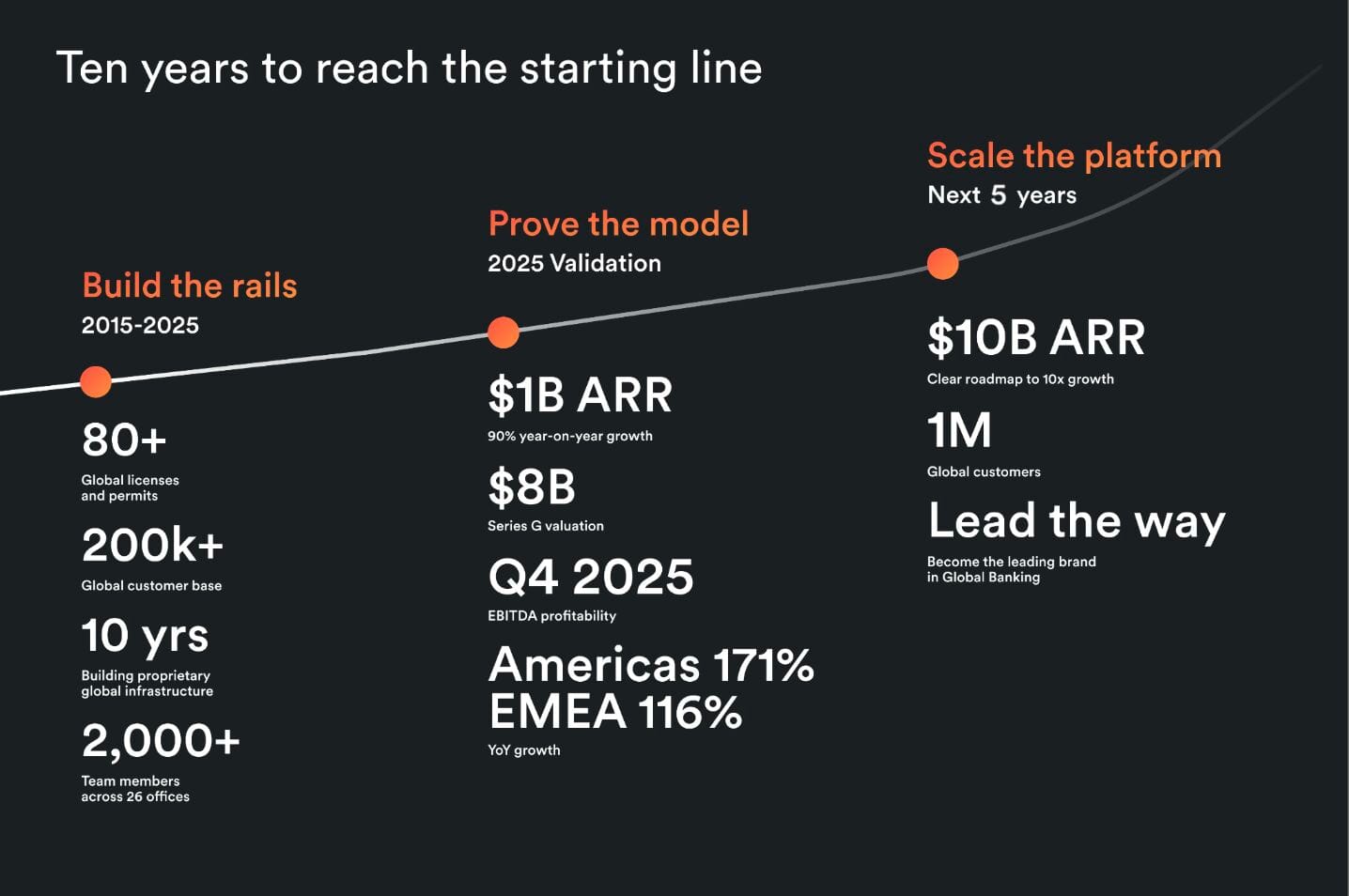
Christos Chamberlain: I am fairly new to the business, but it is well documented by our global CEO, Jack, that it took a lot of discipline. We've always operated with a bootstrap mentality, even when we had capital in the bank. We've seen businesses that committed too much investment too early, and that chased growth at any cost, and knew that wasn't the way to build a business that can make a real difference.
That ethos is what's focused our team on building real, lasting infrastructure rather than shortcuts. When you invest in doing things properly – licensing, compliance, building your own global network – it takes longer, but it compounds. That's what's driven us to over $120bn in annualised transaction volume and 85% year-on-year revenue growth while still reaching profitability.
Marcel van Oost: You've grown to 200,000+ customers across multiple markets. What's the common thread between them?
Christos Chamberlain: Ambition. Our customers are businesses that refuse to let borders define their potential. Here in EMEA, and globally, some are SMBs selling globally from day one. Others are large enterprises optimising treasury operations across multiple markets.
What they share is a belief that where you're headquartered shouldn't limit where you can do business. That's always been our belief, too. We built Airwallex to make global the default, not the exception.
Marcel van Oost: Financial regulation is fragmented and often protectionist. How do you build a business that helps companies operate across so many different markets?
Christos Chamberlain: We believe that we should treat global as a default. Most financial infrastructure was built for domestic use cases and then awkwardly extended across borders. We started from the opposite assumption. Businesses today are global from day one, and the infrastructure should reflect that.
But that means confronting the central tension. Every market has its own licensing requirements, compliance frameworks, payment rails, and political considerations. There's no shortcut. You have to do the work in each jurisdiction.
The hard part isn't the technology, it's the patience. Building a truly global network takes years of licensing, local partnerships, and regulatory relationships. That's the reason we can now operate across so many countries with our own infrastructure, rather than stitching together third parties.
Marcel van Oost: There's a lot of talk about banks fighting back against FinTechs. Do you see traditional players as a serious competitive threat?
Christos Chamberlain: Banks have enormous advantages, including distribution, trust, and regulatory relationships. But their challenge is structural. They're working with decades-old infrastructure and organisational complexity that makes it very hard to move quickly or build truly global products.
We like to consider ourselves as being in 'co-opetition' with traditional banks. They're the fabric of a functioning economy, and it's important to work closely with them, while acknowledging that there are new, better ways of doing things.
Where we see real competition is from other FinTechs who are also building from first principles. Banks will win some battles, but I don't think they'll define the future of global financial infrastructure.
Marcel van Oost: What's next for Airwallex?
Christos Chamberlain: We continue to build! Both here in the UK and EMEA, and the Americas, and in our founding market of Australia, and across APAC, where we first scaled.
Jack often talks about remembering that no matter how much we've achieved, there's always more to learn and more customers to serve.
That mindset has kept us hungry through the highs and grounded through the challenges.
Comments ()