

Q&A: Taking card programs global without starting over: A conversation with Pomelo's Abdul Assal
Launching cards in a new country used to mean starting from scratch. With the right technology, it no longer has to. Pomelo's answer is Global Card, one integration to issue Visa and Mastercard cards in 150+ countries, funded in dollars or stablecoins.
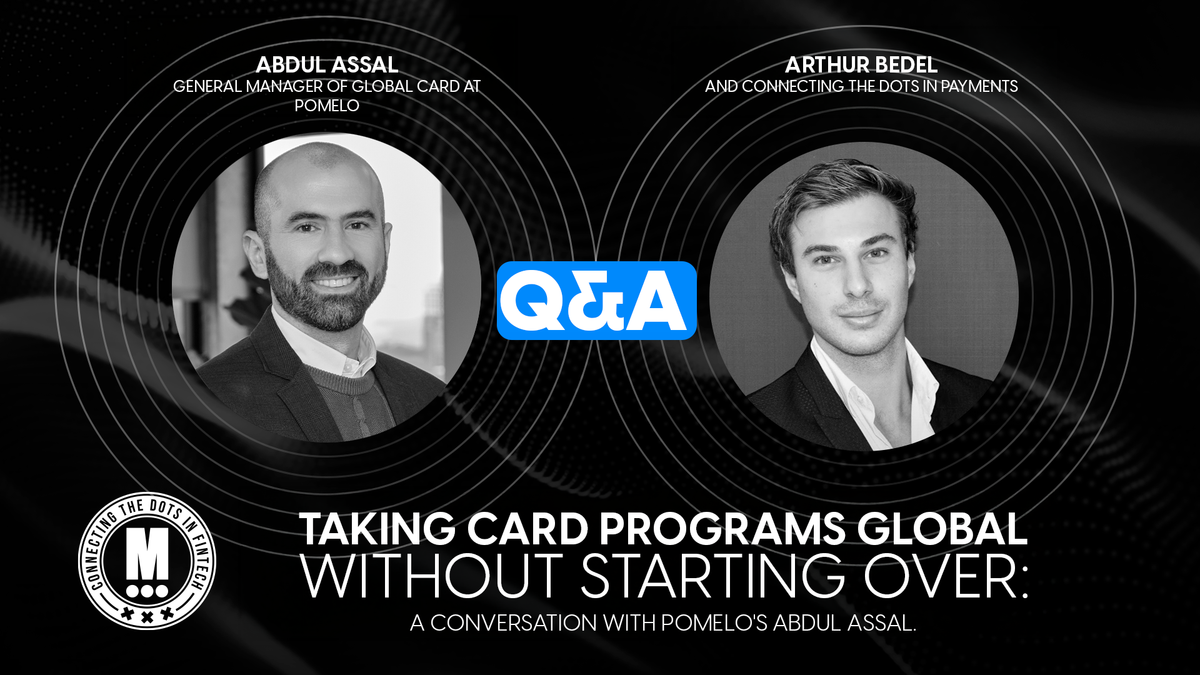
I recently sat down with Abdul Assal, General Manager of Global Card at Pomelo, to talk about how new technology is changing the old rules of international expansion, why the right card depends on the purchase, and where stablecoins, remittances and AI agents fit in.
Arthur Bedel: Let's start with you. You've worked at Santander, Mastercard and Galileo. What brought you to Pomelo, and what are you building as General Manager of Global Card?
Abdul Assal: I have more than 15 years of experience leading financial technology and payments businesses at global companies. I started at Banco Santander Brasil, where I spent seven years in card issuance and payment methods. At Mastercard, I led regional innovation and financial inclusion initiatives with neobanks, FinTechs, crypto companies, and technology enablers, and more recently I was Country Manager for Brazil and Colombia at Galileo Financial, a SoFi company. What stayed with me from my time covering Brazil at Mastercard is how long and sometimes painful launches took. After the FinTech boom that followed Nubank, newly funded FinTechs found that the region's legacy issuer processors needed around a year to get a card program live. Pomelo's three founders saw the same delays, and they were convinced the problem could be solved.
As General Manager of Global Card, I lead Pomelo's global sales strategy to accelerate our international expansion and help banks, FinTechs, and companies adopt modern financial infrastructure to launch and scale payment products in multiple markets.
Arthur: Pomelo launched in 2021. How did it get from there to where it is today?
Abdul: We built issuer processing first, then became a principal member of Mastercard and Visa. Latin America and the Caribbean span more than 40 countries and territories, each with its own regulation, which for years made it hard to serve with a single provider. We were built to change that. And in much of the region, a card issuer doesn't need a bank license, unlike in the US. License plus technology from one provider is what competitors couldn't match.
A good example is Binance. When it assessed providers, we could cover its Latin American footprint through one integration. Today we have more than 175 clients, roughly half of them global, across FinTechs, international platforms and banks such as BBVA, Santander and Bancolombia. And because of our modular offering, a bank can use our processing capabilities on its own license and core banking stack, while other FinTechs can leverage our one-top-shop offer.
Arthur: Visa and Mastercard work almost everywhere, yet launching a card program abroad has traditionally meant starting over in each country. What has changed?
Abdul: The networks have always been global; the programs on top of them historically were not. Traditionally, each market meant its own issuing bank or BIN sponsor, local processors, KYC rules, card production, and dispute handling, so companies ended up rebuilding the same program country by country. That was a limit of the infrastructure, not of what companies were ready to attempt. With the right technology, all of it can sit behind one integration, and the company no longer has to carry it market by market.
It also changes the timing. Expanding country by country used to add complexity before a business knew whether demand justified the investment. Think of a crypto exchange with users in more than 100 countries: without a global approach it would have needed local providers and licenses market by market, and in my view that is why a lot of companies ignored those markets. Today a team can reach them through one integration and let demand show where to go deeper.
Arthur: Pomelo launched Global Card this year. How does it change the way a company launches cards across several countries?
Abdul: Until recently, each new country was its own project. With Global Card, a company integrates once and can issue Visa and Mastercard cards in 150+ countries from a network-authorized hub, while we run the operation behind it: issuing, processing, compliance, fraud, and chargebacks.
Three things define it:
- One integration. No local entity or infrastructure in each market.
- Dollar-native. Cards are denominated in US dollars, and clients can settle in fiat or in stablecoins such as USDC.
- Operations included. The program includes centralized reconciliation, collateral management, and settlement.
Global cards are synonymous with international expansion: issuing from one country and enabling operations in multiple markets simplifies deployment and speeds up time to market. But the value doesn't end there. A global card is a highly configurable payment method. It adapts to each program's currency, limits, and rules, so it fits very different business goals. The practical result is that expansion becomes a configuration decision instead of a new build: a team can test a market, see whether there is demand, and scale from there.
Arthur: You describe the end state as two cards per customer. What do you mean?
Abdul: The right card depends on the purchase. For buying coffee at the corner shop in local currency or even ordering online in a local e-commerce store, the best tool is a card in that currency. For an online purchase from a foreign merchant or even traveling abroad, a dollar card may serve better. I put the job of explaining which to use on the banks and FinTechs that issue them, and ours is to give them both.
Local-currency stablecoins are now appearing alongside dollar coins, and Pomelo already supports both models. Programs issued in the local market and Global Card sit on the same platform as complementary options, so a client doesn't have to choose one forever.
Arthur: Western Union is one of your customers. Why does a card matter in remittances?
Abdul: Because of what happens after the money arrives. Traditionally, the recipient paid to withdraw the cash and then spent it offline. A card keeps the spending inside the sender's ecosystem and lets the platform offer other financial services on top.
The scale is large: the Inter-American Development Bank estimates that remittances to Latin America and the Caribbean reached a record $173.7 billion in 2025.
Arthur: Global Card settles in fiat or stablecoins. Why does that matter for a company issuing across borders?
Abdul: Because funding and settlement are as hard as issuing. The cards are native to dollars and stablecoins, so clients don't need local-currency accounts or market-specific funding. They can fund in the currency they already use. Settling in a stablecoin such as USDC spares treasury teams daily conversions and slow SWIFT transfers, and it takes less working capital to pre-fund a program.
Stablecoin funding and global issuing are two separate choices: you can have either without the other. Global Card is built so clients can have both.
Arthur: Payments are moving onto wallets, watches, cars, and now AI agents. Where does the card sit in all that?
Abdul: I don't think cards go away. They change form. Wallets sit on top of cards: every wallet payment runs on a tokenized card, so the card remains the credential. Payments follow consumers onto watches, into cars paying tolls, and now into AI agents. I expect quick adoption.
Pomelo has been testing agentic payments with the card networks, and we completed a first live transaction early this year, well ahead of most of the market: the first agentic payment in Latin America with cards powered by Pomelo. It was a purchase initiated from ChatGPT with a card issued and tokenized with our technology, confirmed by the user and authorized in real time by our infrastructure. It took place within Mastercard's live agentic transactions in the region, and we implemented Mastercard Agent Pay together with our end-to-end card tokenization technology.
It is the start of a new layer in the payment experience: digital agents don't just recommend; they execute, and behind that execution there has to be security and infrastructure ready for what comes next. My view is that existing tokenization and authentication standards, backed by transaction monitoring, will set the rules agents operate under. That's also why tokenization and wallet capabilities are part of our platform, not a separate layer.
Arthur: A FinTech or bank is weighing a move abroad. Should it go with global issuing or local issuing in each market?
Abdul: They don't compete; they answer different moments and needs. A local program lets you adapt in depth to a market's regulation, tax structure, credit schemes, and payment habits, with its own contract, integration, and compliance work. That is the right investment where you want depth.
A global program prioritizes reach, speed of expansion, portability and a consistent experience across countries. So the most efficient path isn't always to pick one model. A company can use global issuing to get in fast, measure traction and validate a market, and later, when volume or local particularities justify it, deepen with domestic issuing. What we offer is that both live on the same infrastructure: a client can operate locally where it already has scale and use Global Card to launch, test, or serve users in new geographies, without duplicating integrations or fragmenting the operation.
Arthur: Last question. Where does Pomelo go from here?
Abdul: Cards are our opening act. The second act extends into real-time payments such as Pix in Brazil and Bre-B in Colombia, and beyond the region through Global Card. From there, the advantage moves to what companies build on top: credit, loyalty, fraud prevention, and other capabilities they add as they grow. The card stops being just a payment method and becomes the base of a financial product.
To learn more about Pomelo Global Card, visit Pomelo Global Card page.
Comments ()