

A Richer Deal, Blocked

Hey Payments Fanatic!
Imagine a FinTech company caught in a fierce battle: one side wants to sell at a juicy premium, the other holds the keys and says, "No deal."
That's CAB Payments, a London-listed payments processor, right now.
Turns out their biggest shareholder, a powerful investment group called Helios, is blocking a richer buyout offer from StoneX.
This is a classic clash where a big investor (with 45% ownership) overrides smaller shareholders' dreams of cashing out at 110 pence per share, which is 29% better than Helios's own bid. CAB's board calls it "disappointing," leaving minorities sidelined in the battle for control.
After Helios confirmed its plans to vote down the bid, CAB Payments accused its former owner of denying minority shareholders the chance to crystallise their investment at a hefty premium.
Helios’s decision to reject Stone X’s final bid plunges CAB’s future into further uncertainty. London listing rules prevent the US firm from tabling another bid unless it receives a bid from a new suitor.
We’ll keep looking into this case, but in the meantime, CAB Payments’ shares are still languishing more than 70 per cent below the valuation it fetched at IPO.
Track the latest news across the payments landscape below. 👇See you tomorrow!
Cheers,
INSIGHTS
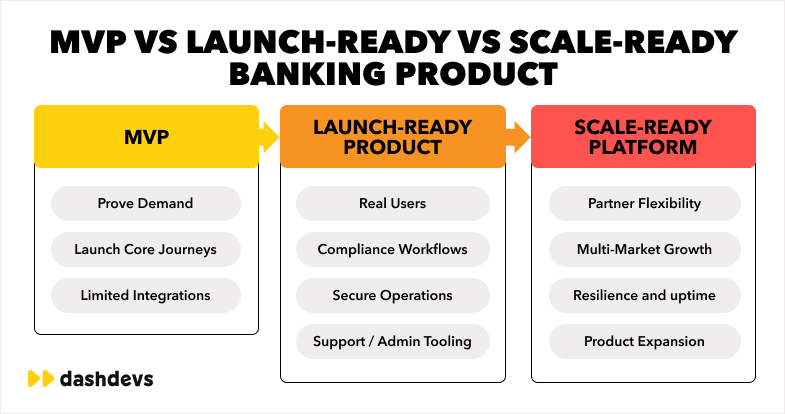
📰 Mobile Banking App Development Guide (2026) by DashDevs. Written by Igor Tomych of DashDevs, this guide explains that mobile banking apps are now the primary customer interface and their success depends more on backend infrastructure, compliance, integrations, and security than on user experience alone. Read the full article here
NEWS
🌎 dLocal launches Stablecoin Full. Stablecoin Full enables global merchants to accept and send payments in stablecoins, fund and settle transactions in digital assets, and optimise their treasury operations across 44+ emerging markets, all through a single API.
🌍 Enfuce joins Mastercard Product Express to fast-track business card programme launches across Europe. The collaboration extends Mastercard’s Product Express offering in Europe to include business card programmes, enabling financial institutions, FinTechs and non-financial institutions (non-FIs) to launch new solutions with greater speed and efficiency.
🇬🇧 CAB Payments lashes out at the largest shareholder for blocking the buyout. The dispute highlights an ongoing battle for control of the company, with competing bids from both parties and rising tensions over its future ownership. Continue reading
🇳🇬 Flutterwave rejects government investment reports and rules out imminent IPO. The denial came in response to local media reports, including a now-deleted post by a special assistant to President Bola Ahmed Tinubu, which stated that the president had authorised an investment of $75 million in the payments company through the Ministry of Finance Incorporated (MoFI).
🇬🇧 Visa and TikTok launch new ‘Creator Card’ to support the UK’s next generation of entrepreneurs. The new Creator Card gives creators access to tools designed to better separate business and personal finances, and follows Visa’s previous recognition of creators as small businesses and their impact on the digital economy.
🌍 SumUp launches loyalty programme to help small businesses compete for repeat customers. Available across the UK, France, Germany, Ireland, Spain, and Italy, the programme requires no new hardware and works with merchants' existing SumUp infrastructure.
🇲🇽 Nuvei launches Direct Acquiring in Mexico. The launch marks the latest step in Nuvei's strategy to operate directly within domestic payment ecosystems, enabling businesses to improve approval rates, increase visibility into transaction data, and reduce the complexity of managing payments across markets, all through a single platform.
🇳🇿 1Cover partners with Adyen to modernise payments. By partnering with Adyen, 1Cover consolidated its payments stack with a single global provider, enabling access to local payment methods across Australia and New Zealand, automated reconciliation to reduce manual intervention, and machine-learning-driven fraud prevention, improving reliability at checkout.
🇨🇳 Alipay adds support for OpenClaw agent payments. The use of the new service requires no coding or complex setup, and includes multi-layer security safeguards for every transaction, making AI agents with Alipay more capable and effective. It also extends Alipay AI Pay’s capabilities by enabling OpenClaw-type AI agents to make payments, with user authorisation.
🇳🇿 Thunes launches real-time payments into New Zealand. With this launch, users can easily transfer NZD directly to New Zealand bank accounts. Transactions can be made either through a direct API integration to Thunes or by leveraging existing Swift connectivity.
🇵🇪 Argentinian FinTech Takenos expands to Peru after a $5 million funding round. This new capital is earmarked for strengthening its technological infrastructure and accelerating its growth across Latin America. The company aims to address existing challenges in managing money across different markets by offering a tailored solution.
🇬🇧 UK sets out plan to integrate payments rules covering stablecoins and tokenised deposits. The UK Treasury announced a regulatory package that includes £1 million ($1.35 million) in additional funding for the Centre for Finance, Innovation and Technology, and plans to bring forward legislation to reduce administrative burdens for firms offering stablecoin payments.
🌍 Bybit Pay expands into Europe, building a trusted layer between crypto and everyday payments. Bybit has expanded Bybit Pay into Europe through its EU entity, offering a crypto payment solution that enables fast, low-cost transfers, QR payments, and seamless crypto-to-fiat use.
🇺🇸 Nium taps Coinbase to expand USDC payouts across global network. The partnership gives clients a way to send and receive stablecoins and convert USDC into fiat for payouts through a single platform that connects on-chain and traditional payment rails.
🇺🇸 PayPal is named the official peer-to-peer payments partner of the NFL. This partnership marks a step forward for PayPal's peer-to-peer offering, bringing together expanded global reach, new product functionality, and more ways for people to send and receive money with each other, all in one place, for the millions of moments people move money every day.
GOLDEN NUGGET
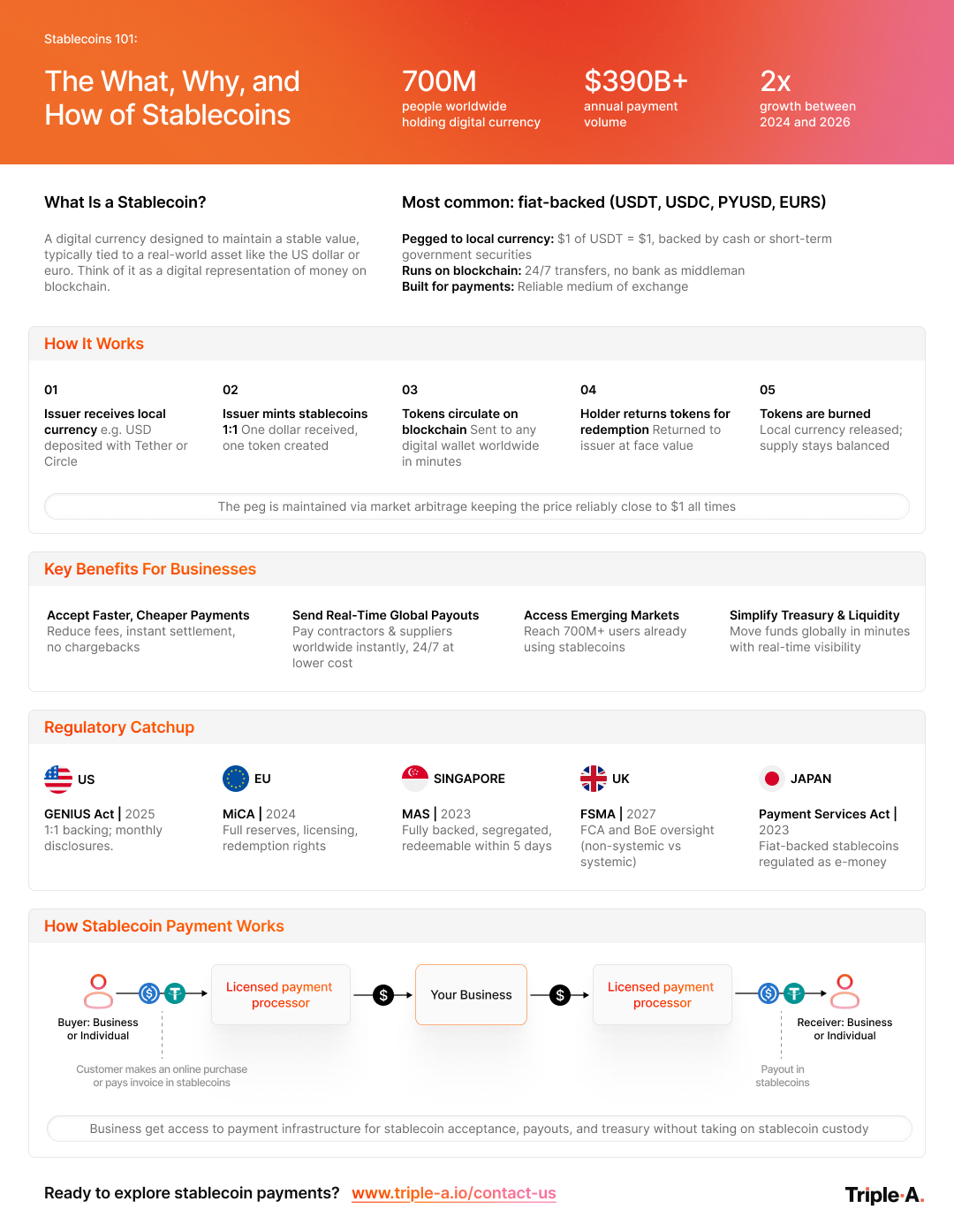
Stablecoins 101: The What, Why, and How of This Digital Asset
More than 700 million people — roughly 8.5% of the world's population — now own some form of digital currency, up from around 560 million in 2024, according to Crypto.com research and Triple-A's own data.
What is a stablecoin?
A stablecoin is a digital currency designed to maintain a stable value, typically by tying it to a real-world asset, like the US dollar or euro.
That predictability makes stablecoins uniquely suited to payments.
Businesses and individuals can send, receive, and settle instantly in stablecoins, knowing the value will be the same when the payment arrives as when it was sent.
How do stablecoins work?
Stablecoins function like local currencies, with a few distinct differences since they live on the blockchain. Here’s what’s happening under the hood of fiat-backed stablecoins (the most common type used in payments):
- Who issues them? Stablecoins are often created by private companies, called issuers – think Tether (USDT), Circle (USDC), and PayPal (PYUSD).
- How do they circulate? Once issued, stablecoins live on public blockchains. From there, they move freely, without a bank or payment processor.
- Tokens vs. network: A stablecoin token is the asset – the digital dollar itself. The blockchain network it runs on is the infrastructure used to move it.
- What redemption looks like: When a holder wants to convert stablecoins back to fiat currency, they return the tokens to the issuer or a participating exchange.
Types of stablecoins
While all stablecoin shares the same goal of minimizing volatility, they can be backed by different types of assets that determine how they maintain their stability.
There are four main types of stablecoins, each with a different approach to backing, risk, and redemption:
- Fiat-backed stablecoins
- Crypto-backed stablecoins
- Algorithmic stablecoins
- Commodity-backed stablecoins
Let’s explore each of these in more detail, reading the full article here.
Source: Tripe-A
Want your message in front of 100.000+ FinTech fanatics, founders, investors, and operators?
Shoot me a message on LinkedIn or send me an e-mail.

Comments ()