

Canada Finally Gets 24/7 Real-Time Payments

Hey Payments Fanatic!
One of the biggest payments stories today comes from Canada.
Payments Canada has launched the Real-Time Rail (RTR), a new national system that lets participants clear and settle payments in real time, 24 hours a day, every day of the year. It runs on ISO 20022 messaging.
The first participants include Wealthsimple, KOHO, Peoples Trust Company and Bank of America. All major Canadian banks are set to join in the coming months, and Payments Canada says the RTR will reach more than nine in 10 Canadians within its first year.
The part that stands out to me is fraud. Canada says it's the first G7 country to launch a real-time payment system with mandatory centralised fraud services from day one.
That includes confirmation of payee for consumer accounts, a fraud "safety" score for transactions and a shared fraud intelligence platform.
That matters, because faster payments also mean faster fraud. Building the checks in from the start is the right order.
The C.D. Howe Institute estimates up to $14.5 billion in cost savings from the launch functionality alone.
Would you switch banks for instant payments around the clock?
In the meantime, here's what else is happening in payments today👇
See you tomorrow!
Cheers,
INSIGHTS
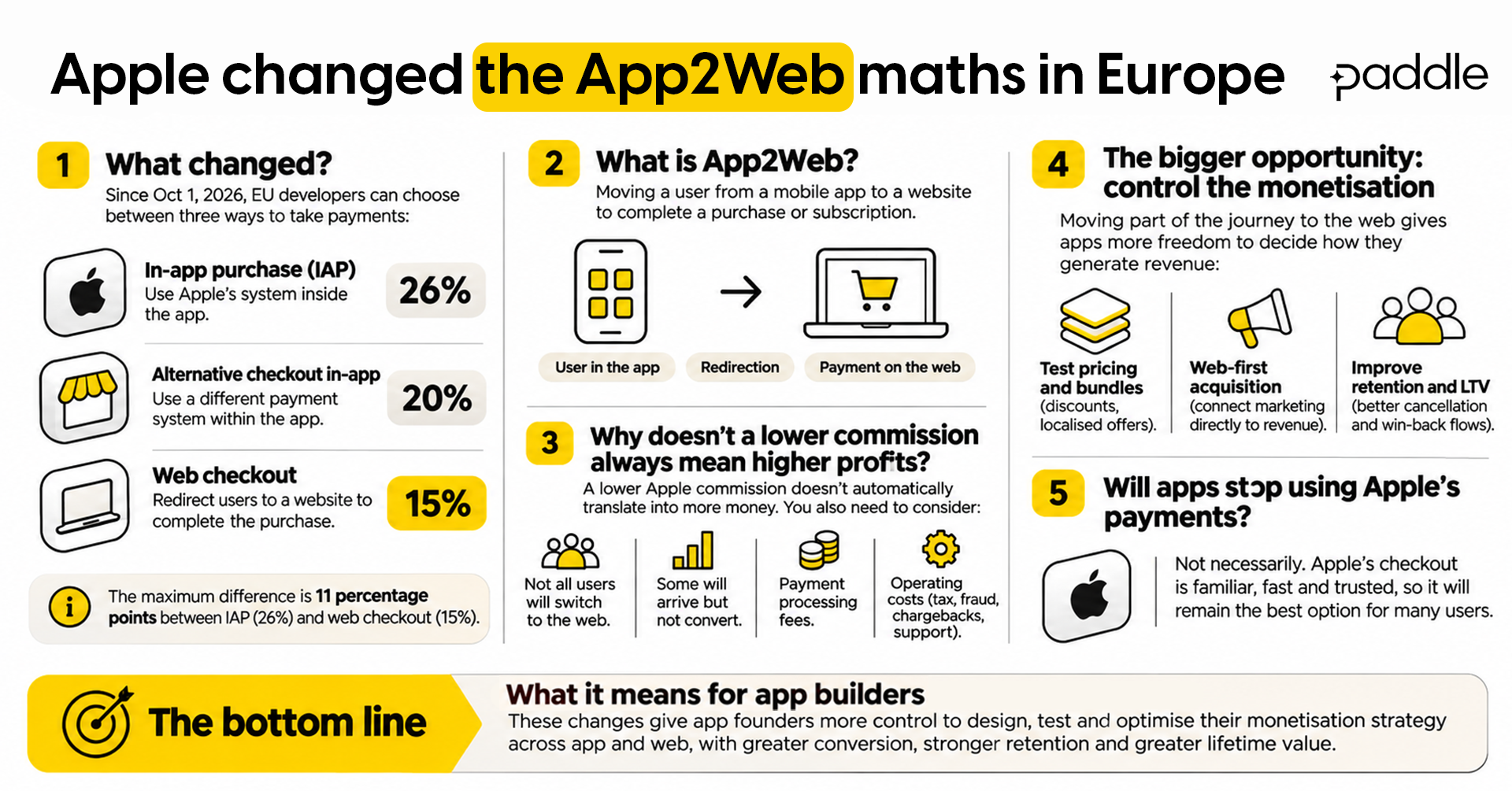
💡 Paddle: Apple Changes App2Web Economics in Europe. In this analysis, Andrew Davies, Chief Innovation Officer at Paddle, explains how Apple's new EU rules give app developers more control over monetisation. Since October 1, developers can choose between a 26% commission for in-app purchases, 20% for alternative in-app checkout and 15% for web checkout. But the real metric is net proceeds: payment costs, conversion and operational expenses all affect how much revenue developers actually keep. The shift creates more opportunities to experiment with pricing, subscriptions and direct customer relationships. Read the full analysis here
NEWS
🇪🇬 Mastercard and Housing and Development Bank collaborate on Egypt's digital payments. The partnership will strengthen HDB's debit, credit and commercial cards. The bank has more than 2 million customers, about 100 branches and 457 ATMs.
🇿🇦 Mastercard and Glyde launch virtual card payments for Southern African travel businesses. Built on the Mastercard Wholesale Program, Glydepay lets travel agencies issue a unique virtual card for each booking. It is the programme's first card issuance in Southern Africa.
🇨🇦 Canada launches its Real-Time Rail payment system. Payments Canada's 24/7 system offers real-time clearing and settlement, with initial participants including Wealthsimple, KOHO and Bank of America. Canada's largest banks are expected to join in stages.
🇰🇷 KakaoBank and Toss Bank prepare to introduce Apple Pay in South Korea. The move could end Hyundai Card's exclusive access to Apple Pay after more than three years. Shinhan Card, KB Kookmin Card and BC Card are also interested.
🇨🇦 PhotonPay registers as a payment service provider in Canada. Its Canadian entity is now registered with the Bank of Canada under the Retail Payment Activities Act, adding to its FINTRAC MSB registration. The company holds 35 payment licences and registrations globally.
🇦🇺 Uber introduces cash payments for rides in Australia. Riders in most areas, excluding Queensland, Tasmania and the Northern Territory, can now pay in cash, with drivers able to opt out through a trip filter and any change returned to riders as Uber credits.
🇬🇧 Zilch CEO confident of $2B valuation in planned IPO. Philip Belamant said the listing could come as soon as the second half of next year, though no bankers have been appointed. Zilch's annual revenue rose 36% to £147.5M.
💡 Worldline: Q3 2026 Results: Revenue Returns to Growth, but Net-Net Revenue Remains Under Pressure. Worldline reported Q3 revenue of €946M (+2.5%), with Merchant Services revenue up 4.0% and Merchant Sales Value growing 3.4%. Transaction volumes also increased across Axis (+8.8% YTD) and GoPay (+10.9% YTD), while Financial Services orders surged 91% YTD. However, higher scheme and partner fees in Merchant Services offset the growth, leaving net-net revenue flat at €517.1M. Group net-net revenue declined 1.0% to €700.7M. The results highlight the key challenge in Worldline’s turnaround: growing transaction volumes is not enough if the company cannot retain more revenue from that activity. Read the full Q3 results breakdown here

🇺🇸 PNC pilots incoming stablecoin payments with Coinbase. Eligible corporate and institutional clients can receive USDC on Ethereum, which is converted 1:1 to dollars in a PNC deposit account. The service runs on Coinbase Payment products.
🌐 BVNK makes Open USD live for business customers. Eligible businesses outside the EEA can mint and redeem the Open USD stablecoin at zero cost on Ethereum, Solana, Base and Tempo. OUSD is backed by a consortium including Mastercard, Stripe and BlackRock.
🌐 Zama spin-off Raycash launches confidential stablecoin payments on Ethereum. The app offers private USDC payments and yield using ERC-7984 confidential tokens, starting as a private beta. More than 75,000 people have joined the waitlist.
🇿🇼 Green Dollar Stablecoin seeks ZIMRA approval for tax payments. The Zimbabwean stablecoin has asked the revenue authority to accept it for selected taxes and customs duties, subject to ZIMRA's assessment and approval.
🇩🇪 PayPal offers YouLend term loans to German merchants. Loans of €1,000 to €1M for up to a year now appear on PayPal's German business page, arranged by YouLend and funded by Banking Circle. PayPal has not formally announced the product.
🇬🇧 Trade Nation's head of payments Tariq Ahmed departs. Ahmed, with the CFD broker since 2021 and head of payments and client onboarding for the past year, has left the firm. No successor was named.
GOLDEN NUGGET
AI could make fraud a $40 billion problem. A report by Plaid.

And the defenses we've trusted for years are already breaking.
Here's what's changing 👇
For three decades, every new fraud defense arrived one wave at a time:
Credit bureau data → the dot-com boom
Knowledge-based questions → the early internet
ID document checks → the gig economy
Liveness verification → crypto
Behavioral analytics → social media at scale
Each one solved the problem of its moment.
Then fraudsters caught up, and the signal got weaker.
Now generative AI can spoof, buy, or synthesize almost all of it:
• Years of breaches made static identity data cheap and everywhere
• Synthetic identities created in minutes
• Deepfakes look more convincing than ever
• Device and location can be masked
It's been nearly a decade since a genuinely new data source for fighting fraud entered the market. Fraud hasn't waited.
So what actually holds up?
A person's financial footprint across the broader system.
How their devices, accounts, and bank connections behave over time, seen across institutions and beyond any single company's walls.
One example from the report:
A user signs up for a new app and passes every identity check. Clean in isolation. Then you look across the network:
→ The same phone number just opened a crypto wallet elsewhere
→ The device was flagged for promo abuse on a P2P app
→ The linked bank account cycled through several FinTechs in a week
No single signal is damning. Together they're a clear picture of fraud.
And the results are hard to argue with:
• Step up just 5% of users → catch 40% of first-party fraud that went undetected
• Step up 1 in 10 users → catch 47% of fraud that already passed KYC
The key insight is simple:
Fraudsters can fake who you are.
They can't fake how you behave over time, across the entire financial system.
That's the thinking behind Plaid Protect, built connection patterns for 1B devices across 12K+ financial institutions, 9K+ apps.
I highly recommend reading the full report by Plaid.
Trusted reach among senior decision-makers in FinTech, Payments & Banking.
👉 Explore Partnership here


Comments ()