

Georgia Just Made One of the Boldest Stablecoin Moves by Any Government Yet
Hey Payments Fanatic!
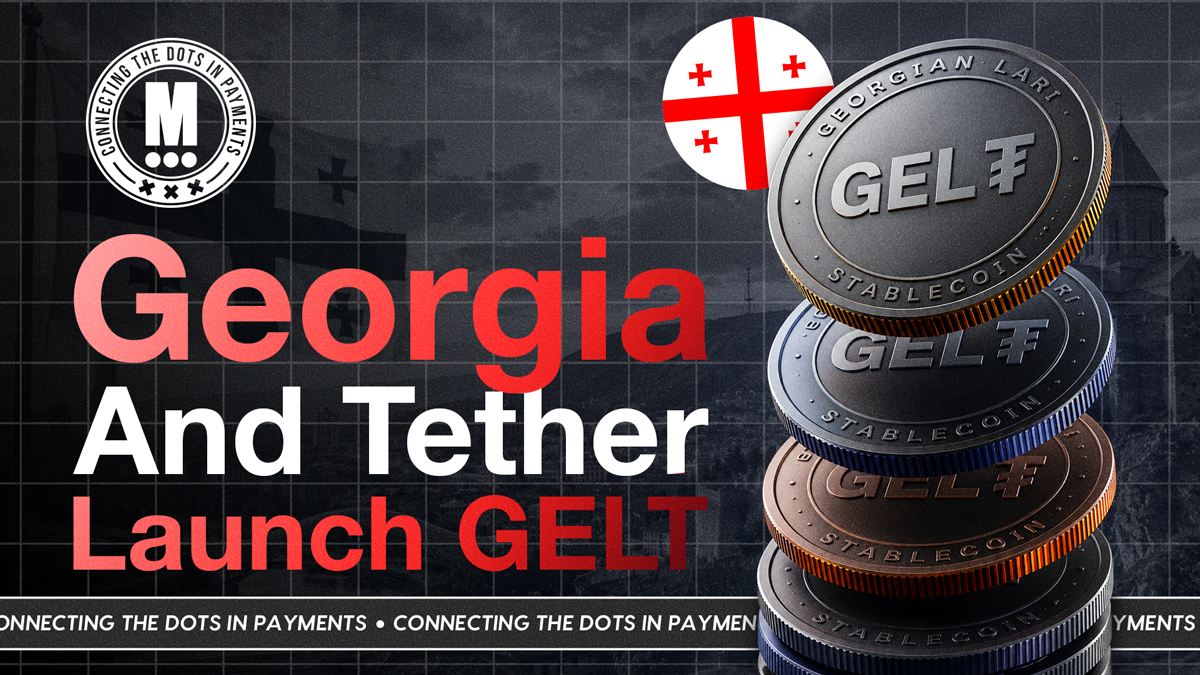
Tether and the Government of Georgia are launching a national stablecoin together.
And that’s a much bigger signal than it may sound at first glance.
The new GEL₮ stablecoin will represent the Georgian Lari on digital rails, making Georgia one of the first countries to officially work with a private stablecoin issuer at the government level under a dedicated regulatory framework.
What makes this especially interesting is the timing.
Over the past few weeks, Tether reported more than $1 billion in quarterly profit, increased its reserve buffer to a record $8.23 billion, and expanded its U.S. Treasury exposure to roughly $141 billion. At the same time, the company has been deepening its Bitcoin and infrastructure strategy through moves like increasing its ownership in Twenty One Capital.
In other words, Tether is increasingly behaving less like a crypto company and more like a parallel financial infrastructure layer.
And Georgia seems to understand where this is heading earlier than most governments.
Today's remaining Payments headlines are just below. 👇 See you tomorrow!
Cheers,
INSIGHTS
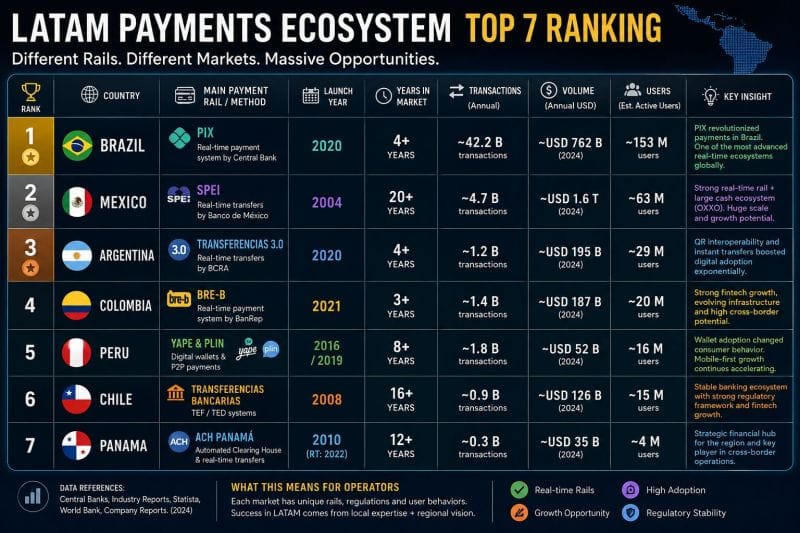
📊 LATAM Payments Ecosystem
NEWS
🇨🇴 Mastercard officially launches its card for the highest-value segment in Colombia. Federico Martínez, president of Mastercard Colombia, said that with the launch of World Legend Mastercard in Colombia, “we are taking a new step in the evolution of our premium offering, expanding the concept of value beyond payments.”
🇬🇧 Aave and MetaMask bring DeFi to traditional payments with Mastercard. The initiative aims to bridge decentralised finance and traditional payment infrastructure by enabling real-world transactions without requiring users to first convert crypto holdings into fiat currency.
🇬🇪 Tether and the Government of Georgia to launch GEL₮, the official stablecoin of Georgia. GEL₮ is designed to function as a digital representation of the Georgian Lari, enabling lower transaction costs, near-instant settlement, programmable payments, and more efficient movement of value across digital financial systems.
🇮🇹 Italian state-backed bank to raise stake in payments group Nexi after CVC weighs bid. Cassa Depositi e Prestiti plans to increase its stake in Nexi to just under 30%, a move that would strengthen its influence over the Italian payments group and effectively block a potential takeover by CVC Capital Partners.
🇮🇳 Visa-backed PayMate ties unpaid employee dues to long-pending DigiAsia deal and funding. The company said outstanding dues are expected to be settled once the transaction closes and new capital is secured. Read more
🌎 TransFi appoints Victor Lucena as CEO for Latin America to drive regional expansion. Lucena brings more than a decade of leadership and commercial experience across the global payments industry. His career spans senior roles at Worldpay, PayU, Rapyd and Thunes.
🇦🇪 Samsung Gulf Electronics has integrated Samsung Wallet with qlub to enable faster contactless bill payments at restaurants and hospitality venues. Galaxy users can scan a QR code, review their bill, and pay directly from their devices, with transactions secured through tokenisation and Samsung Knox technology.
🇧🇪 Crypto trading group Keyrock tallies $73m in AI payments, highlighting the growing role of autonomous systems in decentralised finance. The data points to increasing adoption of AI-driven transaction activity and suggests that automated agents are becoming a meaningful part of the digital asset economy.
🇧🇷 FinTech Robbin raises US$8 million with Canary, Atlântico, and Caravela. According to Robbin, the funds raised in this round will be directed towards the growth of its credit and payments platform with a native artificial intelligence architecture, as well as the development of new agents focused on automating financial flows in the industry.
🌍 Paytm said its subsidiary Paytm Cloud Technologies will invest €9 million into Paytm Europe Payments to strengthen the European unit’s capital base and support future business expansion. The Luxembourg-based subsidiary, established earlier this year, has not yet begun operations.
🇧🇷 Evertec acquires a controlling stake in BBChain and enters the digital assets market. The agreement has a two-phase structure. In the first phase, the Puerto Rican company assumes a controlling interest upon closing. In the second phase, the remaining stake is tied to the achievement of future performance targets.
GOLDEN NUGGET
𝐌𝐚𝐜𝐡𝐢𝐧𝐞 𝐏𝐚𝐲𝐦𝐞𝐧𝐭 𝐏𝐫𝐨𝐭𝐨𝐜𝐨𝐥 — 𝐓𝐡𝐞 𝐒𝐚𝐦𝐞 𝐏𝐫𝐨𝐭𝐨𝐜𝐨𝐥. 𝐓𝐰𝐨 𝐕𝐞𝐫𝐲 𝐃𝐢𝐟𝐟𝐞𝐫𝐞𝐧𝐭 𝐅𝐥𝐨𝐰𝐬.👇Created by Arthur Bedel 💳 ♻️
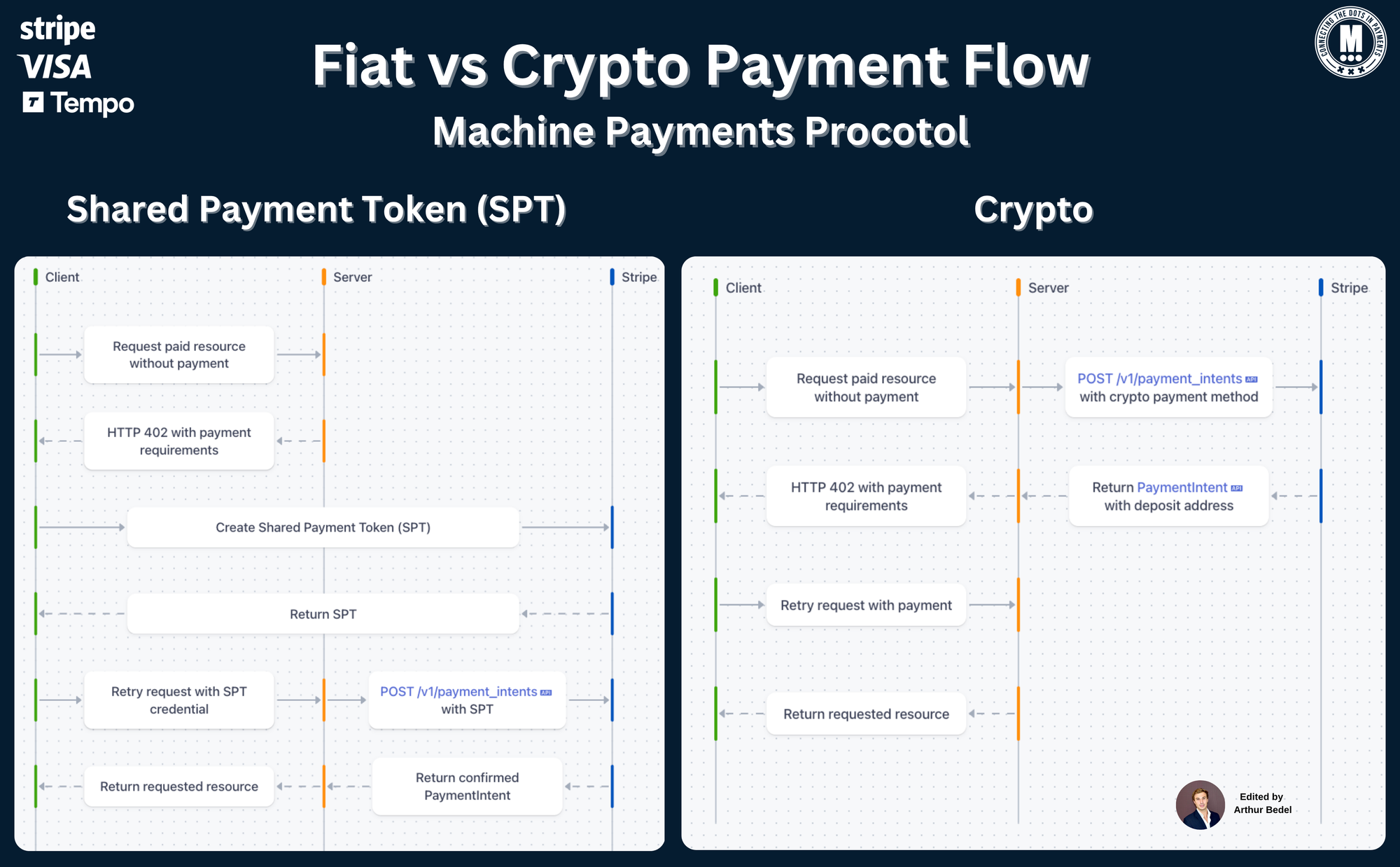
MPP isn't a payment method — it's a protocol.
And it supports two fundamentally different transaction architectures. The choice impacts everything: credential ownership, settlement rails, and what the agent actually holds.
Let's break it down.
──────────────────────
𝐅𝐥𝐨𝐰 𝟏 — 𝐒𝐡𝐚𝐫𝐞𝐝 𝐏𝐚𝐲𝐦𝐞𝐧𝐭 𝐓𝐨𝐤𝐞𝐧 (𝐒𝐏𝐓) | 𝐅𝐢𝐚𝐭 𝐑𝐚𝐢𝐥𝐬
──────────────────────
The fiat path — cards, wallets, Link.
An SPT is a pre-authorized, scoped credential created once by a human and delegated to an agent.
The flow:
→ Agent requests a paid resource
→ Server returns HTTP 402 with payment requirements
→ Agent creates an SPT via Stripe (card captured via Elements)
→ Stripe returns the SPT
→ Agent retries request with the SPT
→ Server confirms via PaymentIntent API
→ Resource is delivered
𝐊𝐞𝐲 𝐢𝐧𝐬𝐢𝐠𝐡𝐭: The server never touches card data. Identity is encoded once into the token. The agent only carries permission — not the underlying credential. Settlement runs on Stripe's rails.
Best for: higher-value transactions, broad payment method coverage, existing Stripe merchants.
──────────────────────
𝐅𝐥𝐨𝐰 𝟐 — 𝐂𝐫𝐲𝐩𝐭𝐨 | 𝐎𝐧-𝐂𝐡𝐚𝐢𝐧 𝐑𝐚𝐢𝐥𝐬
──────────────────────
The on-chain path — stablecoins (e.g. USDC).
No card. No pre-issued token. The agent pays like a wallet.
The flow:
→ Agent requests a paid resource
→ Server creates a crypto PaymentIntent via Stripe
→ Stripe returns a deposit address
→ Server responds with HTTP 402 + payment instructions
→ Agent sends funds on-chain
→ Stripe detects and confirms payment
→ Resource is delivered
𝐊𝐞𝐲 𝐢𝐧𝐬𝐢𝐠𝐡𝐭: No pre-credentialing. The agent just needs a funded wallet. Settlement happens on-chain — Stripe acts as monitoring/reconciliation, not processor.
Best for: micro-transactions, agent-native payments, crypto workflows.
──────────────────────
𝐒𝐨 𝐖𝐡𝐚𝐭'𝐬 𝐭𝐡𝐞 𝐑𝐞𝐚𝐥 𝐃𝐢𝐟𝐟𝐞𝐫𝐞𝐧𝐜𝐞?
──────────────────────
It comes down to the credential model:
→ 𝐒𝐏𝐓: Human-originated, pre-issued, fiat-settled → delegated authority
→ 𝐂𝐫𝐲𝐩𝐭𝐨: Wallet-originated, runtime, on-chain → autonomous value
One is 𝐝𝐞𝐥𝐞𝐠𝐚𝐭𝐞𝐝 𝐬𝐩𝐞𝐧𝐝𝐢𝐧𝐠.
The other is 𝐚𝐮𝐭𝐨𝐧𝐨𝐦𝐨𝐮𝐬 𝐯𝐚𝐥𝐮𝐞 𝐭𝐫𝐚𝐧𝐬𝐟𝐞𝐫.
Same HTTP 402 handshake. Same Stripe surface. Two radically different trust models.
This is where agentic commerce gets real — identity vs value, permission vs ownership.
The rails are ready.
Who builds on top?
Payments, they never stops...
Source: Stripe, Tempo, Visa
Want your message in front of 100.000+ FinTech fanatics, founders, investors, and operators?
Shoot me a message on LinkedIn or send me an e-mail.




Comments ()