

Payments Platforms Are Thinking Bigger
Hey Payments Fanatic!
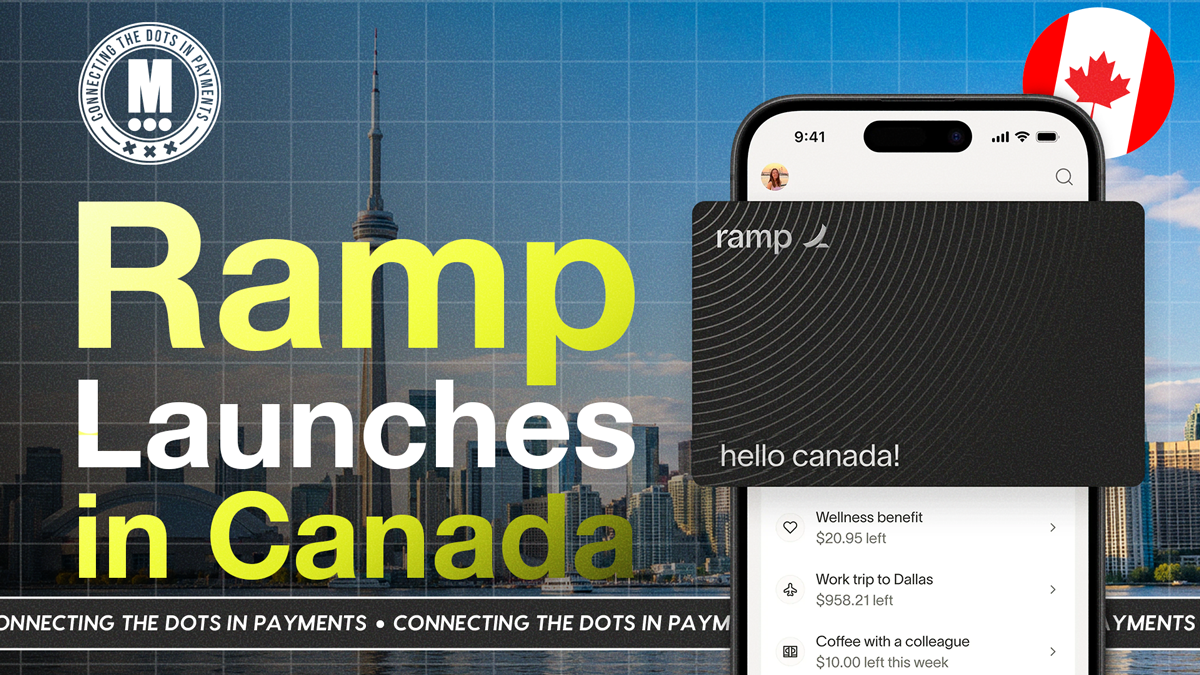
Ramp is heading north.
The U.S. FinTech has officially launched in Canada, opening a Toronto office and bringing its finance platform to Canadian businesses with multi-currency cards, local payments, tax automation, and AI-powered spend management.
It's another sign that today's payments platforms aren't expanding by simply adding another country to the map. They're building products that let finance teams manage currencies, tax rules, approvals, and cross-border operations from a single place. As businesses become more global, that's quickly becoming the expectation—not a premium feature.
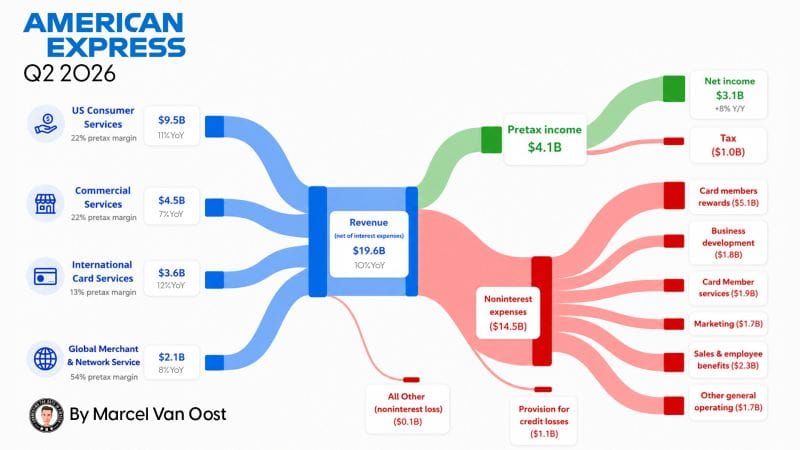
You'll also find why American Express raised its full-year guidance after another strong quarter, delivering double-digit earnings growth while credit provisions continued to decline, a combination that points to resilient spending and healthy credit quality.
Now, let's dive into today's biggest Payments stories. 👇 See you tomorrow!
Cheers,
INSIGHTS
🚨 American Express just raised its full-year guidance.
NEWS
🇨🇦 Ramp has launched its finance platform in Canada, expanding internationally with support for multi-currency spend management, local payments, tax automation, and accounting workflows. The company is also opening a Toronto office to support Canadian businesses as they scale across domestic and global markets.
🇳🇱 ING scanner won’t support Wero payments when the European payment system replaces iDEAL from late 2026. Instead, Wero payments will require the ING app, while the scanner will continue to work for other banking services, unlike authentication devices offered by some competing Dutch banks.
🇧🇷 EBANX has partnered with Pagaleve to launch Pix 4x, a BNPL solution that allows Brazilian consumers to pay in four installments using Pix without a credit card. The offering expands access to installment payments and helps merchants reach millions of consumers with limited or no access to traditional credit.
🇬🇧 GoCardless and anvil partner to launch automated payments for telcos and MSPs. The integration connects anvil's billing system directly to the GoCardless payment network, allowing telecom operators and Managed Service Providers (MSPs) to automate how they collect payments and manage their accounts.
🇳🇱 PayPal is now live on Rootline, allowing partners and merchants to offer PayPal through a single API alongside other payment methods. The integration streamlines checkout, settlement, reconciliation, and dispute management while simplifying PayPal onboarding for platform merchants.
🇵🇱 Dariusz Mazurkiewicz steps down as BLIK CEO after nine years. In a farewell statement, he said that the time had come to begin a new professional chapter. He described his years at the company as an opportunity to build BLIK together with its employees, shareholders, banking partners and representatives of Poland’s financial sector.
🇩🇪 Pliant has reached $100 million in annual recurring revenue (ARR). Rather than prioritizing rapid expansion, the B2B payments company focused on building scalable card infrastructure, growing through banking and software partnerships, and expanding across Europe before entering the U.S.
🇺🇸 Visa used Mythos to hunt for bugs in its own payment network, then open-sourced the harness that made it possible. The initiative aims to help organizations strengthen cybersecurity by automating vulnerability discovery and sharing best practices for protecting critical systems.
🇧🇪 Crelan launches Wero. Customers can send and receive money using QR codes and payment links from the Crelan app, without needing to download or install an additional app. Thanks to this integration, the entire user experience remains in Crelan’s familiar digital environment with the same simplicity, security, and user convenience that customers are used to.
🇮🇹 Scalapay is expanding its partnership with Stripe to make it even easier for global businesses to access its Buy Now, Pay Later services. Stripe customers based in over 30 countries can now activate Scalapay more easily and offer their customers a flexible payment experience in key Southern European markets.
🇸🇬 LANDI Global partners with Mollie. By integrating Mollie’s payment technology directly into LANDI’s enterprise-ready Android smart terminals, you can take payments anywhere in your store or restaurant. Keep reading
🇮🇳 Banks in Bangladesh can now offer cross-border transaction services through PayPal and Payoneer. The central bank said the initiative aims to facilitate international service-oriented trade, enhance digital financial inclusion and modernise the country's transaction framework.
GOLDEN NUGGET
🥊 Apple 𝐏𝐚𝐲 𝐯𝐬 Google 𝐏𝐚𝐲: 𝐰𝐡𝐢𝐜𝐡 𝐨𝐧𝐞 𝐚𝐜𝐭𝐮𝐚𝐥𝐥𝐲 𝐩𝐫𝐨𝐭𝐞𝐜𝐭𝐬 𝐲𝐨𝐮𝐫 𝐛𝐚𝐧𝐤 𝐜𝐚𝐫𝐝 𝐛𝐞𝐭𝐭𝐞𝐫? 👇 Created by Arthur Bedel 💳 ♻️
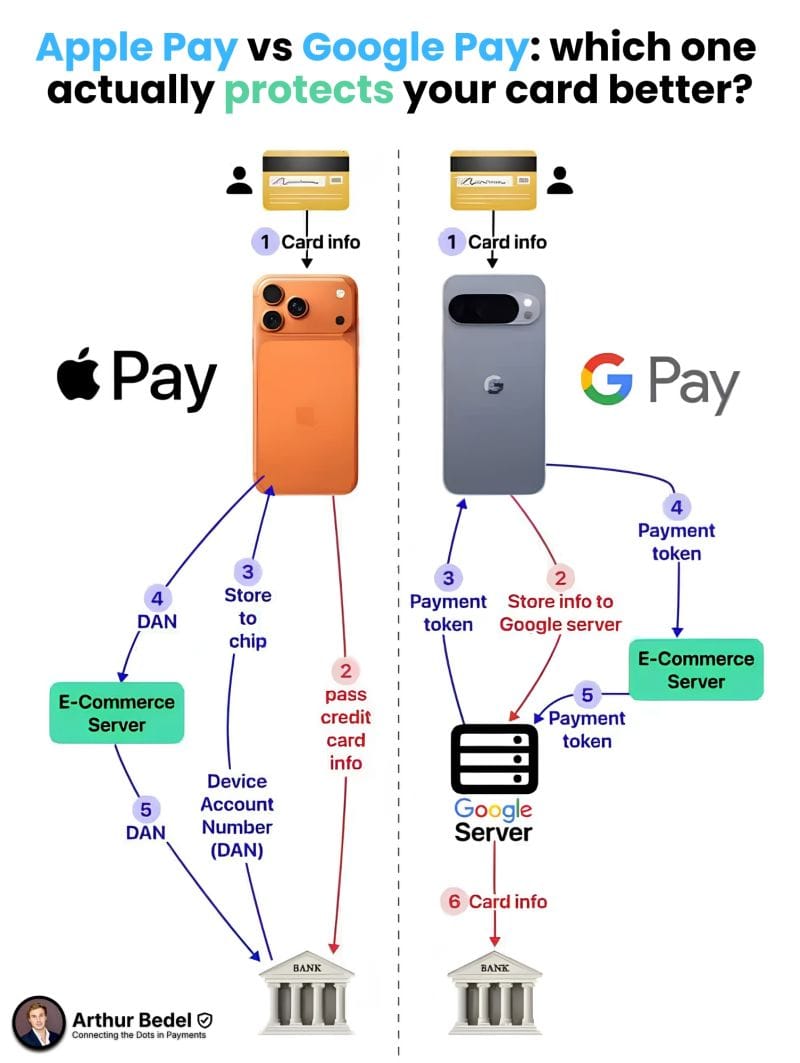
Both are secure. But the architecture behind them is completely different.
Enrollment step.
→ Apple Pay never stores your card details. It passes them to your bank, which returns a token called the DAN (Device Account Number).
That DAN stays stored in a dedicated hardware chip on your iPhone.
→ Google Pay stores your card details on Google's servers.
Google returns a payment token to your phone, but the original data stays server-side.
Payment step.
→ Apple Pay : the e-commerce server passes the DAN directly to your bank. The flow never touches a third-party server.
→ Google Pay : the e-commerce server passes the token to Google's server. Google retrieves the card details and forwards them to your bank.
One extra hop, one extra intermediary.
The technical nuance : in the diagram, the red arrow shows that encrypted card data still travels over the public network on the Google Pay side, while Apple Pay avoids that path entirely by relying on the local hardware chip.
Source : TheAppleDesign on X
Want your message in front of 315.000+ FinTech fanatics, founders, investors, and operators?
Shoot me a message on LinkedIn or send me an e-mail.



Comments ()