

Mastercard’s AI agent Payment in the Netherlands

Hey Payments Fanatic!
Mastercard and Rabobank executed a payment via an AI agent for the first time in the Netherlands.
In this case, an AI agent booked a coffee tasting via Priceless.com, Mastercard’s platform for unique experiences, based on a simple prompt from the consumer. The payment was made using a Rabobank Mastercard credit card.
With Mastercard Agent Pay, the AI agent never touches your card details and operates strictly within your pre-set consent. Which is a relief, the last thing we need is someone else's agent sweet-talking yours into handing over your credit card number.
“AI can make consumers’ lives a lot easier, but only if trust and security remain paramount. This first AI-driven payment in the Netherlands shows how innovation and responsible payments can go hand in hand,” said Jan‑Willem van der Schoot, Country Manager Mastercard Netherlands.
For 60 years, Mastercard built the rails humans ride. They're now laying the ones agents will.
The rest of the events shaking up the world of payments is one scroll away. See you tomorrow!
Cheers,
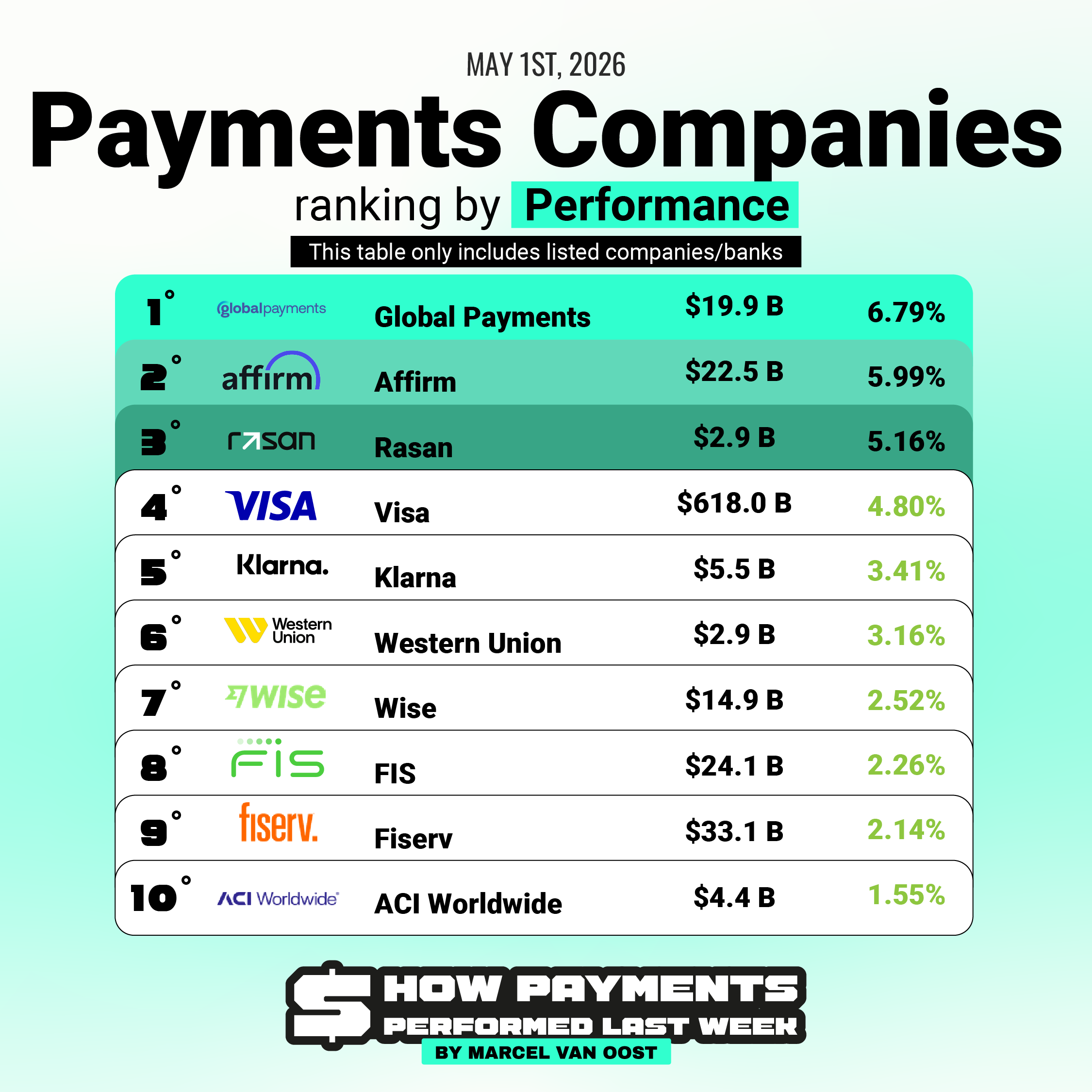
HOW PAYMENTS COMPANIES PERFORMED LAST WEEK
📈 Top 10 Payment Companies/Banks Listed on Stock Exchanges by Weekly Performance 📉
Here are the big movers of the week:
NEWS
🇺🇸 Glass has joined Mastercard Start Path to advance infrastructure for public sector finance. The partnership gives Glass access to Mastercard’s global network, supporting its push to modernize how governments manage procurement, payments, and public funds.
🇦🇪 VaultsPay and Mastercard partner to expand digital payments in the UAE, enabling card issuance and broader access to secure payment infrastructure. This collaboration supports financial inclusion and accelerates adoption of cashless, card-based solutions across the region. Read more
🇳🇱 Mastercard and Rabobank completed the Netherlands’ first AI agent payment, where an assistant booked an experience via Priceless.com using Agent Pay. The system keeps card data hidden, relies on user consent and passkeys, and signals a shift toward secure, AI-driven commerce.
🌍 MoonPay has partnered with Mastercard, Monavate, and Exodus to launch MoonAgents Card, enabling AI agents to spend stablecoins directly from onchain wallets. The collaboration combines issuing, network access, and wallet infrastructure for real-time programmable payments. The card is available today via MoonPay CLI in the UK and LATAM, with U.S. availability planned in the coming months. Identity verification is required before issuance.
🇰🇷 MoonPay Korea, in partnership with Woori Bank will support global distribution and settlement of won-backed stablecoins. The initiative connects local issuance with MoonPay’s global infrastructure, aiming to scale cross-border payments and expand KRW stablecoin use cases.
🇬🇧 PayDo has become a principal acquirer for Apple Pay and Google Pay, enabling direct wallet acceptance via PayDo Checkout. The move reduces reliance on third parties, improves processing speed, and helps merchants unify and simplify their payment infrastructure.
🇸🇬 Oobit has launched Agent Cards, a corporate card built for AI agents, enabling programmable spend controls, audit trails, and real-time oversight. Running on its global infrastructure and funded via stablecoins, the product replaces shared cards as companies scale autonomous software in production.
🇺🇸 Grey has registered as a payment service provider in Canada under the RPAA, expanding its cross-border capabilities. The YC-backed firm, already integrated with Interac, aims to streamline transfers across key trade corridors with multi-currency accounts and faster settlement times.
🇺🇸 Shift4 has partnered with the Chicago Cubs to power payments across Wrigley Field. Its end-to-end commerce technology will support concessions, retail, and entertainment purchases, modernizing operations and streamlining the fan experience.
🇺🇸 Bakkt completed its acquisition of Distributed Technologies Research (DTR) to build a 24/7 digital settlement layer. Through this acquisition, combines institutional infrastructure with AI-driven payments and stablecoin technology, aiming to bridge traditional finance and digital assets.
🌍 Fun has raised $72M in a Series A co-led by Multicoin Capital and SignalFire. The funding will support further engineering investment, Asia-Pacific expansion with a new Singapore office, and selective acquisitions. The company powers deposits, withdrawals, and settlement flows for platforms like Polymarket, Aave, and Lighter.
🇺🇸 Opay is preparing a U.S. IPO with Citigroup, Deutsche Bank, and JPMorgan Chase, targeting a ~$4B valuation. Opay, backed by SoftBank, with 40M+ users, could list later this year as demand for mobile financial services accelerates across Africa.
🇺🇸 PointsKash has acquired Keating Software’s rewards platform to expand its payments and loyalty capabilities. The deal brings key technology in-house, enabling scalable, white-label rewards programs while opening new enterprise revenue streams and strengthening its financial ecosystem.
🇺🇸 Extend and WEX in collaboration to enable virtual card payment in Concur Invoice. This automates invoice payments end-to-end, improving control, security, and efficiency for corporate customers managing accounts payable workflows. Read on
🇺🇸 PayPal has announced a strategic reorganization into three business units to streamline operations and accelerate growth. As part of the changes, Frank Keller was appointed President of Checkout, Alexis Sowa and Jeff Pomeroy took interim leadership roles, while Antonio Lucio and Anshu Bhardwaj joined as Chief Marketing and Chief AI Transformation Officers, respectively.
GOLDEN NUGGET
Breaking down the types of cards in payments👇
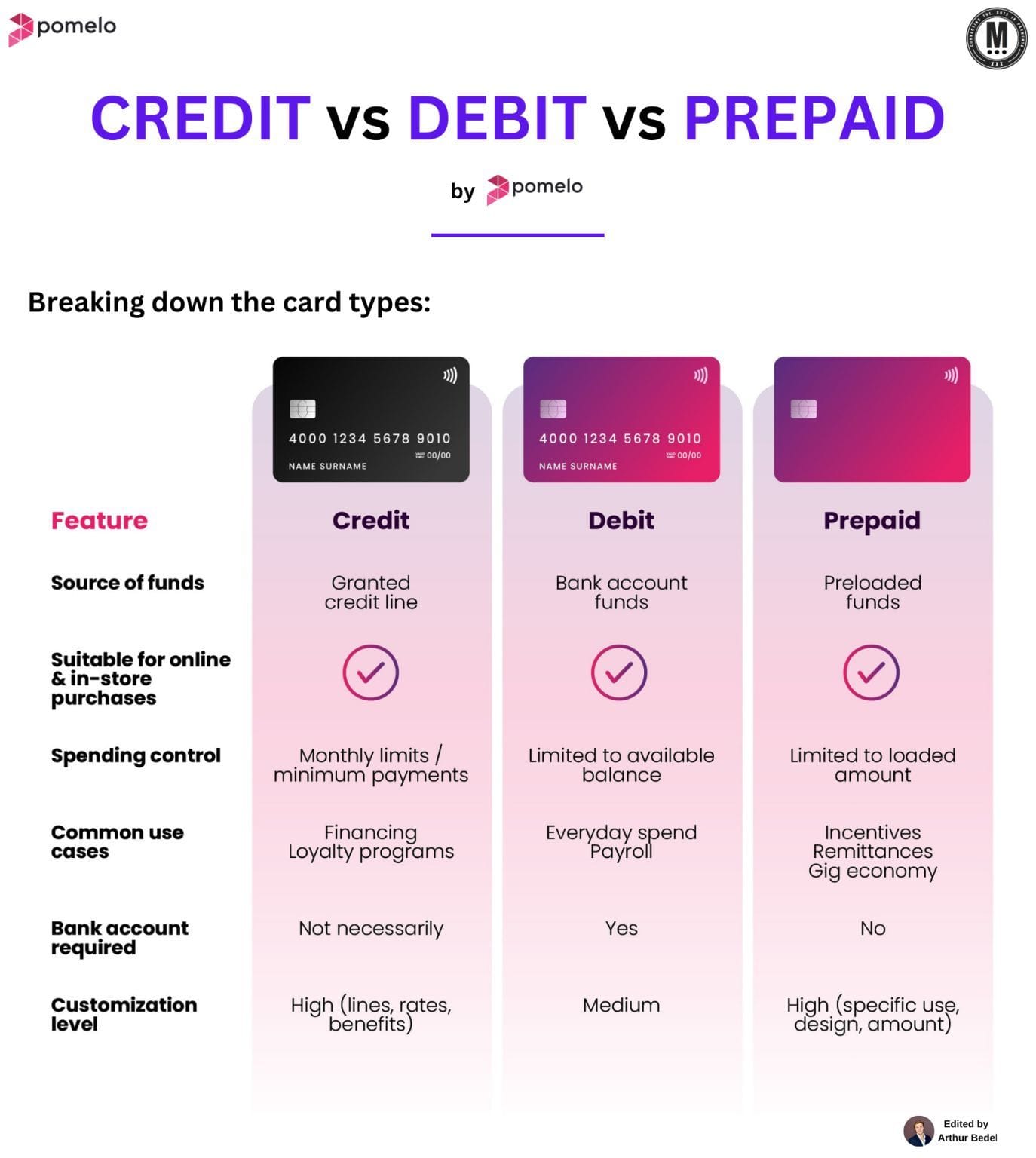
𝗖𝗿𝗲𝗱𝗶𝘁 🆚 𝗗𝗲𝗯𝗶𝘁 🆚 𝗣𝗿𝗲𝗽𝗮𝗶𝗱
Understanding the differences between these three card types is essential for both consumers and businesses. Each has its own funding source, spending rules, and ideal use cases.
𝐃𝐞𝐟𝐢𝐧𝐢𝐭𝐢𝐨𝐧𝐬 101:
𝐂𝐫𝐞𝐝𝐢𝐭 𝐂𝐚𝐫𝐝 — A payment card that lets you borrow funds from an issuer up to a set limit, repaid later with possible interest or fees.
𝐃𝐞𝐛𝐢𝐭 𝐂𝐚𝐫𝐝 — A payment card that draws directly from your bank account balance at the time of purchase.
𝐏𝐫𝐞𝐩𝐚𝐢𝐝 𝐂𝐚𝐫𝐝 — A payment card preloaded with funds in advance, usable until the balance is depleted.
𝐃𝐞𝐞𝐩 𝐃𝐢𝐯𝐞 𝐢𝐧𝐭𝐨 𝐭𝐡𝐞 3 𝐂𝐚𝐫𝐝 𝐓𝐲𝐩𝐞𝐬:
𝐖𝐡𝐚𝐭 𝐢𝐬 𝐚 𝐂𝐫𝐞𝐝𝐢𝐭 𝐂𝐚𝐫𝐝?
→ A card with a granted credit line by the issuer, allowing users to borrow funds up to a limit.
→ Suitable for online & in-store purchases, with monthly limits and minimum payment requirements.
→ Commonly used for financing and loyalty programs.
→ No bank account required.
→ High customization in terms of credit lines, rates, and benefits.
𝐖𝐡𝐚𝐭 𝐢𝐬 𝐚 𝐃𝐞𝐛𝐢𝐭 𝐂𝐚𝐫𝐝?
→ A card linked directly to bank account funds.
→ Works for online & in-store purchases but limited to available balance.
→ Used for everyday spend and payroll.
→ Requires a bank account.
→ Medium customization.
𝐖𝐡𝐚𝐭 𝐢𝐬 𝐚 𝐏𝐫𝐞𝐩𝐚𝐢𝐝 𝐂𝐚𝐫𝐝?
→ A card loaded with prepaid funds in advance.
→ Spending is limited to the loaded amount.
→ Commonly used for incentives, remittances, and gig economy payments.
→ No bank account required.
→ High customization for specific use, design, and amount.
𝐊𝐞𝐲 𝐃𝐢𝐟𝐟𝐞𝐫𝐞𝐧𝐜𝐞𝐬 — 𝐂𝐨𝐬𝐭 & 𝐒𝐭𝐫𝐮𝐜𝐭𝐮𝐫𝐞
► 𝐂𝐫𝐞𝐝𝐢𝐭 𝐂𝐚𝐫𝐝: May incur interest charges, annual fees, and penalties if balances are not cleared on time.
► 𝐃𝐞𝐛𝐢𝐭 𝐂𝐚𝐫𝐝: Generally low-cost, with minimal or no maintenance fees; no interest applies as spending is limited to existing funds.
► 𝐏𝐫𝐞𝐩𝐚𝐢𝐝 𝐂𝐚𝐫𝐝: May involve reload, issuance, or maintenance fees, but eliminate interest risk entirely.
𝐒𝐭𝐫𝐚𝐭𝐞𝐠𝐢𝐜 𝐂𝐨𝐧𝐬𝐢𝐝𝐞𝐫𝐚𝐭𝐢𝐨𝐧
The choice between credit, debit, and prepaid cards extends beyond convenience — it shapes financial management, risk exposure, and purchasing flexibility. Selecting the right option requires evaluating cost structures, access to funds, and the desired level of spending control. Partners like Pomelo can be extremely helpful in making these complex decisions.
Source: Pomelo & my mate Arthur Bedel👌
Want your message in front of 100.000+ FinTech fanatics, founders, investors, and operators?
Shoot me a message on LinkedIn or send me an e-mail.


Comments ()