
Tackling global expansion with Flow: A conversation with Checkout.com’s Umang Sota
Hey there,
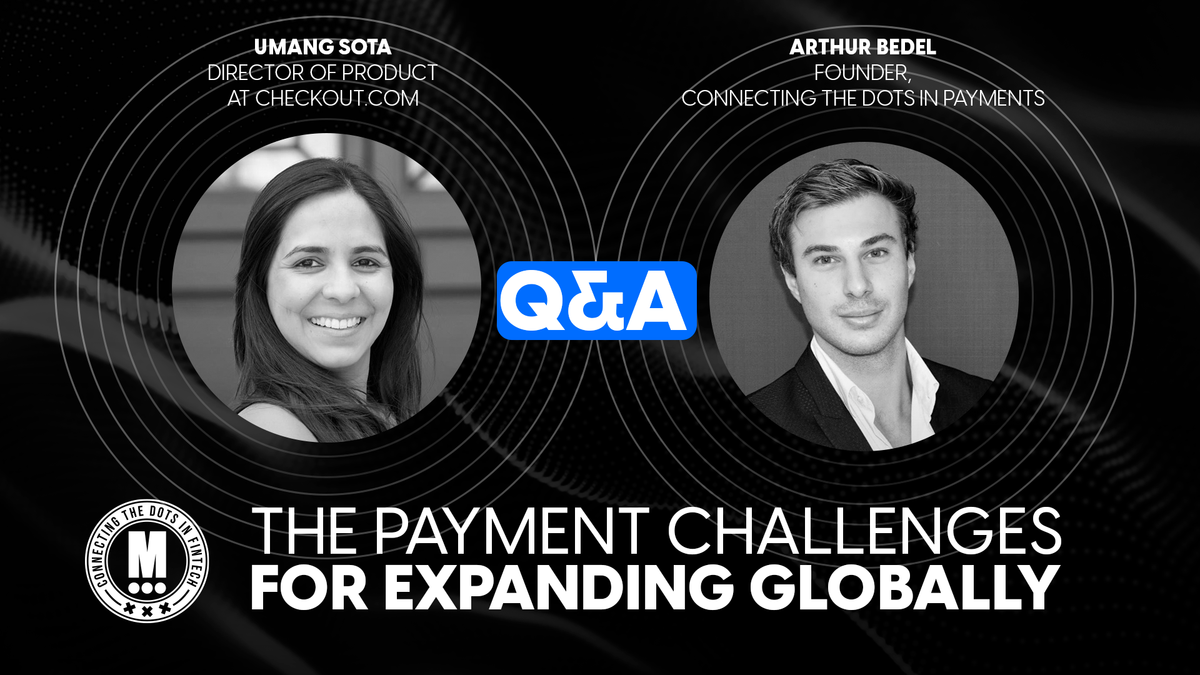
Today, we explore how merchants can overcome payment challenges in global expansion. Joining me is Umang Sota, Director of Product at Checkout.com, to discuss how they are helping merchants simplify payments, boost acceptance rates, and conquer global markets.
Arthur Bedel: Umang, it’s great to have you with us. Let’s dive right in. When merchants expand globally, they’re not just entering new markets, they’re entering new payment ecosystems. What challenges tend to catch them off guard?
Umang Sota: One of the biggest surprises for merchants is just how varied payment expectations are around the world. It’s not just about accepting cards anymore. Consumers in the Netherlands expect iDEAL. In the UAE, it might be Tamara or another local wallet. The same applies across regions, and if merchants don’t meet those expectations, they lose conversions. But beyond payment methods, merchants grapple with unfamiliar fraud patterns, compliance complexities, slow checkout flows, and clunky integrations that don't scale. All of these have a direct impact on conversion and acceptance rates.
Arthur Bedel: So it’s not just about “supporting more methods”. It’s about supporting them well. How does Checkout.com help merchants do this?
Umang Sota: This is where Flow comes in. It gives merchants a low-code toolkit to configure and deploy payment experiences tailored to local markets. You can launch in a new region and instantly enable relevant payment methods, all without engineering effort. What’s powerful is that Flow doesn’t just display options. It uses real-time data and network intelligence to surface the most likely-to-convert payment methods based on geography, device, and more. We also embed smart validation to reduce payment errors at checkout, which improves both conversion and customer satisfaction.
Arthur Bedel: Let’s talk about your recent launch, Remember Me. What is it and why should merchants care?
Umang Sota: Remember Me is a one-click checkout experience built into Flow. Once a shopper opts in, their card details are securely saved and immediately available across all Checkout.com merchants globally. That means no more re-entering details, just faster, smoother transactions. We’re seeing an 88% reduction in checkout time amongst earlier adopters and a 7% uplift in acceptance rates. We are also seeing 30% fewer timeouts and 22% fewer authentication challenges, which is a game-changer for businesses where even small frictions can cost big revenue.
Arthur Bedel: Those results speak to superior user experience. Your one-click solutions feel like a stepping stone toward a future where the wallet does much more. How do you see the digital wallet space evolving next?
Umang Sota: That is the critical evolution we're seeing. Today, digital wallets are useful, but limited. They are primarily for humans, used in narrow contexts, and governed by thin policies. Think of Apple Pay focussed on cards, or a local transit pass system like Octopus expanding to cover transit and payments.
The next leap is for the wallet to become like our Operating System (OS) for Value. This means evolving to unify critical elements of our life: Payments, Identity, Access and Ownership.
This future wallet must cater to varied needs, supporting not just humans, but also agents and things (IoT devices) with their own wallets. The vision is already being driven by global trends:
- Programmable Identity: Initiatives like the EU eIDAS and India's Aadhaar show the global shift toward the digitization of identity.
- Policy-Rich Controls: AI agents are starting to demand policy-rich wallets that allow for things like programmable rules and consent management.
The future wallets need to offer effortless financial control, allowing users to:
- Prove Identity Instantly: Prove your identity instantly using selective disclosures. For example, instead of giving a copy of your driver's license to a car rental company (where it lies unprotected), you can use your wallet to show a share code or credential that only proves your ability to drive.
- Manage Control with Policy: Use a Policy Engine for programmable rules, managing consent, and setting limits. For example, you could give a trusted AI agent permission to make recurring subscription payments up to $50 per month, while setting a different, higher limit for your personal use, and instantly revoking that agent's access with a kill-switch if needed.
- Own and Store Assets: Store all assets you own, starting with digital assets (like crypto), and subsequently other virtual, physical assets.
Arthur Bedel: That vision of the wallet as an "OS" hinges entirely on user trust and portability. What do you think of the security and regulatory complexity of Remember Me?
Umang Sota: It’s a critical concern, and one we’ve taken very seriously. The compliance burden is only increasing. Meeting PCI DSS standards is costly and time-consuming, and many businesses including the largest merchants actively seek to minimize their Cardholder Data Environment (CDE) scope. Compounding this is the coming era of Agentic Commerce, which introduces new liability ambiguity and fraud risks.
Flow Remember Me is built with security and compliance at its core. It adheres to PCI DSS and uses secure authentication to verify users before checkout. Crucially, it’s part of a broader compliance framework we manage on behalf of merchants. Global regulations, like GDPR, SCA, and card scheme mandates, change frequently. Our platform handles those updates dynamically, so merchants don’t have to rework their integration each time a new policy rolls out.
As we see merchants adopting agent driven payments, there will be a need for verifiable mandates and agent identity verification as the essential building blocks for a successful wallet.
Arthur Bedel: What does this all mean for merchants, and how does it ultimately benefit the consumer?
Umang Sota: Don’t let payments be an afterthought. In today’s landscape, payments are a growth lever. By prioritizing local experiences and performance, you not only overcome barriers but you turn them into advantages.
And more importantly, the tools you use today must prepare you for tomorrow.
Comments ()