

The ECB Is Bringing the Euro On-Chain
Hey Payments Fanatic!
The ECB is putting its own money on-chain.
It’s preparing to launch Pontes, a system that will connect blockchain-based financial markets to the ECB’s existing payment infrastructure and allow institutions to settle tokenised assets using central bank money.
What caught my attention is that the ECB isn’t positioning this as a replacement for stablecoins. Isabel Schnabel sees them as complementary, with stablecoins still useful for things like wallets, remittances and accessing decentralised markets.
That could make for an interesting split: central bank money for settlement, private stablecoins for moving money around.
And Pontes isn’t starting from scratch. A 2024 pilot involved 64 institutions across nine jurisdictions and settled almost €1.6bn in central bank money.
Now we’ll see what happens when the experiment moves into production.
Here’s what else is happening in payments today👇
See you tomorrow!
Cheers,
INSIGHTS
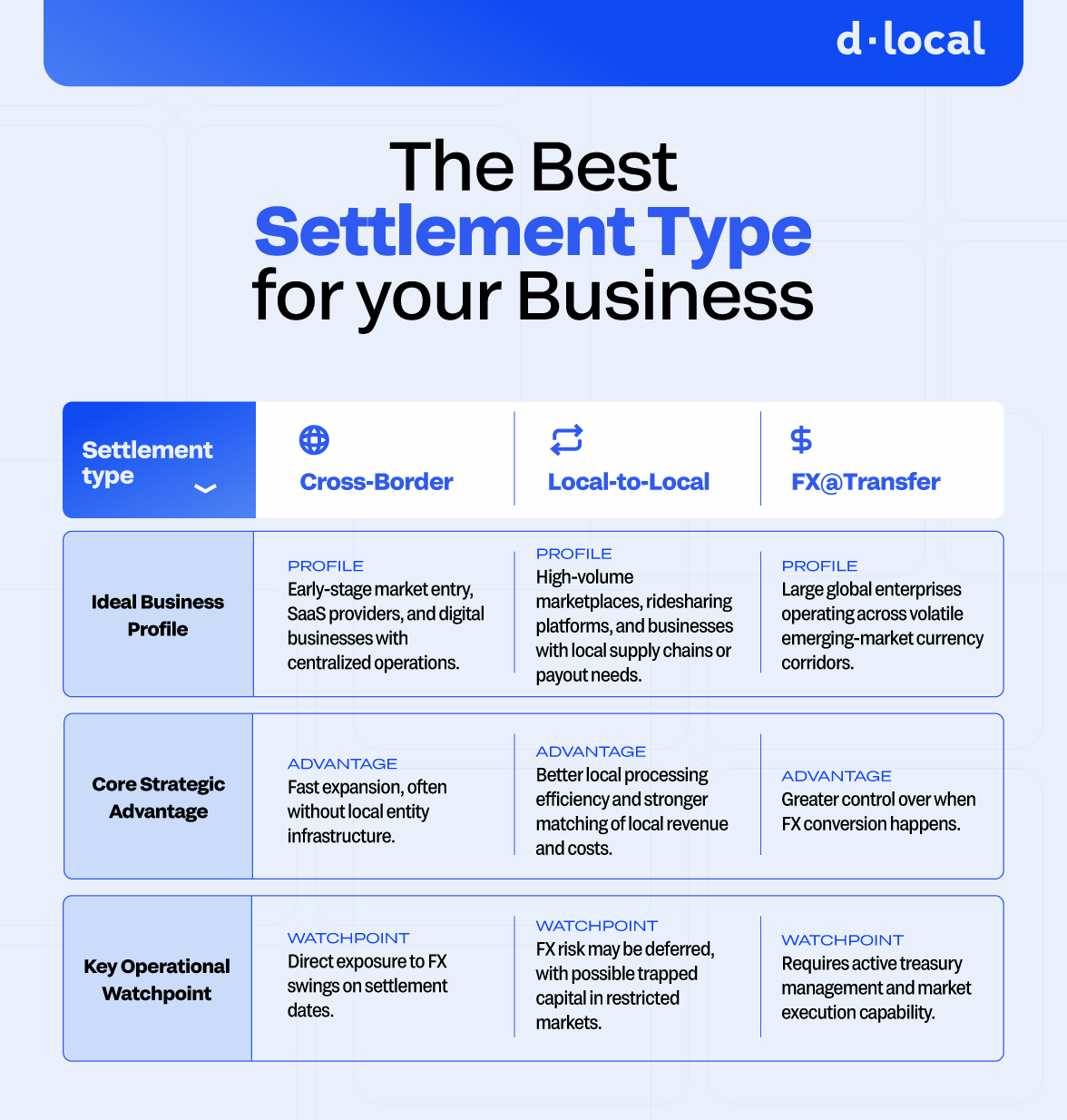
💡 dLocal: 3 Settlement Models, 3 Different FX Outcomes. dLocal breaks down Cross-Border, Local-to-Local, and FX@Transfer settlement models and how each affects FX risk, liquidity, and treasury control. There is no single best model — the right choice depends on a company’s market footprint, growth stage, treasury capabilities, and risk appetite, with stablecoins emerging as a potential fourth option. Read the full article here
NEWS
🇦🇴 Banco BCS and Mastercard aim to strengthen digital payment experiences in Angola with expanded card benefits and contactless capabilities. The collaboration will introduce Mastercard Gold and World card benefits and roll out contactless and e-commerce payment functionality for Banco BCS customers.
🇨🇭 Mastercard and Visa team up with Swiss platform Payinit, aiming to simplify international money transfers for Swiss bank customers. Transfers will work via mobile number or email, without needing the recipient's card or account details. Read more
🇳🇿 Equerra partners with Airwallex, connecting the payments platform to Microsoft Dynamics 365 Business Central. The integration helps businesses streamline global payments and multi-currency reconciliation.
🇮🇳 UPI expands to Uzbekistan, becoming the 11th country to accept the Indian payments platform. NPCI International partnered with Uzbekistan's NIPC to let Indian travelers make instant merchant payments by scanning the national UZQR code.
🇮🇳 PhonePe brings UPI to feature phones, enabling payments without internet via UPI 123Pay. The SMS-based service supports P2P transfers and merchant payments on select Nokia, HMD, Lava and Itel devices.
🇶🇦 Qatar Central Bank integrates Himyan into Samsung Wallet, enabling contactless payments via Galaxy devices. Eligible debit and prepaid cardholders can now tap to pay at points of sale nationwide.
🇿🇦 Samsung Wallet adds Scan to Pay in South Africa, powered by EFT Corp. Galaxy users can now make QR code payments directly from Samsung Wallet.
🇳🇬 OPay dismisses a viral notice advising customers to withdraw funds, calling it false and unauthorized. The Nigerian payments company confirmed its operations are normal and urged users to disregard the circulating message.
🇰🇲 MEXC launches the MEXC Global Card, offering up to 10% USDT cashback and 7% annualized returns. Built on Visa's network, the card supports Apple Pay and Google Pay with zero fees through September 30, 2026.
🇺🇸 TD successfully completes testing of tokenized payments through the BIS Project Agorá platform. The bank moved real USD between two domestic entities with atomic settlement, demonstrating feasibility of DLT based real money transactions.
🌎 Nium launches stablecoin funding for global payouts, letting businesses fund in USDC and pay out in local fiat currency. The conversion happens instantly, with payouts reaching 190+ countries in seconds.
🇸🇬 BIS sees tokenised deposits playing a bigger role than stablecoins in future payments. The report backs deposit tokens for settlement but flags interoperability and financial stability risks.
🌎 Experian and JPMorgan embed real-time account checks into payment flows to catch fraud before money moves. The integration aims to accelerate account verification during transactions.
🇺🇸 REPAY partners with NxtEdge by DiningEdge to deliver embedded AP payments for hospitality and food and beverage operators. The integration enables automated invoice processing and supplier payments within DiningEdge's platform.
🇺🇸 Clerky is joining Stripe, bringing its popular startup legal platform under the payments giant. Clerky startups account for 23% of Silicon Valley seed financings and have raised over $140B in aggregate venture capital.
GOLDEN NUGGET
🚨 𝐖𝐡𝐨 𝐦𝐚𝐤𝐞𝐬 𝐦𝐨𝐧𝐞𝐲 𝐰𝐡𝐞𝐧 𝐲𝐨𝐮 𝐭𝐚𝐩 𝐲𝐨𝐮𝐫 𝐜𝐚𝐫𝐝? Created by Arthur Bedel
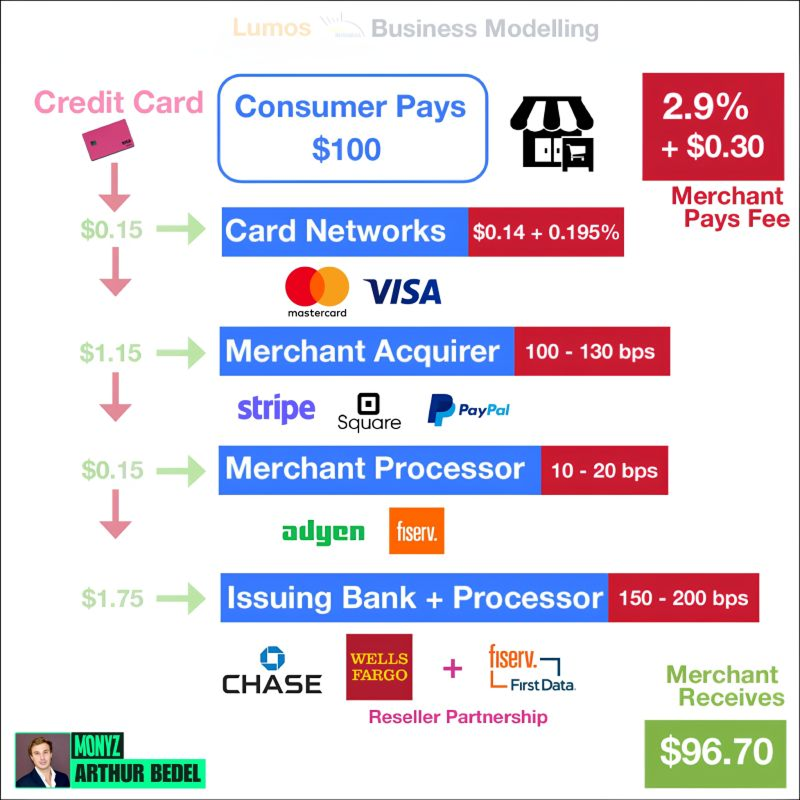
You spend $100. The merchant receives $96.70.
Here is exactly where the other $3.30 goes.
Card Networks → $0.15
Visa and Mastercard earn assessment fees and data processing fees on every transaction that clears their network. The more volume flows through, the more valuable the network becomes.
Rate: $0.14 + 0.195%
Merchant Acquirer → $1.15
Stripe, Square, PayPal process the transaction on behalf of the merchant. They handle authorization, settlement, fraud and risk.
Rate: 100 to 130 bps
Merchant Processor → $0.15
Adyen and Fiserv handle the technical routing and processing layer underneath the acquirer.
Rate: 10 to 20 bps
Issuing Bank → $1.75
Chase, Wells Fargo. The bank that issued your card takes the largest single cut. This is interchange. The more premium the card, the higher the interchange.
Rate: 150 to 200 bps
The merchant receives $96.70 out of $100.
Three things worth understanding:
→ The issuing bank captures the biggest share because it holds the consumer relationship and the credit risk.
→ Networks like Visa monetize pure scale. They take almost nothing per transaction but process trillions in volume.
→ PSPs like Stripe and Adyen are increasingly monetizing software and performance optimization on top of processing.
Source : LumosBusiness.
Trusted reach among senior decision-makers in FinTech, Payments & Banking.
👉 Explore Partnership here



Comments ()