

WEX and Mastercard want to unify fleet payments

Hey Payments Fanatic!
Fuel cards are only part of the fleet payments story now.
WEX and Mastercard are teaming up to launch Asia-Pacific’s first unified fleet payments network, covering everything from fuel and EV charging to tolls, parking, and maintenance.
Think about a business running a mix of petrol, diesel, and electric vehicles. There are different expenses to track, different ways to pay, and plenty of receipts to chase down. It can get messy fast.
WEX and Mastercard want to make that easier by bringing those payments together in one place, so businesses don’t have to juggle separate systems as their fleets change.
And there’s a lot at stake. Fleet-card transactions in Asia-Pacific were worth an estimated $310 billion in 2025 🤯
As more businesses add EVs to the mix, it makes sense that fleet payments are starting to catch up.
Here’s what else is happening in payments today👇
See you tomorrow!
Cheers,
INSIGHTS
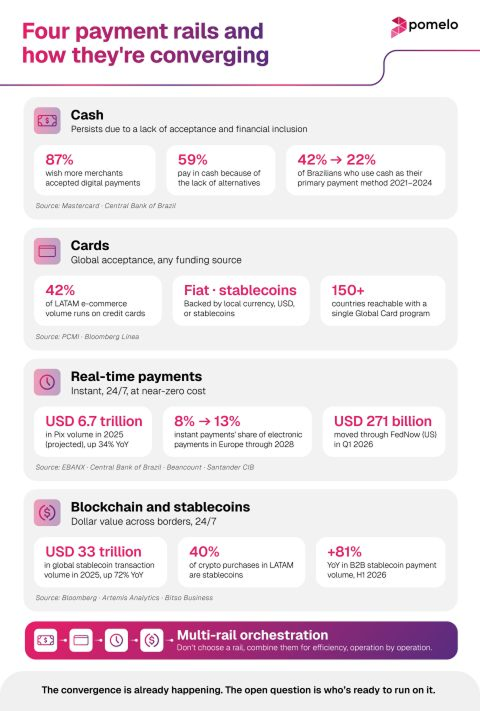
💡 Pomelo: What if cash, cards, real-time payments and stablecoins didn’t have to compete? Each solves a different problem, from everyday acceptance to instant transfers and cross-border payments. Pomelo CEO Gaston Irigoyen explores how these four rails could work together, with payments taking the route that makes the most sense based on cost, speed and geography. Explore how these payment rails are starting to converge
NEWS
🌏 WEX and Mastercard partner to launch Asia Pacific's first unified fleet payments network. The initiative aims to simplify fleet payment management across the region, helping businesses manage vehicle-related spending through a more integrated payment infrastructure.
🌐 Oobit lets AI assistants pay for users with crypto and stablecoins. Users connect their Oobit account to an assistant, tell it what to buy or book, and review the purchase. Once the amount is approved, the AI pays with a card issued for that purchase only.
🇺🇸 Moomoo launches real time deposits through Visa and Checkout.com, expanding how eligible users fund their investment accounts. New Apple Pay and Google Pay options let users fund accounts in real time, 24/7. Deposits can go toward stocks, cryptocurrencies, ETFs, options and event contracts.
🇬🇧 Klarna partners with The White Company, enabling shoppers at the British home and lifestyle retailer to spread the cost of homeware. Customers can now choose Pay in Full, Pay in 3 and Pay in 30 days at the online store.
🌐 BVNK adds native support for Plasma, a network designed for high frequency USDT transfers. Plasma removes the need to buy and hold a separate native token to pay transfer fees. Recipients receive stablecoin payouts in seconds with no network fee, and Plasma supports global payroll with platforms like Deel.
🇺🇸 Ramp reportedly raises $1.85 billion at a $60 billion valuation. The funding round was led by Dragoneer Investment Group and Thrive Capital, with participation from Founders Fund. The reported pre-money valuation marks an increase from $44 billion in June, when Ramp raised $750 million.
🇺🇸 Unit launches international payments to 190+ countries and territories. Companies can now offer customers payouts over the SWIFT network. Each payment starts with a quote that locks the rate and shows fees.
🇨🇳 Weixin Pay and WeChat Pay HK become payment options for Meta ads, giving eligible advertisers in mainland China and Hong Kong access to locally preferred payment methods. Boku powers the integration, with full rollout scheduled for Q4 2026.
🇧🇭 Taptap Send launches money transfer services in Bahrain, its second GCC market after the UAE. The launch follows a Payment Service Provider licence from the Central Bank of Bahrain. The platform lets users in more than 35 countries send money to recipients in over 90 destination markets.
🇳🇱 YeePay secures an EMI licence from the Dutch central bank, a core payment credential for entering the EU market. The Dutch licence works alongside its UK EMI licence to build a localised licensed service network across Europe. YeePay covers more than 200 countries and regions and supports over 100 currencies.
🇺🇸 BNY Mellon reportedly includes XRP in its corporate payments roadmap. The bank aims to help corporate treasuries move money around the clock through stablecoins and digital assets. BNY Mellon also serves as the primary reserve custodian for Ripple's RLUSD stablecoin.
🇩🇪 FC Bayern München extends its partnership with Adyen, which began in 2023. Cutting average stadium transaction time from 30 to 27 seconds lets the club process about 10% more kiosk transactions on match days. Online, fans can choose from over 250 payment methods in more than 200 countries.
🇦🇪 Paymentology and Huru expand their partnership, supporting the launch of Huru's card on Jaywan, the UAE's domestic card scheme. Huru handles AED 3B in annualised salary flows, with more than 24,000 employers using the platform to pay employees. It targets about one million Universal Accounts over the coming year.
🇹🇷 Payment orchestration platform Craftgate receives investment from Turkven, with the founding partners retaining a majority stake. Craftgate lets businesses reach local and international payment providers through a single integration. The company aims to reach more businesses in Turkey and accelerate product development.
GOLDEN NUGGET
A valid payment credential no longer proves a valid decision.
That's the problem agentic commerce has to solve 👇
AI agents are already learning to buy, return, replenish, and pay. For consumers, for businesses, and for machines settling with other machines.
And the projections are hard to ignore:
• $1T in US agentic retail by 2030 (ICSC x McKinsey)
• $15T+ in B2B spend running through agents by 2028 (Gartner)
So capability isn't the constraint. Trust is.
And trust here has a specific meaning: the ability to verify delegated authority. Proof that this agent, acting for this person or business, was cleared to take this action.
That authority attaches to the action, not the agent.
An agent can be legitimate, its credential valid, and its action still unauthorized.
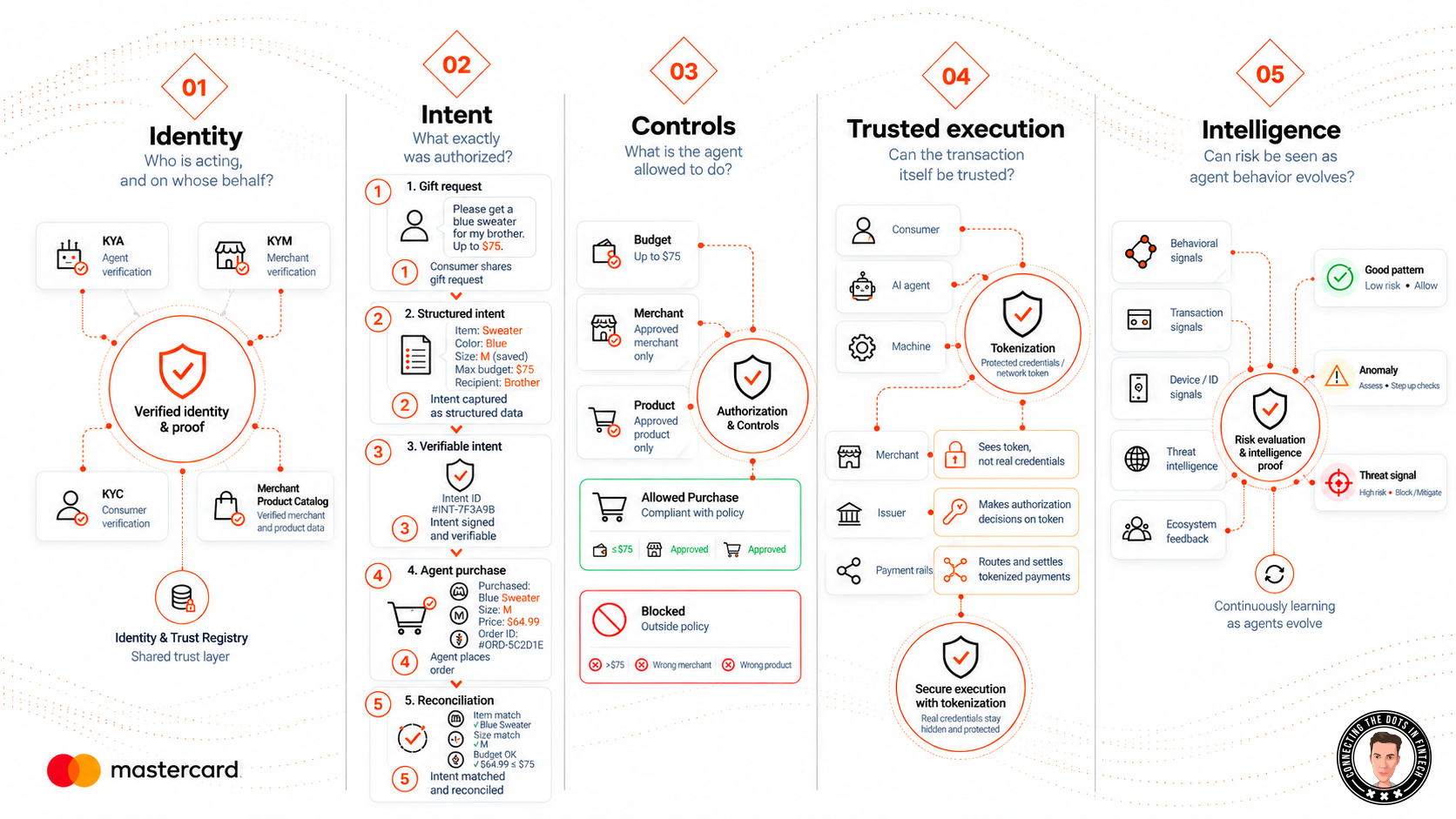
Mastercard just put a name to how they're solving it: the Agentic Trust Framework.
Five capabilities, each producing one proof the ecosystem can check 👇
1️⃣ Identity → who is acting, and on whose behalf?
KYA / KYM / KYC to separate real agents, merchants, and customers from bots and spoofs.
2️⃣ Intent → what exactly was authorized?
Verifiable Intent: cryptographic proof of the item, budget, and timing the user approved. Co-built with Google, contributed to the FIDO Alliance.
3️⃣ Controls → what is the agent allowed to do?
Budgets, categories, time windows, set before the agent acts.
4️⃣ Trusted execution → can the transaction itself be trusted?
Agent Pay plus tokenization, so real credentials are never exposed. On cards, account-to-account, or stablecoins.
5️⃣ Intelligence → can risk be seen as agents evolve?
Fraud models built for agentic behavior, scoring risk even for agents no one onboarded.
The key insight is simple:
Miss any one proof and the safe default is refusal. Merchants block good agents, issuers decline good transactions, and delegation stalls.
Get all five, and the answer stops being yes or no.
It becomes: approve, tighten the limits, send it back for confirmation, or decline.
Mastercard has spent six decades getting strangers who never met to transact with confidence.
Now they're extending that to agents acting on our behalf.
The agentic economy will only scale if trust scales with it.
That's what the five proofs are for.
Source Mastercard. Explore more
Trusted reach among senior decision-makers in FinTech, Payments & Banking.
👉 Explore Partnership here



Comments ()