

BRICS Wants Its Payment Rails to Talk to Each Other
Hey Payment Fanatic!
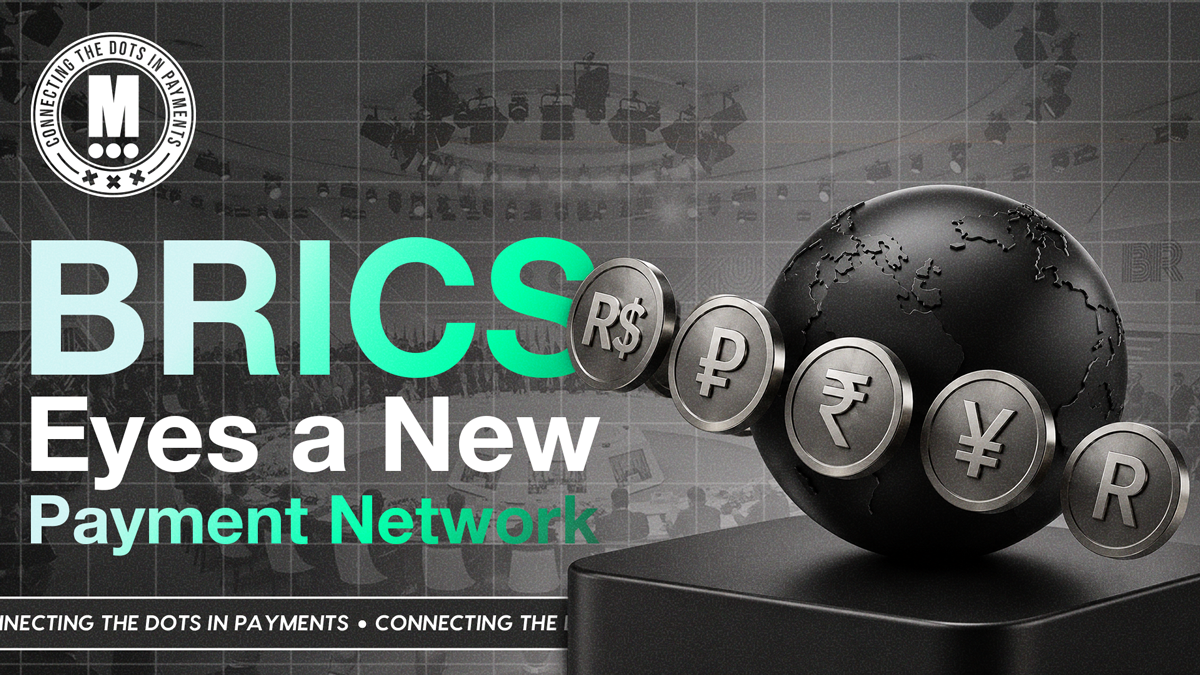
BRICS is looking at ways to make cross-border payments between its members work a little more like domestic payments.
The group is discussing whether national instant-payment systems — like India's UPI — could eventually connect with each other, while a separate proposal looks at interoperability between national CBDCs. Nothing has been agreed yet, but the direction is pretty clear: make cross-border payments faster without creating a single BRICS currency or giving up control over national systems.
The hard part, of course, is everything underneath. FX settlement, technical standards, data, AML and cybersecurity all have to work across countries that are at very different stages of digital-payment development.
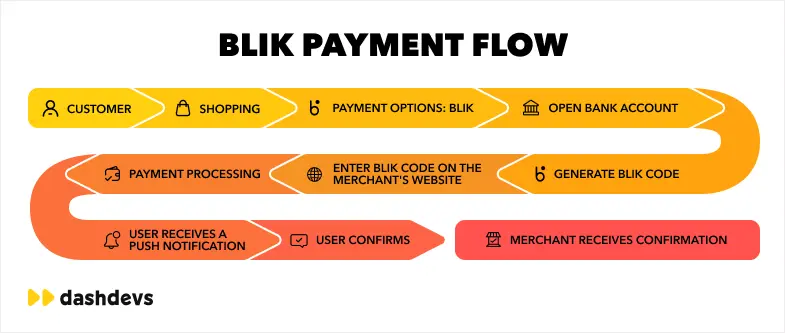
I also wanted to point you to a useful DashDevs guide on BLIK, Poland's bank-app payment network, and how merchants and fintechs can actually integrate it across e-commerce, POS, transfers and recurring payments.
Let's get into today's biggest Payments stories. 👇 See you tomorrow!
Cheers,
INSIGHTS
💡 DashDevs: Poland’s Bank-App Payment Network. BLIK is Poland’s leading bank-app-based payment method, covering e-commerce, POS, transfers, ATMs, and recurring payments. For merchants and fintechs, it offers strong local customer adoption and less reliance on international card rails. Most businesses integrate BLIK through a PSP or acquirer, making the key challenge not the API itself, but getting the right payment flow, reconciliation, and operations in place. Read the full article here
NEWS
🇺🇾 dLocal celebrated its spot among the World's Top FinTech Companies 2026, a ranking from Statista published by CNBC. The company's name appeared on the Nasdaq screen in recognition of its global payments infrastructure.
🇯🇵 PayPay reaches 75 million registered users in Japan, covering over half the population. Payment transactions hit 8.88 billion in 2025, a 19% increase YoY and over 20% of all domestic cashless payments.
🇫🇷 Ingenico secures $150 million in fresh capital to fund its next phase of growth. The payment terminal maker raised the new financing to accelerate its strategic development.
🇺🇸 Stripe clinches over $7 billion deal to buy AI firm OpenRouter, which helps developers switch between AI models. OpenRouter serves 8 million developers and raised at a $1.3 billion valuation just months ago.
🇺🇸 Western Union gets New York approval for its Intermax acquisition, but still faces regulatory hurdles in California. Continue reading
🇸🇬 Thunes expands Web3 infrastructure with EURC to enable instant euro treasury funding. The integration of Circle's MiCA-compliant stablecoin lets network members prefund transactions and manage treasury flows around the clock.
🇸🇬 Thunes to support Fiserv's real-time global payouts for platforms, connecting Fiserv clients to its cross-border payment network. The partnership enables platforms to send real-time payouts to recipients in over 130 countries.
🌍 BRICS members discuss linking instant payment systems and CBDCs to improve cross-border payments. Reserve Bank of India Governor Sanjay Malhotra said proposals remain at the discussion stage with no common infrastructure yet approved.
🇺🇸 oBook Holdings reports preliminary first-half 2026 revenue, disclosing its latest financial results to investors. The Nasdaq-listed company shared early revenue figures ahead of its formal half-year financial reporting.
🇧🇹 Binance Pay goes live across 3,700+ merchants in Bhutan, integrated with DK Bank's domestic QR network. The expansion builds on a 2025 tourism pilot and lets visitors pay with crypto by scanning existing QR codes.
🇺🇸 Expensify launches spend rules for its Visa Commercial Card, letting admins control where, when, and how each card is used. Rules cover merchant restrictions, single use limits, expiry dates, and currency controls across 14 countries.
🇰🇼 Central Bank of Kuwait tightens accounting and fraud reporting rules for electronic payment and exchange companies. The directives require proper classification of partners' funds and new procedures for handling judicial freezing requests.
🇦🇪 Commercial Bank of Dubai becomes the first UAE bank to launch multi-bank payment initiation, following CBUAE approval as a Third Party Provider. The feature lets customers initiate payments from other banks via the CBD app.
🇨🇳 China's central bank adds eight banks as digital yuan operators, including Ping An Bank, Bank of Shanghai, and Bank of Hangzhou. The expansion brings the total number of authorized operators to 30.
🌍 BEAC and ProgressSoft reach a new milestone in modernizing payment infrastructure across Central Africa. The collaboration advances the regional instant payment system to support faster, more reliable transactions for member states.
🌍 Afriex partners with Global Innovations Bank on cross-border payments, expanding settlement and regulatory coverage for its B2B Payments API. The collaboration provides businesses with access to global USD accounts across 35+ countries.
GOLDEN NUGGET
🚨 Visa, Stripe 𝐚𝐧𝐝 Adyen 𝐚𝐫𝐞 𝐭𝐚𝐤𝐢𝐧𝐠 𝐝𝐢𝐟𝐟𝐞𝐫𝐞𝐧𝐭 𝐩𝐚𝐭𝐡𝐬 𝐭𝐨 𝐭𝐡𝐞 𝐬𝐚𝐦𝐞 𝐝𝐞𝐬𝐭𝐢𝐧𝐚𝐭𝐢𝐨𝐧.👇 Created by Arthur Bedel 💳 ♻️
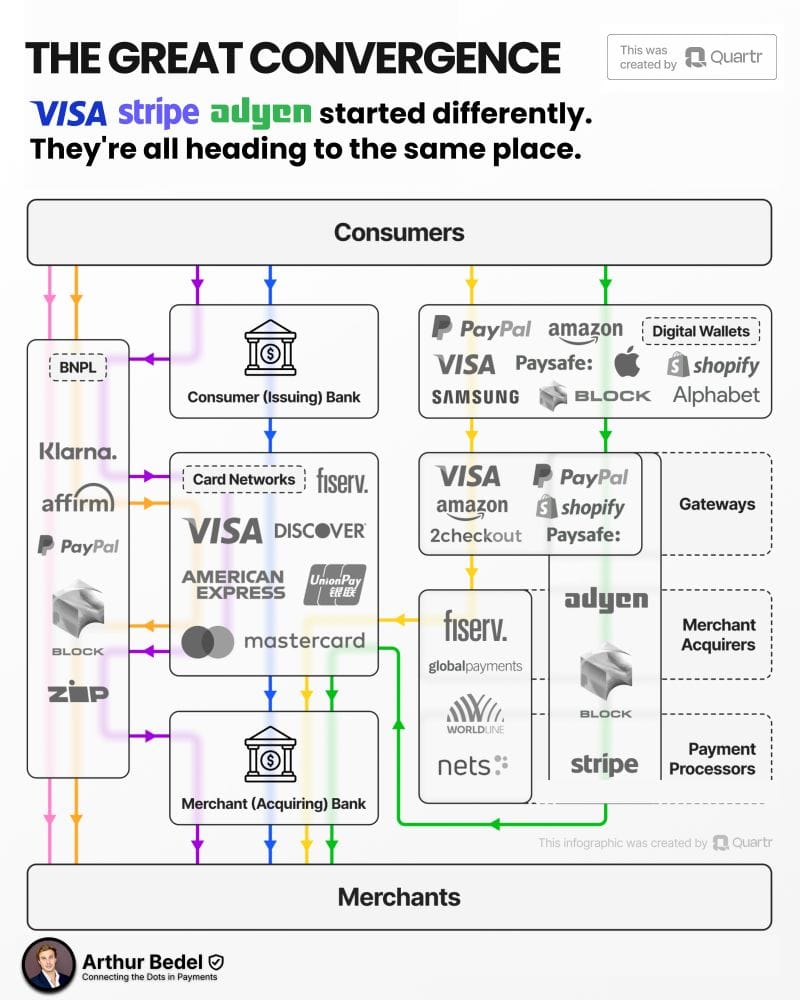
The payments value chain has five distinct layers ↓
→ Digital wallets: PayPal, Apple Pay, Google Pay, Amazon, Samsung Electronics, Block, Shopify.
→ Card networks: Visa, Mastercard, American Express, Discover, UnionPay set the rules and settle funds between issuer and acquirer.
→ Issuing banks: approve or decline every transaction.
→ Processors and acquirers: Stripe, Adyen, Fiserv, Worldline, Block — handle routing, settlement and fraud.
→ Gateways: Visa, PayPal, Amazon, Shopify — collect and securely forward payment credentials.
→ BNPL: Klarna, Affirm, Zip — operate alongside as an alternative to card flows.
Five years ago every company stayed in its lane. That is no longer true.
Visa is now in AI commerce, stablecoin settlement and tokenization.
Stripe is issuing cards and moving into banking. Adyen is layering financial products on top of its acquiring rails. PayPal appears in three layers of this chart simultaneously. Block appears in BNPL, wallets and payment processing.
Merchants no longer want a point solution. They want one partner for conversion, fraud, global reach and new payment methods. That demand is pulling every major player toward the same destination.
Source : Quartr
Trusted reach among senior decision-makers in FinTech, Payments & Banking.
👉 Explore Partnership here

Comments ()