

Fiserv Adds AI-Powered E-Commerce to Clover

Hey Payments Fanatic!
Clover made its name at the counter. Now Fiserv wants it to build the online store too.
Fiserv has added AI-based e-commerce tools to Clover for U.S. merchants with a limited online presence. The new Clover AI Website Builder lets them set up an online store with AI, synced with the inventory and payments already running through their Clover POS.
But there’s more to the story. Fiserv says the tools should also make merchants’ products easier to find, both in search and in AI-enabled shopping sessions.
That last part matters. Earlier this month, I wrote about Mastercard teaming up with OpenAI on agent payments. It’s still early days, but if more shopping starts with an AI assistant, small merchants will need to show up there too.
What stands out to me is where this starts. Plenty of small merchants never get round to building a proper website, let alone thinking about AI shopping. If the system that already runs their checkout and stock can do it for them, going online becomes one more step in a tool they already use.
For POS providers, that could become a strong way to grow alongside their merchants as they move online.
Will the POS become the way small merchants show up in AI shopping?
Here’s what else is happening in payments today👇
See you tomorrow!
Cheers,
INSIGHTS
💡 Pliant: Why Third-Party Agents Travel First Class on the Pliant Platform. Should businesses use the AI built into their payments platform, or bring their own agents such as Claude? In this analysis, Fabian Terner, CPO & Co-founder at Pliant, explains how the company approaches that choice. He splits its AI features into chat for ad hoc tasks, automations for recurring ones, and connectors that bring Pliant into third-party AI tools. He then sets out eight factors for deciding between them, from whether a task spans several tools to whether several people need to approve it. The key takeaway: Pliant says it will keep building its own Assistant and Agents while treating external agents as first-class citizens on its platform. Read the full analysis here

NEWS
🇧🇭 GPS, EazyPay and Mastercard launch prepaid card programme in Bahrain. GPS will provide card issuing and processing, tokenisation, fraud monitoring and 3D Secure for EazyPay's new Mastercard prepaid cards, running on Mastercard's network.
🇺🇸 Mastercard and Tidalwave bring open finance to mortgage lenders. Mastercard Open Finance is being integrated into Tidalwave's AI-native mortgage platform, letting lenders access borrower-consented financial data within origination workflows. No rollout timeline was given.
🇹🇭 Omise becomes a direct acquirer for Visa and Mastercard in Thailand. The payment gateway can now manage card acquiring and settlement itself. Acquiring-as-a-service, PayFac and orchestration services are planned as future offerings.
🇸🇬 Airwallex to invest more than S$2B in Singapore over five years. The company, which has opened an expanded co-headquarters at Guoco Tower, plans to grow its Singapore workforce from about 750 to more than 1,000 over the same period.
🇺🇸 Fiserv launches AI-powered eCommerce tools for Clover merchants. The new capabilities allow US small businesses to build online stores using AI, improve product visibility across search engines and AI shopping assistants, and manage inventory, orders and payments through one connected platform.
🇺🇸 SurveyMonkey selects Checkout. com as payment acquirer. Under the agreement, Checkout. com will process subscription payments for SurveyMonkey across the US, UK, Europe, Canada and Australia, using its payment orchestration capabilities, although a start date has yet to be announced.
🇪🇺 Duffel and Katanox combine hotel bookings, payments and financing. Travel sellers using Duffel's API will be able to pay hotels through Katanox's instant account-to-account payments, with automated reconciliation and payment advances from Katanox Capital.
🇺🇸 Coinflow and Bastion power US payouts for Samsung Wallet. Eligible users can move stablecoin balances out via push-to-card, RTP and ACH, with Bastion acting as the licensed stablecoin custodian.
🇪🇺 Revolut Pay becomes a payment option in the Uber app. Users in the UK and Europe can pay natively with Revolut Pay inside Uber and earn five times the usual Uber points until 6 January, while still collecting Revolut card rewards.
💡 Zilch Moves Closer to a Potential London IPO. The UK FinTech reported FY26 revenue of £147.5M (+36% YoY), with GMV reaching £2.4B (+28%) and its active customer base growing to 970,000. Momentum has continued into FY27, with annualised revenue run rate reaching $300M, ARR hitting £245M in October, and two consecutive quarters of adjusted profitability. CEO and Co-Founder Philip Belamant says the company is closer than ever to its stock market ambitions, with a London listing reportedly possible as early as 2027. Read the full update here

🇬🇧 OpenPayd reaches $107M in annual recurring revenue. Q2 FY27 revenue rose 44% YoY to $25.4M, while stablecoin orchestration revenue grew from $0.5M to $3.9M in the first half. OpenPayd serves more than 1,260 corporate clients.
🇺🇸 Visa adds Monad to its stablecoin settlement network. Participating issuers and acquirers can now settle through Monad. Visa's annualised stablecoin settlement run rate reached $20B in September, with more than 225 stablecoin-linked card programmes live.
🇩🇪 Crédit Agricole Deutschland selects Enfuce for Visa debit cards. Enfuce acts as issuer, BIN sponsor and processor for the newly launched retail bank, with Giesecke+Devrient supplying the physical cards.
🇩🇰 Clearhaus aims to double its customer base by 2027. The Danish payments firm is expanding its merchant network by processing payments for new retail locations and targeting more small and medium-sized businesses as it competes with Nets.
🇧🇷 Nova raises $24M Series A to link credit cards to Pix. Canaan led the round for the Brazilian FinTech, which lets consumers use existing credit cards for instant payments and bills such as rent and tuition, CEO Rafael Matos said.
🇺🇸 Imprint raises $130M at a $1.88B valuation. Ribbit Capital, Thrive Capital, Kleiner Perkins and Khosla joined new investor Positive Sum. The co-branded card company, which is adding a Fanatics card, expects about $400M in revenue this year.
🇨🇴 Palomma raises $14M for AI-driven rental payments in Latin America. Cometa led the round, with Y Combinator participating. The Colombian firm handles $130M in monthly rent payments and may expand to Mexico, Brazil and the US Hispanic market.
🇺🇸 Western Union terminates its agreement to acquire Intermex. Western Union cited California regulator conditions attached to its approval of the roughly $500M deal. Intermex rejects the termination and has reserved its rights, including seeking damages.
🇺🇸 Stripe completes acquisition of OpenRouter. The AI model marketplace, used by more than 10 million developers and businesses, officially joined Stripe following their August agreement. OpenRouter will retain its neutral approach to AI model routing, while the companies work to help businesses optimise token usage and costs.
GOLDEN NUGGET
Revolut is worth $115B. Yet its cards and transfers run on rails it doesn’t own.
And that’s by design.
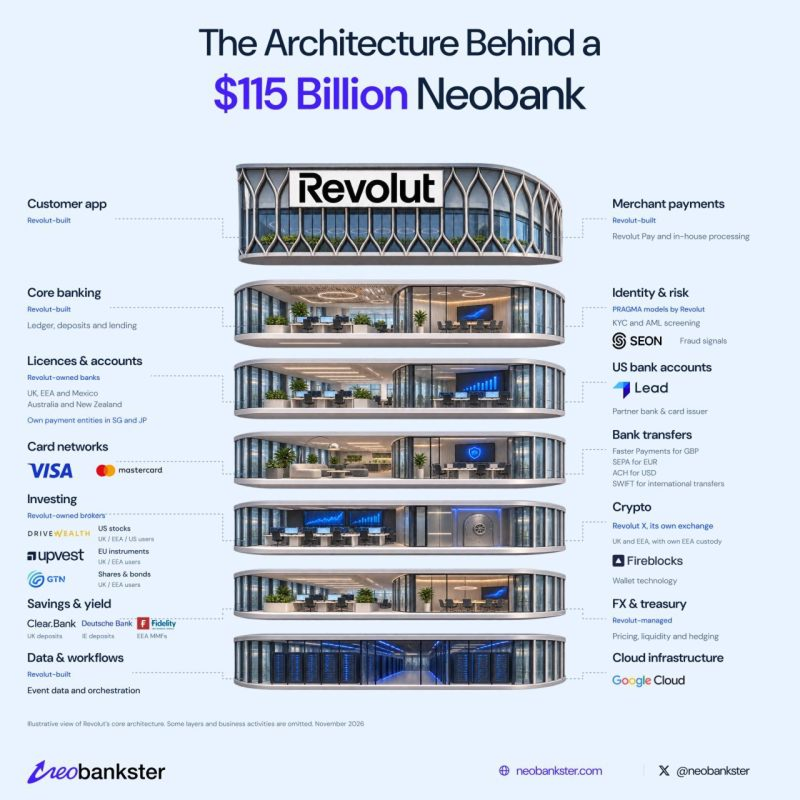
Revolut built only 6 of the 14 layers in its stack.
The payment layers show why.
Follow the money 👇
Tap your card → it travels over Visa or Mastercard
Send pounds → Faster Payments
Send euros → SEPA
Send dollars → ACH
Send anywhere else → SWIFT
Open a US account → the account and card come from Lead, a partner bank and card issuer
None of those rails is Revolut’s.
So what does it own?
Everything that wraps around the payment:
→ The app where the payment starts
→ The ledger that records it (core banking: deposits, lending)
→ FX and treasury: pricing, liquidity and hedging, all Revolut-managed
→ Risk: its own PRAGMA models and KYC/AML screening, with SEON adding fraud signals
On the merchant side, it goes further.
Revolut Pay and the processing behind it are built in-house.
The key insight is simple:
Rails are shared infrastructure. Everyone plugs into the same ones.
The edge sits in what’s around them: the experience, the ledger, the FX and the risk calls.
That’s how you serve 80M+ retail customers without building a single network.
Which payment layer would you never outsource?
Source: Gleb K. Learn more
Trusted reach among senior decision-makers in FinTech, Payments & Banking.
👉 Explore Partnership here


Comments ()