

Mastercard and Danske Bank Complete an AI-Powered Payment

Hey Payments Fanatic!
What happens when you ask an AI agent to book something — and it actually makes the payment for you?
Mastercard and Danske Bank have just tested exactly that in Denmark. A consumer asked an AI agent to book a coffee tasting through Priceless.com, and the agent completed both the booking and payment using a Danske Bank Mastercard.
The transaction ran through Mastercard Agent Pay, with PayOS handling the technical execution. The key part is that the consumer still stays in control: consent is explicit, the payment is authenticated with Mastercard Payment Passkeys, and the agent operates within those permissions.
It’s another step toward a world where AI doesn’t just recommend what to buy — it can actually complete the transaction.
And that makes the payment experience itself even more important. A new dLocal report, based on 1,358 consumers across seven markets, found that 93% are more likely to buy from a foreign brand when they can pay their preferred way, while 71% are unlikely to buy without local payment support.
So as AI starts making purchases on our behalf, the question isn’t only whether the agent can pay. Can it pay the way the customer expects?
Here’s what else is happening in payments today👇
See you tomorrow!
Cheers,
INSIGHTS
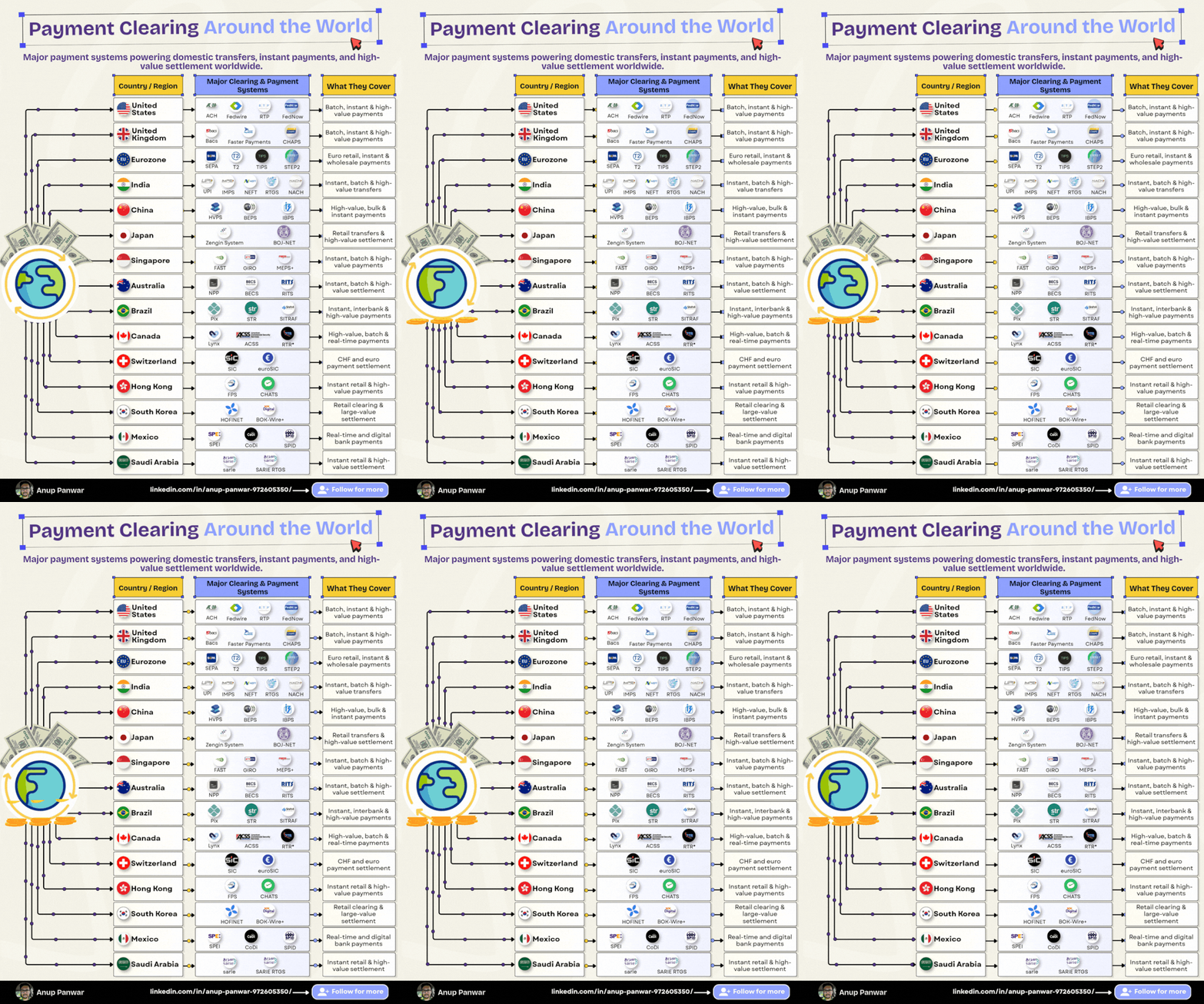
💡 The Global Payments Infrastructure Map. The payments world looks global, but underneath, it remains highly fragmented, with different rails, standards and systems across markets. This overview gives a good sense of the infrastructure sitting behind global payments and the many layers needed to connect them. As cross-border payments and stablecoins evolve, these connections will become increasingly important.
NEWS
🇩🇰 Danske Bank performs an AI agent transaction with Mastercard, becoming one of the first banks to test agentic commerce in a live banking environment. The trial demonstrates how AI agents can initiate and complete payments autonomously within an established bank's infrastructure.
🇦🇪 UPFRONT and Mastercard collaborate to expand digital payment solutions for SMEs. The partnership will integrate Mastercard commercial card capabilities into UPFRONT's platform, giving SMEs new ways to manage working capital and business expenses across MENA.
🇦🇪 Network International launches Network MAX, a new suite of business card solutions for UAE SMEs. Developed with Mastercard, the digital platform gives merchants instant access to settlement funds while offering cashback and tools to manage employee spending.
🇪🇺 The ECB launches Pontes to settle tokenized wholesale assets in central-bank money. The platform connects distributed-ledger technology to the Eurosystem's TARGET Services, offering an alternative to stablecoins for institutional settlement.
🇰🇷 Bank of Korea launches a 24-hour offshore won settlement network trial, aiming to lower barriers for foreign investors. The pilot program will enable round-the-clock settlement of won transactions outside traditional banking hours.
🇸🇦 Visa Direct ecosystem expands in Saudi Arabia, as demand for digital money movement accelerates. Card transaction volume on Visa Direct in the Kingdom grew over 50% YoY, with alrajhi bank, Alinma Bank and SAB among participating institutions.
🇬🇧 FMPay unveils a card acquiring and payout model for mid-sized digital businesses and B2B FinTechs. The FCA-authorized payment institution handles pay-ins and payouts across Visa, Mastercard and UnionPay without intermediaries.
🇸🇬 Convera and JustLogin partner to enable cross-border payroll across Southeast Asia. The integration lets JustLogin customers initiate payroll in up to 16 currencies from within the HR platform, while Convera handles payment execution.
🌍 Paymob secures $35M in a pre-Series C round, scaling its payments infrastructure and AI solutions across the Middle East and Africa. The raise expands Paymob's merchant acceptance network in a region where digital payments adoption is accelerating.
GOLDEN NUGGET
🚨 71% of shoppers in emerging markets won't buy from a site that doesn't accept their local payment method 🤯
In these markets, payments decide the sale. Not price. Not product.
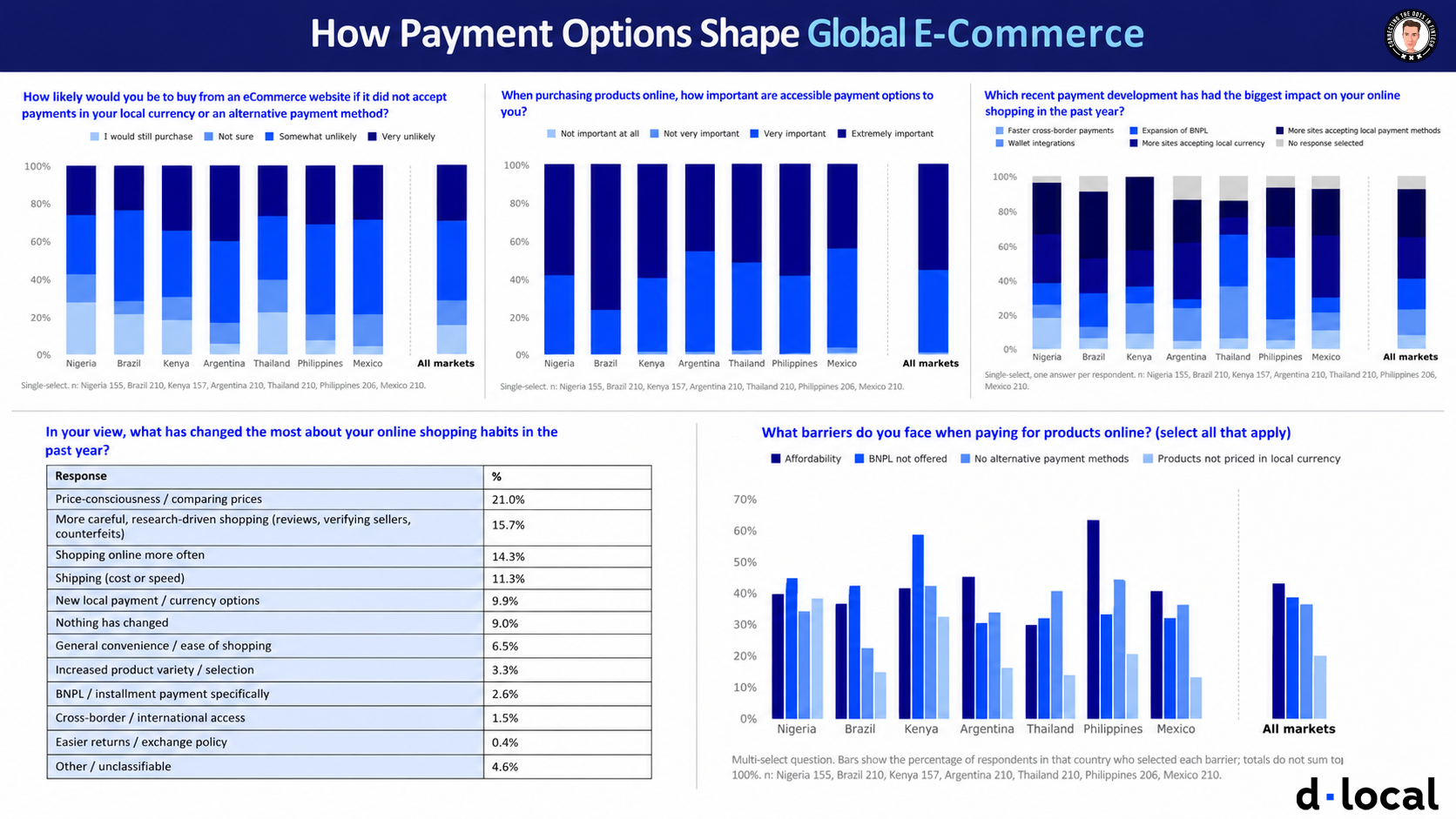
A new dLocal report (2026) surveyed 1,358 consumers across 7 markets: Mexico 🇲🇽, Argentina 🇦🇷, Brazil 🇧🇷, Thailand, the Philippines, Kenya, and Nigeria.
Here are the stats that stand out:
• 99% call accessible payment options important
• 93% more likely to buy from a foreign brand if they can pay their way
• 71% unlikely to buy without local payment support
• Only 15% would buy anyway
• 92% would switch brands for a better price or payment experience
The barriers people actually hit at checkout:
• Affordability — 43%
• BNPL not offered — 39%
• No alternative payment methods — 37%
• Products not priced in local currency — 20%
And the resistance isn't spread evenly.
Argentina 🇦🇷 is the most rigid market in the study: 82% won't buy without local payment support.
Nigeria and Kenya are the most willing to work around it, often through mobile wallets or crypto.
One number says it all:
Only 2% said nothing would change their likelihood of buying from a U.S. brand.
Which means 98% have a concrete, fixable reason they aren't buying more already.
The playbook isn't the same everywhere, though:
→ LATAM and Africa still need basic local currency and payment-method coverage
→ Thailand and the Philippines respond more to BNPL and wallet integrations
The willingness to buy is already there.
Whoever removes the payment friction first wins the customer.
Source: dLocal. Read the full piece
Trusted reach among senior decision-makers in FinTech, Payments & Banking.
👉 Explore Partnership here


Comments ()