

Mastercard and World Bank Group Put $500M Behind More Inclusive Payments

Hey Payments Fanatic!
Mastercard and the International Finance Corporation, part of the World Bank Group, are putting $500 million behind a new facility designed to help banks and fintechs in emerging markets access global payment infrastructure.
The facility will help financial institutions join Mastercard’s network while reducing some of the collateral and settlement-risk barriers that can make participation expensive. The initial focus is on Europe and Latin America.
The bigger point is simple: expanding digital payments isn’t only about reaching more consumers. The infrastructure and risk framework underneath those payments has to scale too.
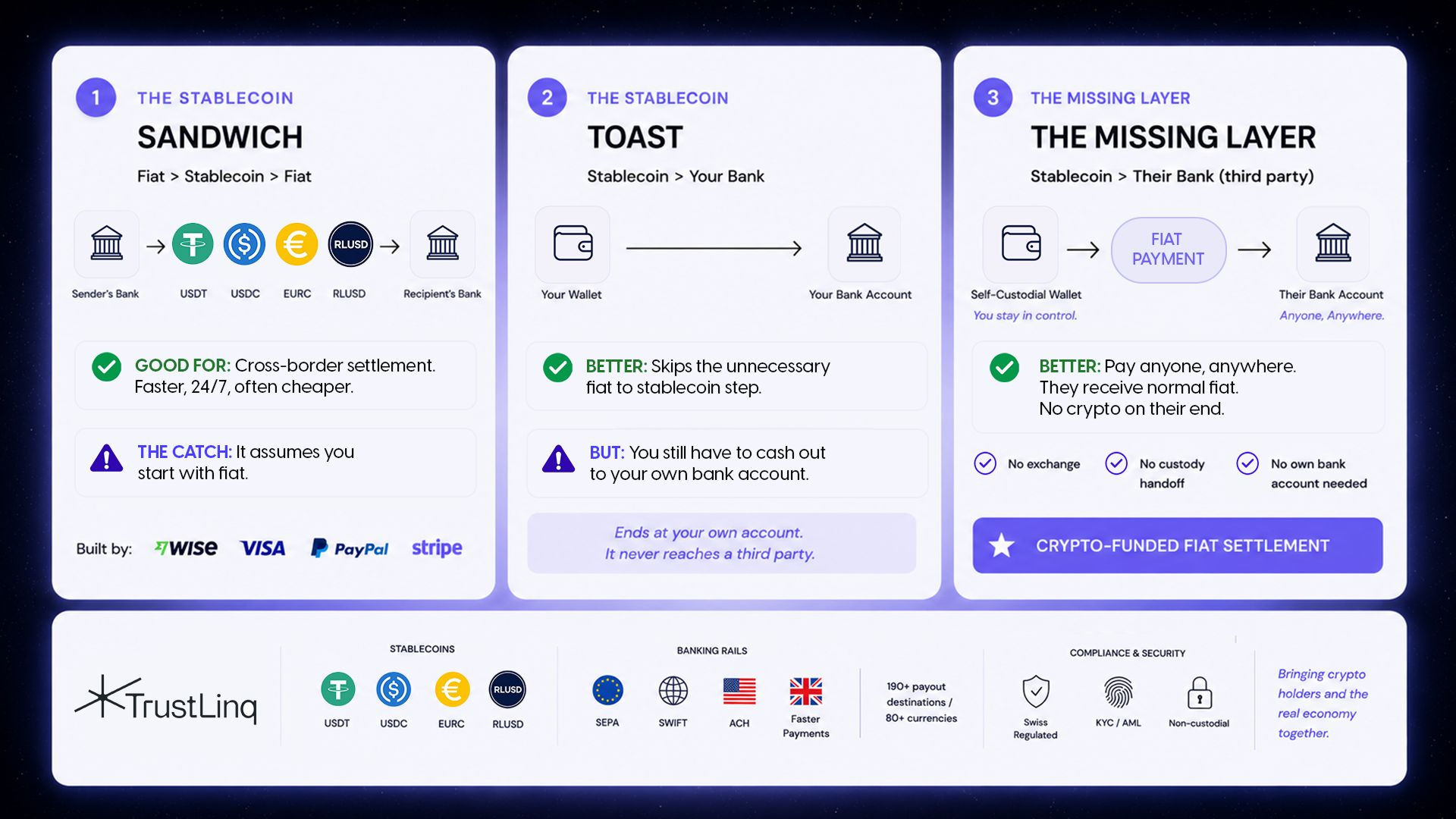
And as payment networks expand, stablecoins are creating another route for moving money across borders. TrustLinq’s “The Stablecoin Sandwich, Explained” looks at how fiat → stablecoin → fiat settlement works, and what changes when the money starts in a self-custodial wallet.
Let’s get into today’s Payments stories. 👇 See you tomorrow!
Cheers,
INSIGHTS
💡 TrustLinq: The Stablecoin Sandwich, Explained. Stablecoins can simplify cross-border payments by moving fiat → stablecoin → fiat on-chain, but the model breaks when money starts in a self-custodial wallet. TrustLinq explores crypto-funded fiat settlement, allowing stablecoin holders to pay third parties directly into their bank accounts without an exchange, custody handoff, or intermediate account — potentially becoming increasingly important as more wealth and payments move on-chain. Read the full article here
NEWS
🌎 Mastercard and World Bank Group launch a $500 million global risk facility to expand financial access in emerging markets. The settlement exposure facility, built with IFC, aims to help banks and fintechs connect to the Mastercard network with reduced collateral requirements, with an initial focus on Europe and Latin America.
🇦🇪 noon payments enables Jaywan acceptance through Mastercard Gateway, expanding the UAE's domestic card scheme across digital commerce. The capability is delivered via Mastercard Merchant Cloud, letting merchants support Jaywan alongside international payment methods through a single scalable gateway.
🇬🇭 dLocal receives Enhanced Payment Service Provider licence from the Bank of Ghana, enabling direct local operations. The licence allows dLocal to connect directly to mobile money networks and bank accounts, collect payments locally, onboard merchants, and process inbound remittances without routing through intermediaries.
🇺🇸 Checkout.com goes live with US direct acquiring, launching operations under its MALPB charter in Georgia. The charter gives the company direct access to card networks and greater control across the payment lifecycle.
🇵🇱 First pilot BLIK transaction completed independently by an AI agent, marking a new milestone for autonomous payments. The agent monitored product availability, made a purchase, and paid PLN 19.99 using BLIK, all based on prior user instructions and banking app approval. Juo enabled the AI agent chat while PayU processed the payment.
🇪🇺 ECB and Brazil explore a cross-border link between TIPS and Pix, testing interoperability between the two instant payment systems. The initiative aims to enable faster and cheaper cross-border transfers between Europe and Brazil by connecting their real-time payment infrastructures.
🇸🇬 Visa unveils its Singapore Security Roadmap 2026 and Beyond, outlining six strategic priorities for the digital payments ecosystem. The roadmap covers cybersecurity, authentication, tokenisation, and eCommerce checkout improvements for the AI era.
🇮🇳 Adyen plans to expand its India operations, identifying the market as a long-term growth opportunity. Its local workforce has grown tenfold since 2023 to 120 employees. The fintech is also adapting its offering to India’s UPI and data-localisation requirements.
🇸🇬 Gemini secures an MPI licence from the Monetary Authority of Singapore, covering cross-border money transfers and digital payment token services. The licence allows Gemini to expand crypto and payments operations in Singapore.
🇳🇱 MoonPay obtains an Electronic Money Institution licence from the Dutch Central Bank, enabling custodial payment flows and stablecoin issuance. MoonPay becomes the first Netherlands-based company to combine MiCA CASP authorisation, EMI licence, and open-loop stablecoin capabilities.
🇺🇸 U.S. Bank completes a live cross-border payment using its USBDC stablecoin on the Stellar blockchain. The Minneapolis-based lender is exploring USBDC for cross-border treasury operations, liquidity management, and collateral, with no commercial rollout timeline announced.
🌍 TerraPay connects its wallet interoperability network Xend to Alipay+, enabling cross-border QR payments for digital wallets. In the initial phase, 15 African wallets gain access to over 150 million merchants in Alipay+'s global ecosystem.
🇮🇪 Bank of Ireland agrees a new strategic partnership with Stripe, expanding an existing relationship to accelerate payments innovation and AI integration. Stripe's technology already underpins Davy's payments reconciliation, processing over €2 billion since 2021.
🇨🇭 Avolta launches a direct wallet-to-wallet stablecoin payments pilot at its Zurich Airport duty free store. From September 2 to 25, travelers can pay via QR code with transactions settled directly on blockchain without card networks or intermediary payment providers.
🇪🇺 HiPay becomes a principal member of the European Payments Initiative, strengthening its multi-local expertise for merchants. The French FinTech will integrate Wero, EPI's pan-European payment method, building on its existing A2A and wallet payment deployments across Portugal, Italy, Belgium, and Spain. Read more
🇮🇳 Paytm bets on workplace AI agents in a pivot beyond payments, launching a new service called Paytm Intelligence (Pi). Pi deploys AI agents across sales, customer service, and operations to target enterprise customers seeking automated workloads.
🇮🇳 BharatPe launches Agentic AI and Credit Coach to support its merchant network. The tools aim to provide smarter financial guidance and merchant assistance. The products were unveiled at Global Fintech Fest 2026.
🇮🇳 PayGlocal launches Flash, an express checkout solution for cross-border commerce. Customers can reuse verified details across participating merchants. The product aims to make international payments faster and easier.
🇺🇸 IXOPAY rolls out an Agentic Suite for merchants preparing for agentic commerce, covering protocol-agnostic connectivity, token-based transaction context, and a governed MCP Server. The suite includes Payment Agent, Universal Tokens, and an MCP Server that gives approved AI assistants secure access to payment and tokenization capabilities without exposing credentials or expanding existing permissions.
🇮🇳 PhonePe and Visa launch three new cardless payment solutions, including Tap to Pay, Cross Border Scan to Pay, and Smart Accept. PhonePe becomes the first Indian app to offer Visa Cross Border Scan to Pay across 14 international markets.
🇬🇧 MADFIN partners with Tribe Payments for processing and 3D Secure capabilities. Tribe will provide transaction processing, fraud prevention and scheme compliance. The partnership supports MADFIN’s expansion as a card acquirer.
🇺🇸 Ramp is reportedly raising $1B at a $60B valuation, up sharply from its previous $44B valuation. The funding would reportedly be primarily new capital. Ramp has raised around $3B in equity to date.
🇺🇸 Latitude raises $35 million in a Series A to scale its stablecoin-to-local-payments infrastructure. Oak HC/FT led the round with participation from NEA, Coinbase, and Lightspeed Faction, following an earlier $8 million seed round. The company helps neobanks, payroll platforms, and marketplaces convert stablecoins into local currency across emerging markets.
🇲🇽 BBVA names Raimundo Sala as new CEO of Openpay for Latin America, aiming to accelerate its omnichannel payments strategy. Sala brings over 20 years of experience at firms including PayPal, PagoNxt/Getnet, and EVO Payments.
GOLDEN NUGGET
🤔 How does a Mastercard Merchant Presented QR (MPQR) payment actually work?
Here's the full flow, step by step:
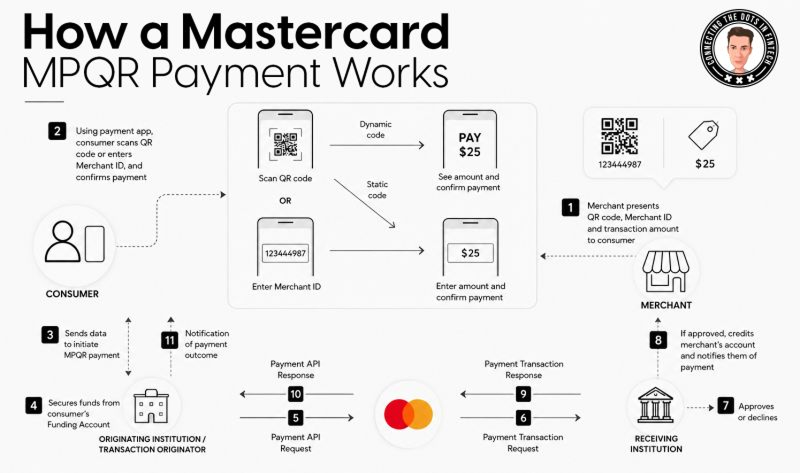
MPQR lets a merchant take payments without a card terminal or a heavy POS setup. All they need is a QR code or a Merchant ID.
𝗧𝗵𝗲 𝗳𝗹𝗼𝘄:
1️⃣ The merchant shows a QR code or shares their Merchant ID.
2️⃣ The consumer scans the QR code (or types the ID), sees the amount, and confirms.
3️⃣ The transaction runs across Mastercard's rails: validation, fund authorization, and final approval.
4️⃣ If approved, the funds move, and both sides get notified. In seconds.
𝗪𝗵𝘆 𝘁𝗵𝗶𝘀 𝗺𝗮𝘁𝘁𝗲𝗿𝘀:
► No terminal, no hardware cost for the merchant
► A real entry point for small and informal merchants
► A strong fit for financial inclusion in emerging markets
Now think about where this goes next.
MPQR + biometric authentication.
MPQR + programmable payments.
MPQR + real-time analytics.
At that point, every smartphone becomes the POS.
The key insight is simple:
The terminal was always the barrier. QR takes it away.
Source: Mastercard
Trusted reach among senior decision-makers in FinTech, Payments & Banking.
👉 Explore Partnership here




Comments ()