

Paddle Powers Lovable’s Payments
Hey Payments Fanatic!
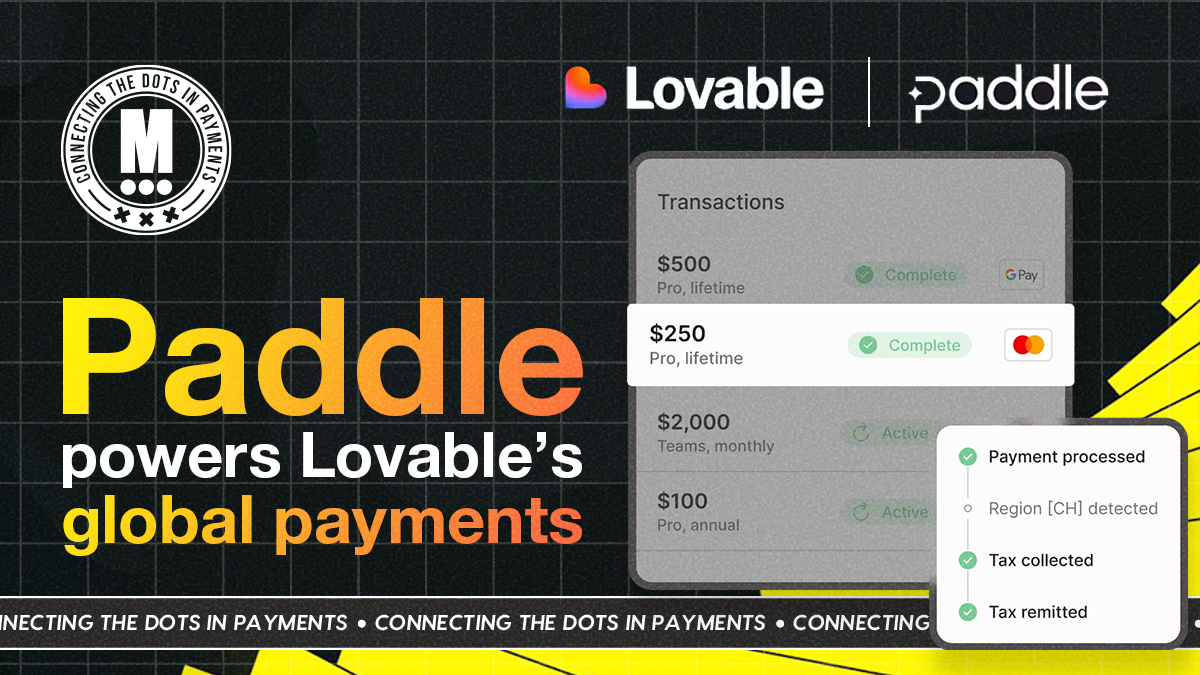
Lovable just launched Lovable Payments, powered by Paddle, a game-changing feature that lets vibe coders monetize AI-built apps instantly through natural language prompts.
Paddle is embedded directly into the Lovable experience, with the agent helping handle account creation, product setup, checkout configuration, and billing logic as part of the build process. No more need to manually configure a payments stack, since builders can go from prompt to payments with this integration.
Lovable has solidified its status as a pioneer in the vibe coding arena, where users describe app ideas in chat to generate full-stack prototypes, frontends, backends, and deployments without traditional code.
One thing to highlight is that this is the first native Merchant of Record integration inside an AI development platform.
Now, you might be asking how this is different from using a PSP.
Well, a PSP typically handles payment processing only. If you use one directly, you’re responsible for tax registration, compliance in each market, subscription billing logic, and managing fraud or chargebacks.
Using a Merchant of Record provider like Paddle brings these responsibilities together into one system.
Track the latest shifts across the payments landscape below. 👇
Cheers,
INSIGHTS
📰 Making payments a profit centre with Ecommpay. In this whitepaper, Ecommpay highlights how payments can evolve from a cost centre into a profit driver, showing that smarter strategies, like improving authorisation rates, reducing false positives, and optimizing fees, can unlock significant savings and performance gains across the business. Download the new expanded edition here
Making Payment a Profit Centre
NEWS
🇬🇧 Lovable Payments, powered by Paddle. Paddle has built the first native Merchant of Record integration inside Lovable, embedding payments directly into the AI development workflow so developers can go from prompt to monetization without manual setup. By handling billing, taxes, compliance, and transactions end-to-end, Paddle removes the need for complex payment infrastructure and enables builders to launch and start earning much faster.
🌍 dLocal and National Exchange partner to power remittance payouts across Africa, APAC, and Latin America. Through this partnership, dLocal connects National Exchange to local payment infrastructure across 18 markets through a single integration, removing the need to manage multiple local providers or entities.
🌍 Nedbank and MasterCard link up for SADC payments. The deal spans SA, Zimbabwe, Namibia, Eswatini, Lesotho, and Mozambique, and aims to bring enhanced digital payment experiences to retail banking, small businesses, and merchant services.
🌍 MoneyGram partners with NALA to enable payouts across Africa and Asia using stablecoin settlements via NALA’s Rafiki infrastructure, improving speed and efficiency in cross-border payments. Continue reading
🇦🇪 Adyen and Careem Pay partner to power digital remittances in the UAE. Through this partnership, Adyen will deliver an integrated payments infrastructure designed to enhance the performance, trust, and resilience of Careem Pay’s offerings and support its sustainable, long-term growth.
🇧🇭 Stc pay partners with GPS to power the next generation of digital payments in Bahrain. The partnership enables stc pay to enhance its card and digital payment services by leveraging GPS’s 20+ years of payment processing expertise. It will strengthen the reliability, scalability, and security of stc pay’s ecosystem, specifically supporting cards and digital payment transactions.
🇬🇧 FinTech SumUp lines up banks for possible London IPO, with banks including Deutsche Bank, Goldman Sachs, Jefferies Financial Group, and JPMorgan Chase, though key details remain undecided; the move could boost London’s IPO market and reflects a broader trend of European listings despite recent volatility.
🇬🇧 Zeller launches in the UK to fight for fairer fees against FinTechs and legacy banks. Zeller Terminal is set to redefine market expectations around payment hardware, software, and affordability. UK merchants will save up to 35% annually on processing fees by switching to Zeller, equating to up to £5.2B annually across the market.
🇮🇹 Satispay adds dedicated business insurance coverage via REVO partnership. This move aims to make it easier for small and medium-sized businesses to comply with the new requirement introduced by the 2024 Budget Law, offering a simple and immediate solution.
🇻🇳 Grab expanded to the payment market in Vietnam in 2027. Grab introduced 13 new AI-powered features to enhance its superapp, including the Tap to Pay feature. This B2B solution enables merchants to turn smartphones into contactless POS terminals using NFC.
🇱🇰 Alipay+ teams with LankaPay to push LankaQR payments. These incentives are expected to increase tourist spending within Sri Lanka, according to a press release by Ant International. It is also expected to encourage micro and small merchants to adopt cross-border QR payment acceptance via LankaQR.
🇸🇪 SolvaPay raises €2.4M to build payment infrastructure for agentic commerce. The investment will support the scaling of SolvaPay’s payment infrastructure platform, enabling businesses to participate in the emerging agentic economy where AI agents transact autonomously.
🇰🇪 Cellulant hires ex-Xapo Bank executive Anthony Hernandez as COO. Hernandez will oversee onboarding, transaction processing, and customer growth, with a focus on reducing failures and improving how payments are tracked across markets. He brings more than 25 years of experience across financial services and FinTech.
🇲🇾 AmBank enables Apple Pay for debit cardholders on PayNet Network. The move allows eligible domestic debit payments made through Apple Pay to remain on Malaysia’s local payment rails. PayNet operates the national MyDebit network. Read more
GOLDEN NUGGET
🚨 𝐇𝐨𝐰 𝐑𝐞𝐚𝐥-𝐓𝐢𝐦𝐞 𝐏𝐚𝐲𝐦𝐞𝐧𝐭𝐬 𝐂𝐡𝐚𝐧𝐠𝐞𝐝 𝐅𝐫𝐚𝐮𝐝 — 𝐚𝐧𝐝 𝐰𝐡𝐚𝐭 𝐭𝐡𝐞 𝐔𝐒 𝐡𝐚𝐬𝐧'𝐭 𝐥𝐞𝐚𝐫𝐧𝐞𝐝 𝐲𝐞𝐭 👇 Created by Arthur Bedel 💳 ♻️
Brazil ran this experiment first.
The US is about to repeat it.
👇
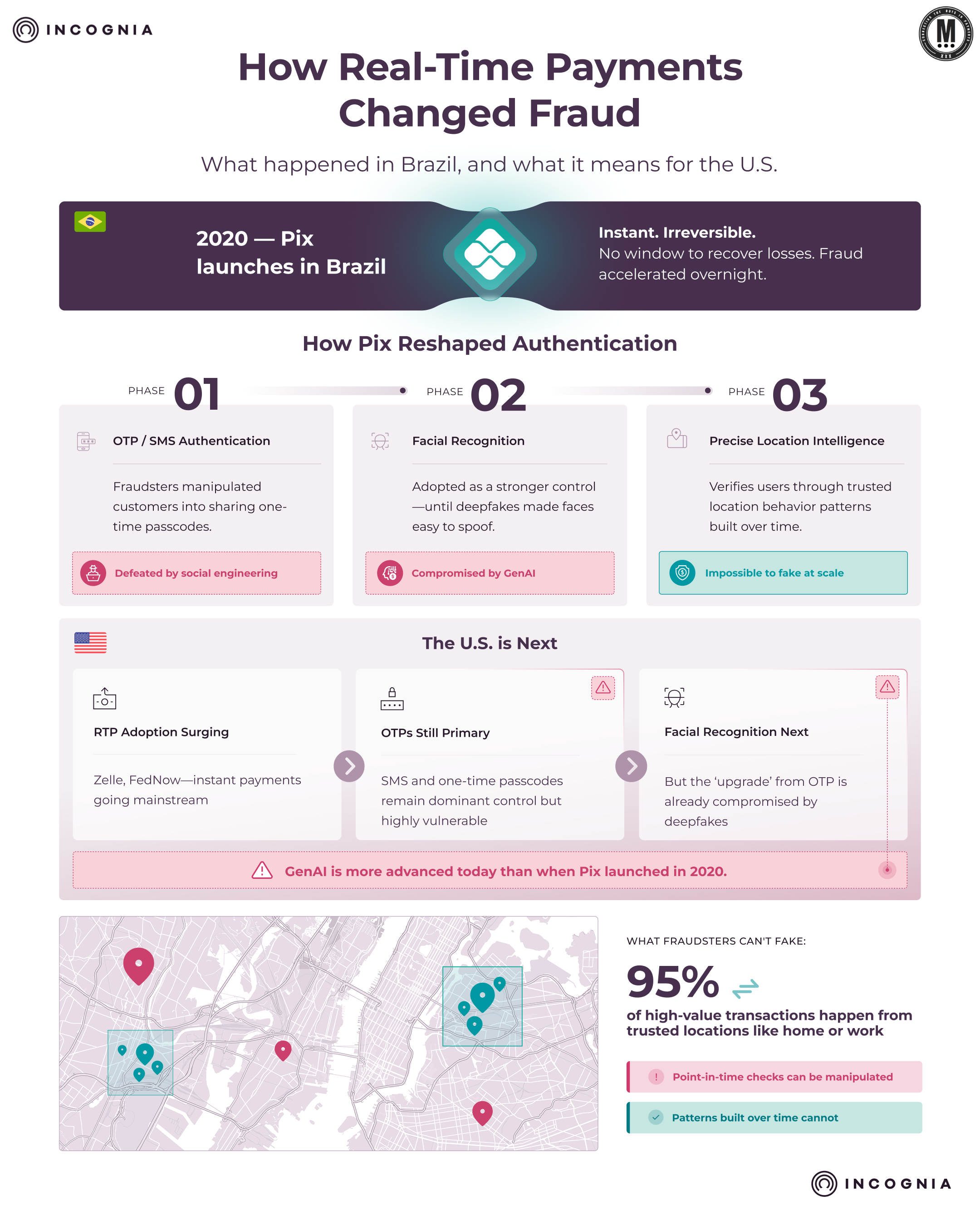
𝟐𝟎𝟐𝟎: 𝐏𝐢𝐱 𝐥𝐚𝐮𝐧𝐜𝐡𝐞𝐬 𝐢𝐧 𝐁𝐫𝐚𝐳𝐢𝐥
Instant. Irreversible. No window to recover losses.
Within a year, Pix volume eclipsed card payments in Brazil — 29 billion transactions by 2022.
Fraud accelerated overnight.
And what followed was a masterclass in how fast authentication breaks down.
👇
𝐓𝐡𝐫𝐞𝐞 𝐩𝐡𝐚𝐬𝐞𝐬. 𝐓𝐡𝐫𝐞𝐞 𝐟𝐚𝐢𝐥𝐮𝐫𝐞𝐬.
𝐏𝐡𝐚𝐬𝐞 1 — 𝐎𝐓𝐏 / 𝐒𝐌𝐒 𝐀𝐮𝐭𝐡𝐞𝐧𝐭𝐢𝐜𝐚𝐭𝐢𝐨𝐧
→ Fraudsters simply social-engineered customers into sharing codes.
→ Defeated almost immediately.
𝐏𝐡𝐚𝐬𝐞 2 — 𝐅𝐚𝐜𝐢𝐚𝐥 𝐑𝐞𝐜𝐨𝐠𝐧𝐢𝐭𝐢𝐨𝐧
→ Adopted as a stronger control.
→ Then GenAI made faces trivial to spoof.
→ Compromised before it scaled.
𝐏𝐡𝐚𝐬𝐞 3 — 𝐏𝐫𝐞𝐜𝐢𝐬𝐞 𝐋𝐨𝐜𝐚𝐭𝐢𝐨𝐧 𝐈𝐧𝐭𝐞𝐥𝐥𝐢𝐠𝐞𝐧𝐜𝐞
→ Verifies users through trusted location behavior built over time.
→ Impossible to fake at scale.
→ 95% of high-value transactions happen from trusted locations like home or work.
The key insight: point-in-time checks can be manipulated. Patterns built over time cannot.
👇
𝐍𝐨𝐰 𝐥𝐨𝐨𝐤 𝐚𝐭 𝐭𝐡𝐞 𝐔𝐒.
→ Zelle® and FedNow are going mainstream
→ OTPs are still the primary control — highly vulnerable
→ Facial recognition is the "upgrade" being considered — already compromised by deepfakes
The US is starting where Brazil started.
With one critical difference: GenAI is far more advanced today than it was when Pix launched in 2020.
The attack surface is bigger. The tools are sharper. The window to act is smaller.
👇
85% of US payment professionals expect fraud to increase as instant payments scale.
Yet most institutions are still deploying controls that Brazil already proved don't work.
𝐓𝐡𝐞 𝐥𝐞𝐬𝐬𝐨𝐧 𝐟𝐫𝐨𝐦 𝐏𝐢𝐱 𝐢𝐬 𝐜𝐥𝐞𝐚𝐫: the only signal fraudsters can't fake is where you actually live, work, and spend — consistently, over time.
What is the US waiting for?
Source: Incognia, André Ferraz
Want your message in front of 100.000+ FinTech fanatics, founders, investors, and operators?
Shoot me a message on LinkedIn or send me an e-mail.


Comments ()