

Zelle Picks Solana for ZelleUSD and Shows a Private $1.25M Transfer

Hey Payments Fanatic!
Last week, I wrote about the banks’ joint stablecoin venture, which reportedly has a $270M budget. Now Zelle, the bank-owned payments network, is showing what its own stablecoin can do.
At Solana’s Breakpoint conference, Zelle demonstrated a $1.25M confidential transfer in ZelleUSD on stage.
One bank received ZelleUSD, switched its balance to confidential and sent it to a second bank, which decrypted it. The amounts stay private, while the transfer can still be verified.
An important detail: the demo ran on Solana’s test network, with test tokens. So this was a showcase, not a live payment.
Zelle unveiled ZelleUSD in June, together with its plan to take Zelle international, starting with remittances from the US to India by the end of this year. Solana is the chain it has picked for that push.
What stands out to me is the privacy part. When banks move money on a public blockchain, anyone can see the amounts. For a bank, that’s a very practical problem, and this is exactly what Zelle chose to show on stage.
And this isn’t a small crypto startup testing the waters. Zelle processed more than $1.2T in payments last year.
So here’s my question: would your bank settle with other banks on a public blockchain if the amounts stayed private?
Here’s what else is happening in payments today👇
See you tomorrow!
Cheers,
INSIGHTS
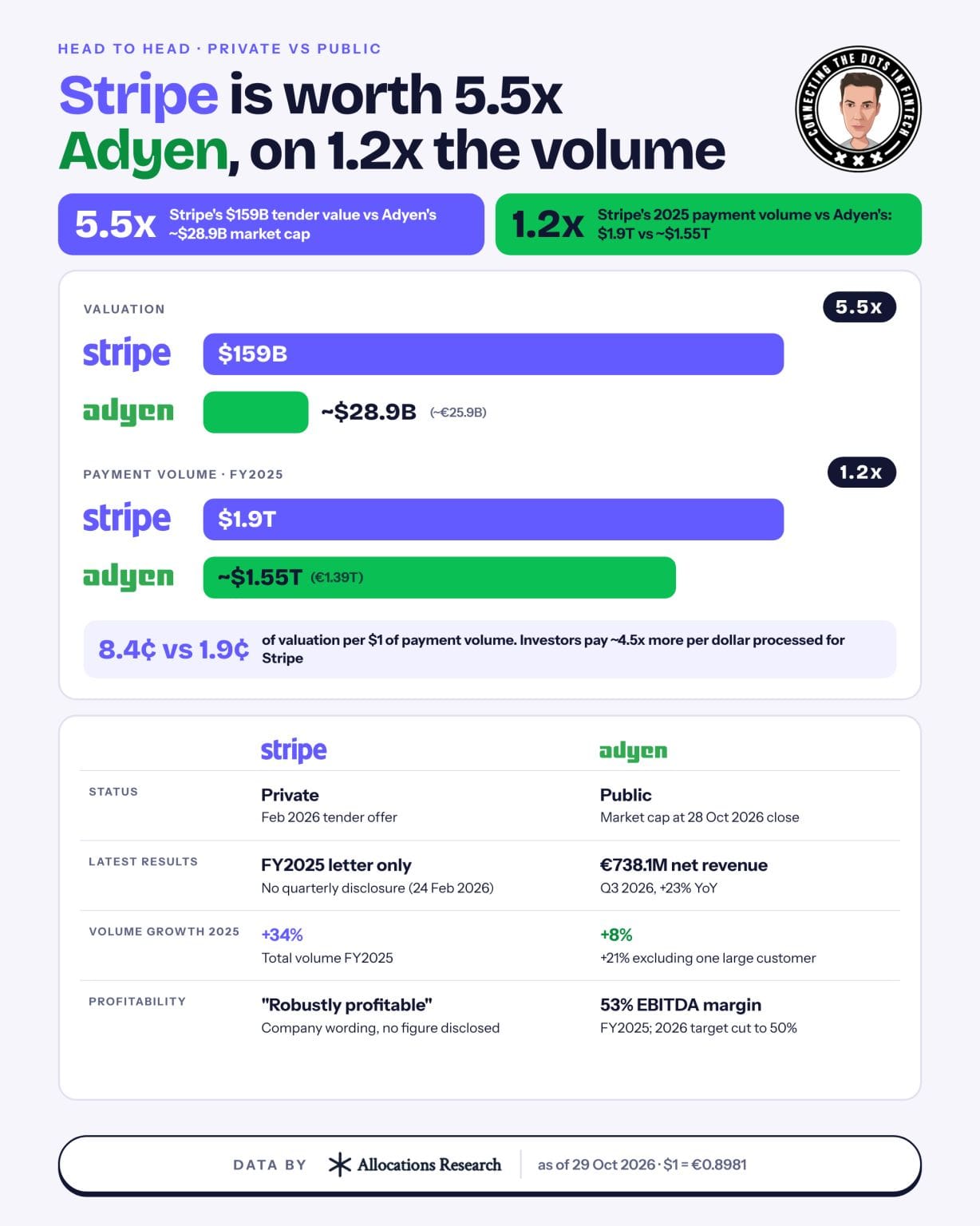
💡 Stripe vs. Adyen: A $159B Valuation vs. $29B — Is the Gap Justified? Stripe’s latest private valuation is roughly 5.5 times Adyen’s market value, despite processing only around 1.2 times its payment volume. The comparison highlights two very different market positions: Stripe’s valuation rose approximately 74% in the year to February, while Adyen trades at around 21x last year’s EBITDA and reported 30% payment volume growth in Q3. Adyen has lowered its 2026 margin outlook as it continues investing, while Stripe says it remains robustly profitable without disclosing detailed figures. The analysis explores whether the valuation gap reflects differences in growth, profitability, investment strategy or simply how private and public markets price these businesses. Read the full comparison here
NEWS
🌏 Mambu and Mastercard bring cross-border payments to banks in Asia Pacific. Mambu will offer a pre-built connection between Mastercard Move and its cloud core banking platform, so banks can serve SME and retail customers in more than 200 countries and territories. It extends a partnership launched in September.
🇯🇴 Mastercard and Bank of Jordan partner on digital payments in Jordan, Palestine and Iraq. Mastercard becomes the bank's sole provider across all types of cards, including World Elite cards. Bank of Jordan will also use Mastercard's fraud and risk tools and its payment solutions for SMEs and corporates.
🇦🇷 Pomelo appoints former Naranja X CFO Martín Zanella as its CFO. Zanella previously worked on dLocal's Nasdaq IPO and will oversee accounting, treasury, financial planning, tax and investor relations at the card-issuing and processing infrastructure provider.
🇺🇸 Zelle demos a $1.25M confidential ZelleUSD transfer on Solana. Shown on devnet at Solana Breakpoint, the transfer hid the amount on-chain while staying verifiable. Zelle also confirmed ZelleUSD will run on Solana for international P2P payments, starting with the US–India corridor.
🇧🇹 Thunes extends real-time payouts to Bhutan. Through its Direct Global Network, Thunes now offers 24/7 payouts in ngultrum to all licensed bank accounts in the country. More than 70,000 Bhutanese live abroad, and remittances grew 69% between 2024 and 2025.
🇰🇭 Cambodia explores linking Bakong with Rwanda's payment network for remittances. The National Bank of Cambodia plans to connect Bakong with RSwitch so people in Cambodia can send money to Rwanda. Governor Chea Serey said links with other French-speaking African countries could follow, starting with remittances and small trade payments.
🇵🇪 Yape reaches 17 million monthly active users in Peru. Credicorp's payments app averaged 71 transactions per user per month at the end of Q3, with a S/2.3B loan book. Management says the next focus is cross-border payments and instalment loans for consumers and small businesses.
🇨🇴 Colombia's Bre-B instant payment system passes 1.7B transactions. Run by Banco de la República, the system processed more than COP262 trillion in its first year of operation and has more than 36 million users and 245 connected entities.
🇬🇧 LianLian Global selects ClearBank for local UK payments. ClearBank will give the cross-border payments firm access to Faster Payments, Bacs and CHAPS as well as SEPA, plus safeguarding accounts and virtual IBANs to serve global merchants with Asia–UK flows.
🇪🇸 Euronet and Getnet integrate tax-free shopping into payment terminals in Spain. An Android app on Getnet terminals will detect eligible foreign cards and print Tax Free documents at checkout. Getnet, Santander's payments platform, processed more than €238B across 10.5B transactions in 2025.
🇬🇧 Adyen to process all of OVO's consumer card payments. The UK energy supplier will use Adyen for one-off top-ups, weekly payments and recurring billing. It is Adyen's first major UK utility partnership, covering more than 3.5 million households.
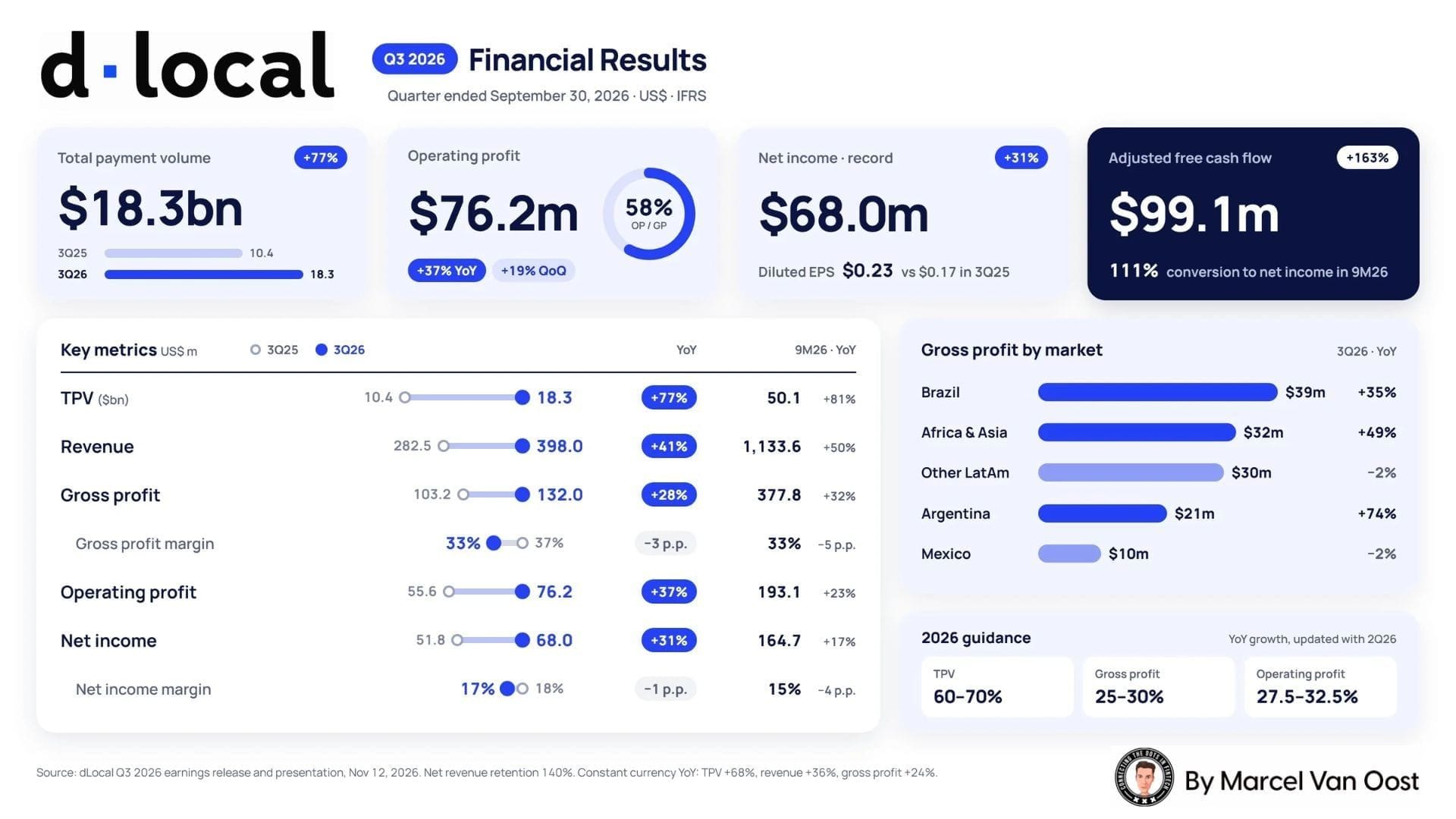
💡 dLocal Q3 2026: Payment Volume Jumps 77% as Net Income Hits a Record $68M. dLocal reported $18.3B in total payment volume (+77% YoY), revenue of $398M (+41%) and record net income of $68M (+31%). Existing merchants were the main growth driver, contributing $112M in additional revenue compared with $4M from new merchants, while net revenue retention reached 140%. Operating profit grew 37% to $76.2M, supported by lower operating expenses and improving operating leverage. Growth was particularly strong across Argentina (+74%) and Africa and Asia (+49%), while dLocal maintained its full-year 2026 guidance of 60–70% TPV growth. Explore the full Q3 results here
🌐 Solflare adds MoneyGram cash-outs for USDC in more than 170 markets. Users of the Solana wallet can withdraw USDC as local cash at participating MoneyGram locations, subject to ID checks and availability. Fees are waived for eligible users until 31 December.
🇭🇰 HKMA and Swift explore cross-border payments with tokenised deposits. The pair will test interoperability between the Swift ledger and Project Ensemble's settlement layer for multi-currency tokenised deposits. Bank of China (Hong Kong), Standard Chartered and HSBC are taking part.
🌏 Visa and Samsung launch Scan to Pay on Samsung Wallet in Asia Pacific. Galaxy users in Australia and Singapore can make QR payments with their Visa cards, with more markets planned. Travellers can also pay at QR merchants through networks including Alipay+, Lakala and VNPay.
🇳🇱 Visa to close its Rotterdam tokenisation office, cutting 78 jobs. Staff will leave under a social plan agreed with FNV, with the office closing when its lease ends in 2027. Part of the work has moved to Poland, where Visa opens a Warsaw centre in March 2027.
🇰🇷 KakaoBank launches Apple Pay in South Korea. Holders of its debit and mini cards can now pay with iPhone, Apple Watch, iPad and Mac. KakaoBank is the second issuer after Hyundai Card, ending its exclusive access since March 2023.
🇬🇧 Global Payments extends its payments partnership with Birmingham City FC. Global Payments remains the club's Official Payments Technology Partner at St Andrew's @ Knighthead Park, supporting matchday payments, self-service kiosks and spend data that shapes the food and drink offer.
🇰🇪 Payaza secures payment service provider licence in Kenya. The Central Bank of Kenya licensed Payaza Africa to offer payment gateway services, covering online checkout, cards, mobile money and bank transfers. Payaza now has regulatory backing in 14 African countries.
🇪🇬 Klivvr adds in-chat money transfers to its K. ai assistant. Users of the Egyptian FinTech can send money by prompting K. ai and find nearby Klivvr booths through real-time geolocation routing. The assistant first launched in May 2026.
GOLDEN NUGGET
🤔 What does a payments company look like once it stops being “just” payments?
Neobankster mapped Stripe’s answer as a building, from merchant payments up to AI commerce.
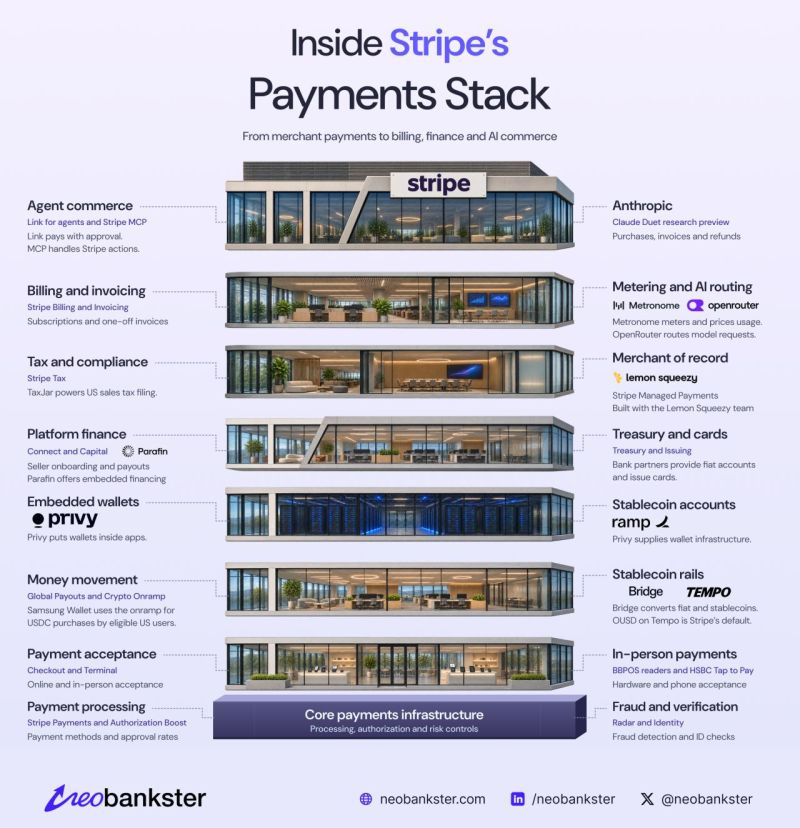
Let’s go floor by floor, from the ground up:
→ The foundation: core processing, authorisation and risk controls. Radar and Identity handle fraud detection and ID checks.
→ Acceptance: Checkout online and Terminal in store, with BBPOS readers and HSBC Tap to Pay on the hardware side.
→ Money movement: Global Payouts and a Crypto Onramp. Samsung Wallet uses the onramp for USDC purchases by eligible US users.
→ Stablecoin rails: Bridge converts between fiat and stablecoins, and Privy puts wallets inside apps.
→ Platform finance: Connect onboards and pays out sellers, Capital offers embedded financing with Parafin, and Treasury and Issuing rely on bank partners for fiat accounts and cards.
→ Tax and billing: Stripe Tax (with TaxJar for US sales tax filing), Billing and Invoicing, and Stripe Managed Payments as merchant of record, built with the Lemon Squeezy team.
→ The top floor: agent commerce. Link pays with approval, Stripe’s MCP lets agents take Stripe actions, Metronome meters and prices usage, and OpenRouter routes model requests.
The key insight is simple:
Each floor could be a company on its own.
Stripe is stacking them so a business never has to leave the building.
Which floor do you think will matter most in five years?
Great breakdown + visual by Gleb K. and Neobankster.
Trusted reach among senior decision-makers in FinTech, Payments & Banking.
👉 Explore Partnership here




Comments ()